By AZE.US Editorial Team
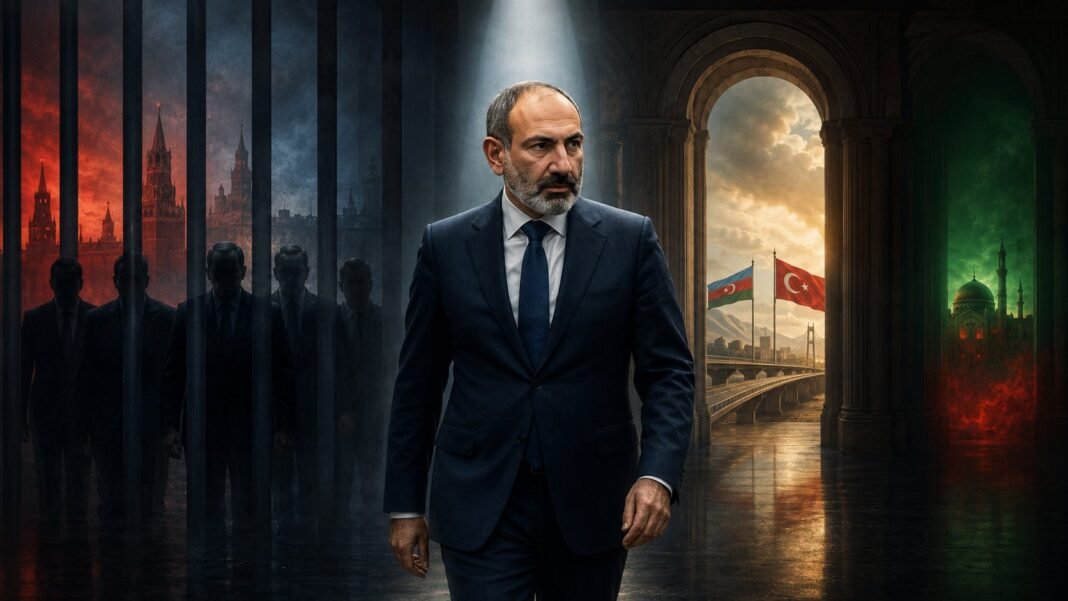
The detention of former President Robert Kocharyan is the latest move against Armenian Prime Minister Nikol Pashinyan’s political opponents. Azerbaijan and Turkey still see Pashinyan as a partner in the peace process, Russia is watching its influence collapse, and Iran fears a new U.S. presence along its northern border.
The detention of former Armenian President Robert Kocharyan can no longer be viewed as an isolated criminal case. It is part of a much broader transformation of Armenian politics in which Prime Minister Nikol Pashinyan is steadily removing his most dangerous opponents from the political arena.
Prosecutors accuse Kocharyan of money laundering, bribery and abuse of power during his presidency from 1998 to 2008. They allege that state property was transferred to him and his associates on favorable terms and that its criminal origin was later concealed. Nine other people, including one of Kocharyan’s sons, have also been charged.
A court must determine whether those allegations are true. But the political context cannot be ignored.
Kocharyan leads the Armenia Alliance, the second-largest opposition bloc in parliament. He is one of the country’s most prominent advocates of close relations with Moscow and a longtime personal and political rival of Pashinyan.
His detention follows criminal proceedings against several other major opposition figures. Reuters described the case as the latest development in a broader crackdown on government critics.
Too Many Coincidences
Opposition leader and businessman Gagik Tsarukyan is in pretrial detention. Strong Armenia leader Samvel Karapetyan is under house arrest on charges of calling for the overthrow of the government.
Six candidates from Karapetyan’s pro-Russian party were detained one day before Armenia’s June parliamentary election. State media initially reported no reason for the arrests.
Archbishop Bagrat Galstanyan and 13 supporters were arrested in June 2025 on accusations of preparing a violent seizure of power. The government is also engaged in an escalating confrontation with the leadership of the Armenian Apostolic Church.
Each case can be explained separately by the authorities: corruption, financial crimes, vote buying or an alleged coup plot. But when politicians, business leaders and senior clergy members united by their opposition to one man are repeatedly targeted, the issue becomes larger than their possible individual guilt.
The question is whether Armenia still has room for meaningful political opposition.
Pashinyan came to power in the 2018 Velvet Revolution promising to end the authoritarian practices of the old system. His critics now accuse him of using law enforcement agencies to eliminate his own competitors.
Even if some of the accusations are well-founded, the concentration of investigations against political opponents, as well as the timing of the arrests, creates the appearance of selective justice.
A democracy stops functioning as a democracy when elections are held but the government’s most dangerous challengers meet them in detention centers or under house arrest.
Russia Has Lost Armenia, but It Has Not Left
Most of the prominent figures facing prosecution are regarded as supporters of closer relations with Russia. That has turned Armenia’s internal political struggle into part of the broader geopolitical realignment of the South Caucasus.
For decades, Moscow treated Armenia as a guaranteed sphere of influence. Russia maintains a major military base in the country, remains its primary energy supplier and largest trading partner, and anchors the Eurasian Economic Union, on which the Armenian economy remains heavily dependent.
Politically, however, Russia has already lost Armenia.
That loss cannot be explained solely by Pashinyan’s turn toward the West. Moscow helped destroy its own image as Armenia’s security guarantor.
After the 2020 war and Azerbaijan’s restoration of full sovereignty over Karabakh in 2023, Armenian society saw that Russian troops, the Collective Security Treaty Organization and the old alliance system could not deliver what Moscow had promised for decades.
Pashinyan used that disillusionment. He froze Armenia’s participation in the CSTO, expanded relations with the United States and European Union, and made peace with Azerbaijan the foundation of a new foreign policy.
Yet claims of a complete break with Moscow remain premature.
Armenia sends roughly one-third of its exports to Russia and remains heavily dependent on Russian energy. Moscow retains its military base and substantial economic leverage. Russia has lost Armenia as an unquestioning political ally, but it can still inflict serious economic pain.
The arrests of pro-Russian politicians now give Moscow a convenient argument. The Kremlin can portray its geopolitical defeat not as the result of its own failures, but as the product of a Western-backed purge of Russia’s allies.
Azerbaijan Needs Durable Peace, Not Pashinyan Forever
For Azerbaijan, the situation is more complicated than it may initially appear.
Pashinyan became the first Armenian leader to publicly recognize Azerbaijan’s territorial integrity, abandon the previous Karabakh doctrine and pursue a direct peace process with Baku.
Under his government, the text of a peace agreement was finalized and practical trade and transportation links began to emerge. Baku says the two countries are already living under conditions of “real peace,” but it continues to demand the removal of language from Armenia’s Constitution that Azerbaijan considers a territorial claim.
Once that issue is resolved, Baku says there will be no remaining obstacle to signing a final peace treaty.
Azerbaijan therefore has an objective interest in the continuation of Pashinyan’s peace policy. But that does not mean Baku should have an interest in Pashinyan establishing a political monopoly.
A peace settlement that depends on one leader and is sustained by the elimination of his opponents remains fragile. If part of Armenian society sees the agreement as Pashinyan’s personal project, imposed while the opposition was suppressed, a future government may try to challenge it.
Azerbaijan’s interest is not in keeping Pashinyan in power indefinitely. Its interest is in making Armenia’s recognition of borders, renunciation of territorial claims and reopening of regional communications irreversible state policy.
Baku should not interfere in Armenia’s internal political struggle. But it has every reason to insist that peace be secured constitutionally, legally and institutionally rather than resting solely on the political survival of one prime minister.
Turkey Supports the Policy, Not the Methods
Turkey’s position is even more pragmatic.
Ankara has praised Pashinyan’s constructive role and says it is prepared to normalize relations with Armenia, reopen the border and restore economic ties.
But Turkish diplomacy does not separate that process from a final settlement between Armenia and Azerbaijan. Turkish Foreign Minister Hakan Fidan has said the Armenia-Azerbaijan agreement should first be formally signed, after which Ankara wants to complete normalization with Yerevan as quickly as possible.
Turkey views the emerging order as an opportunity to establish a land connection through Nakhchivan, expand access to the Caspian Sea and Central Asia, and integrate the South Caucasus into a larger transportation network linking the Turkic world.
For Ankara, Pashinyan is useful not as an ideological ally but as an Armenian leader willing to abandon permanent confrontation. Turkey will therefore support his peace policy without necessarily endorsing his domestic methods.
Iran Fears the New Geography
Iran takes a fundamentally different view.
Tehran welcomes peace between Armenia and Azerbaijan but strongly opposes any shift in the regional balance or the establishment of U.S.-linked infrastructure along its northern frontier.
Its central concern is the Trump Route for International Peace and Prosperity, or TRIPP, which is designed to connect mainland Azerbaijan with Nakhchivan through southern Armenia.
The route would operate under Armenian law, but the United States has secured exclusive development rights. For Azerbaijan and Turkey, it is a gateway to a new regional economy. For Armenia, it offers a path out of transportation isolation.
For Iran, however, it threatens to reduce the country’s transit role while establishing an American strategic presence near its border.
Tehran therefore supports Armenia’s territorial integrity and insists that no transportation project should change regional borders or sever Iran’s direct connection with Armenian territory.
Iran’s Foreign Ministry welcomed the Washington peace framework as a step toward lasting peace but warned against foreign intervention that could undermine regional security. A senior adviser to Iran’s supreme leader issued a much harsher warning and said Tehran would oppose any geopolitical changes associated with the route.
On this issue, Iranian and Russian interests partially converge. Neither country wants the new order in the South Caucasus to be designed by Washington without their participation.
The Price of Pashinyan’s Victory
Pashinyan has achieved what appeared impossible only a few years ago.
He survived military defeat, abandoned Armenia’s Karabakh-centered political model, won another election, reduced dependence on Russia and preserved the possibility of peace with Azerbaijan and Turkey.
But he now risks destroying his most important political legacy.
If the new Armenia is built through the arrests of rivals, pressure on the church and criminal cases against every major center of resistance, it begins to resemble the old Armenia that Pashinyan once mobilized the public to overthrow.
Russia has indeed lost Armenia. Azerbaijan and Turkey have gained a historic opportunity to establish peace and open borders. Iran faces a new transportation and geopolitical reality on its doorstep.
But the durability of this emerging order will depend on more than corridors and treaties. It will depend on whether Pashinyan can prove that he is building a state rather than a system of personal rule.
Otherwise, today’s peace process will remain the project of a single leader and may prove as vulnerable as his political future.
AZE.US