By AZE.US
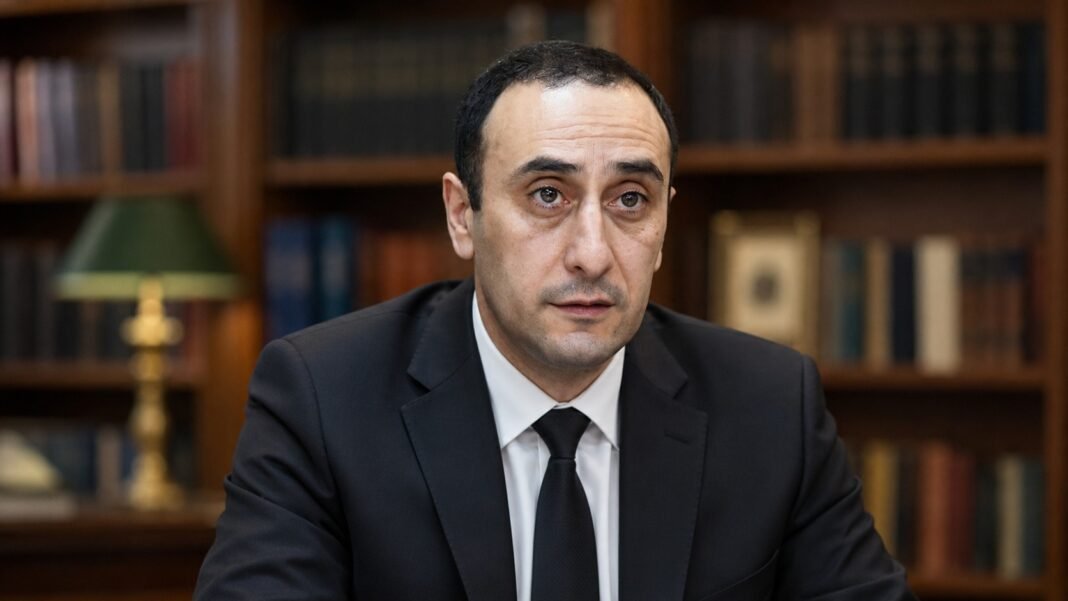
A debate over Karabakh’s Christian heritage should be based on historical sources, epigraphy and archaeological evidence rather than national myths, Azerbaijani historian and political analyst Rizvan Huseynov said.
Huseynov made the remarks during an appearance on the Novosti Kavkaza channel, according to Vesti Baku.
He said the controversy that followed a visit by foreign diplomats to the Gandzasar monastery showed how sensitive the issue of Karabakh’s religious and historical legacy remains for Armenia.
Foreign diplomats have visited Azerbaijan’s restored territories many times, Huseynov noted, but this particular trip drew an unusually sharp response from official Yerevan and the Armenian information space.
The dispute, he said, has long moved beyond academic debate. Gandzasar, Khudavang – known in the Armenian tradition as Dadivank – and Aghoghlan, which Armenians call Amaras, carry significant symbolic weight in the Christian world. Questions about their origins and identity therefore quickly take on a political dimension.
Three Christian Shrines in Karabakh
According to Huseynov, the three monastic complexes are connected to the early Christian history of Caucasian Albania.
Christian tradition associates Aghoghlan with the burial place of Saint Grigoris, a grandson of Gregory the Illuminator and one of the earliest leaders of the Albanian Church. Khudavang once held the relics of Saint Dadi, while Gandzasar is linked to the tradition of Saint John the Baptist.
“These are not merely Karabakh, Albanian or Caucasian monuments. They have significance for the entire Christian world,” Huseynov said.
He also alleged that Saint Dadi’s relics were removed from Khudavang after the events of September 2023 and that some of the monastery’s frescoes were damaged or destroyed. In his view, Azerbaijan should seek an international investigation into the monument’s condition, including through relevant UNESCO bodies.
Why Gandzasar Became the Center of the Dispute
Huseynov paid particular attention to inscriptions preserved at Gandzasar. He said the monastery’s epigraphy refers to the Albanian Catholicos Nerses, ruler Hasan Jalal and members of the local nobility.
He argued that the ethnicity of the monument’s builders cannot be determined solely from the script used in its inscriptions.
“The use of a particular church language or alphabet does not by itself establish ethnic identity. Muslim peoples used Arabic script for centuries, but that did not make them Arabs. Azerbaijanis use the Latin alphabet today, but that does not make them ancient Romans,” he said.
According to Huseynov, the names and titles found in Gandzasar’s inscriptions point to the complex cultural and political composition of medieval Khachen. He cited Hasan Jalal, Mama Khatun, Mina Khatun, Altynbek, Kochubek and Amir Hasan among the names recorded there.
At the same time, he said Azerbaijan should not present the heritage as exclusively Turkic.
“We describe it as Albanian and, at the same time, as shared heritage. It is connected to the Udis, Georgians, Turkic tribes and other peoples who lived in this region,” Huseynov said.
Separating History From Politics
Huseynov recalled that Soviet-era authorities had attempted to organize scholarly dialogue between Azerbaijani and Armenian historians. Meetings were held in Baku, Yerevan, Tbilisi and Leningrad, but the sides failed to narrow their differences because historical research had become politicized and they approached sources differently.
He called for closer scrutiny of manuscripts, including their provenance, date of composition, later additions and the accuracy of translations. Huseynov argued that some texts traditionally dated by Armenian historiography to the early Middle Ages may have been compiled or revised much later.
Those claims remain the subject of intense academic debate and require comparison with the findings of Armenian and international scholars.
Huseynov said a willingness to revise one’s own conclusions is essential to serious scholarship.
“If someone proves through sources that I was wrong, I am ready to acknowledge it. That is what scholarship is: checking documents, comparing evidence and revising earlier conclusions when necessary,” he said.
Georgia Could Provide a Platform for Dialogue
Huseynov said Georgia could play an important mediating role in the historical debate. He pointed to the contribution of Georgian academic Zaza Aleksidze to the study of Caucasian Albanian palimpsests discovered at Saint Catherine’s Monastery on Mount Sinai.
In his view, Tbilisi could provide a neutral academic platform where Azerbaijani, Armenian and Georgian scholars discuss disputed issues without political declarations.
Program host Gela Vasadze proposed developing a common Caucasian methodology for studying the past rather than attempting to produce a single history textbook. He said researchers from Azerbaijan, Armenia, Georgia and the North Caucasus should take part, with experts from Turkey, Iran and other countries joining at a later stage.
The speakers said national interpretations would inevitably continue to differ, but those differences should not prevent scholars from checking specific facts.
“Every nation may have its own heroes. But on fundamental issues, sources must be compared, and religion and history must not be turned into instruments of new conflicts,” they concluded.
AZE.US