By AZE.US Editorial Team
The claim that Serzh Sargsyan deliberately handed power to Nikol Pashinyan after betraying an agreement with Moscow is politically seductive.
It would explain Sargsyan’s surprisingly peaceful departure in 2018, the continued existence of his Republican Party and the harsher treatment Pashinyan’s government has reserved for former President Robert Kocharyan.
But the facts tell a more complicated story.
Sargsyan did build the political system that ultimately brought Pashinyan to power. There is, however, no evidence of a prearranged transfer between the two men.
And Sargsyan was not the only one who miscalculated. Moscow also underestimated Pashinyan, apparently believing Armenia’s Velvet Revolution would be a temporary disruption and that the Kremlin could eventually restore a more familiar political order in Yerevan.
Sargsyan Built the System for Himself
It was Sargsyan, not Pashinyan, who oversaw Armenia’s transformation from a presidential into a parliamentary republic.
After completing two terms as president, Sargsyan moved into the newly empowered prime minister’s office in April 2018. To many Armenians, the maneuver looked like an attempt to extend his rule after a decade in the presidency.
That decision triggered mass protests led by Pashinyan.
Sargsyan and Pashinyan met at Yerevan’s Marriott Hotel on April 22, 2018. The televised encounter lasted only a few minutes and ended in a public confrontation. Pashinyan demanded Sargsyan’s resignation and was detained shortly afterward.
Sargsyan stepped down the following day.
It is reasonable to conclude that he chose not to use large-scale force and surrendered power to prevent bloodshed. But the hotel meeting does not prove the existence of a secret agreement.
Sargsyan did not formally transfer power to Pashinyan. He lost control after the political system he designed encountered a level of public resistance it could no longer contain.
Was Sargsyan Secretly Pro-Western?
Another oversimplification is the portrayal of Sargsyan as the architect of an exclusively European course for Armenia.
His government negotiated an association agreement with the European Union. But in September 2013, Sargsyan abruptly abandoned the planned deal and announced that Armenia would instead join the Russia-led Customs Union.
In November 2017, Armenia signed a less ambitious but still significant Comprehensive and Enhanced Partnership Agreement with the EU.
Armenia’s European vector therefore predates Pashinyan. Sargsyan attempted to balance relations with Brussels and Moscow while preserving the country’s strategic dependence on Russia.
Pashinyan did not invent this policy. He pushed it to the point where balancing increasingly resembles a geopolitical choice.
The “Controlled Opposition” Theory
Supporters of the secret-deal theory point out that Sargsyan remained free after 2018 and that his Republican Party continued operating, while Kocharyan faced imprisonment and criminal prosecution.
But it is inaccurate to say that Pashinyan’s government left Sargsyan entirely untouched.
In 2020, the former president was charged in a case involving the alleged embezzlement of 500 million drams in public funds. A court acquitted him in 2024, but an appeals court later overturned the verdict and sent the case back for retrial.
Kocharyan has faced considerably greater pressure. He was prosecuted over the March 2008 unrest in Yerevan, which left 10 people dead - not 15 or 20, as suggested during the Media Turk TV discussion. That case ended in 2021 after Armenia’s Constitutional Court ruled that the relevant criminal code provision was unconstitutional.
In August 2026, prosecutors brought new corruption charges against Kocharyan, including allegations of money laundering, bribery and abuse of power. Kocharyan has previously denied wrongdoing, while his supporters describe the prosecution as politically motivated.
The difference between the treatment of Sargsyan and Kocharyan is clear. But it does not establish that Sargsyan and Pashinyan secretly coordinated the 2018 transition.
A more plausible explanation is that Pashinyan views Kocharyan as the more dangerous opponent - one with considerable financial resources, an active political bloc and especially close connections to Moscow.
The Kremlin Made the Bigger Mistake
Russia did not intervene to save Sargsyan in 2018.
Moscow may have viewed Pashinyan as a weak or temporary figure who could ultimately be controlled through Armenia’s economic dependence, energy supplies, Russian military presence and Moscow-friendly opposition.
That calculation failed.
Pashinyan survived Armenia’s defeat in the 2020 war, domestic unrest and Azerbaijan’s restoration of sovereignty over Karabakh in 2023. Despite those shocks, his Civil Contract party won another parliamentary election in June 2026 with approximately 49.8% of the vote.
Pro-Russian parties entered parliament but failed to remove him.
More importantly, resentment toward Russia proved stronger among many Armenian voters than nostalgia for the country’s former leaders.
A considerable part of Armenian society believes Moscow failed to honor its security commitments and did not protect Armenia’s position in Karabakh. Russia counters that it had no grounds to intervene after Yerevan recognized Karabakh as part of Azerbaijan.
The legal argument, however, has done little to repair Russia’s reputation among Armenians. Moscow lost something more important than an election: its status as Armenia’s indispensable security guarantor.
Russia Still Holds Powerful Levers
It would nevertheless be premature to conclude that Russia has lost Armenia completely.
The South Caucasus Railway, which operates Armenia’s rail network under a concession agreement, is a wholly owned subsidiary of Russian Railways. Armenia remains dependent on Russian energy supplies, while Russia accounted for approximately 35% of Armenia’s foreign trade in 2025.
But claims that the entire Armenian energy sector is directly owned by the Russian state are misleading.
The country’s electricity distribution network, for example, was controlled by Tashir Group, the private holding company of Russian-Armenian businessman Samvel Karapetyan. Russian influence is substantial, but the ownership structure is more complicated than total Kremlin control.
Moscow has already used restrictions on Armenian exports as a pressure tool. Yerevan has challenged those measures by invoking the rules of the Eurasian Economic Union while simultaneously deepening its relationship with the EU.
This creates a central contradiction in Pashinyan’s strategy: Armenia is moving politically toward the West but cannot yet afford an economic rupture with Russia.
Why the Bishkek Meeting Matters
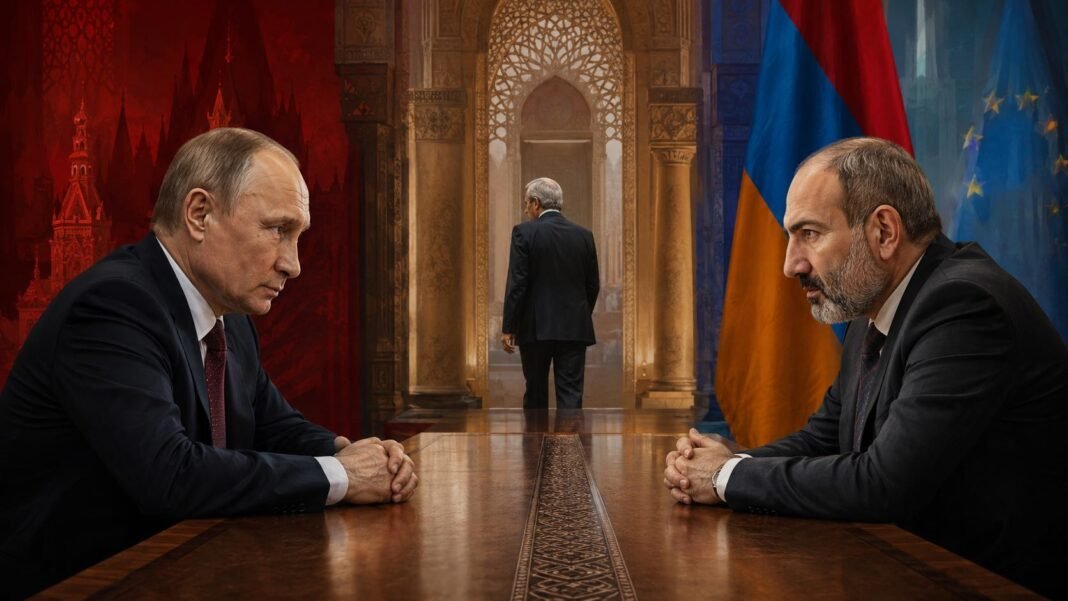
That is why the planned September 1 meeting between Vladimir Putin and Pashinyan in Bishkek belongs at the center of this debate.
According to Russian presidential aide Yuri Ushakov, the two leaders are expected to discuss Armenia’s European ambitions and the arrests of politicians who favor maintaining close ties with Moscow.
The Kremlin insists that Armenia cannot pursue EU membership while continuing to enjoy the economic benefits of the Eurasian Economic Union.
Bishkek will reveal the new balance of power.
Putin is not meeting a Moscow-backed successor to Pashinyan. He is meeting Pashinyan himself - the politician the Kremlin may have expected to outlast eight years ago.
Moscow must now negotiate with a leader who is steadily reducing Russian influence but still needs Russian gas, markets and transport infrastructure.
Pashinyan does not have complete freedom either. His party controls parliament but lacks the two-thirds majority needed to amend Armenia’s Constitution without broader support. That means the constitutional changes relevant to a final peace agreement with Azerbaijan will likely require a referendum.
Russia may attempt to use that process, economic restrictions and the prosecution of Moscow-friendly opposition figures as bargaining tools.
Sargsyan Did Not “Sell” Putin
Sargsyan undoubtedly opened the road that brought Pashinyan to power. He redesigned Armenia’s political system to prolong his own rule and then stepped aside when the system collapsed around him.
He may also have believed that resigning would protect his family, business interests and political circle from a more destructive confrontation.
But that does not mean he deliberately “sold out” Putin or handed Armenia to Pashinyan as part of a secret bargain.
The more convincing conclusion is that the Kremlin misread Armenia.
Moscow believed military, economic and infrastructure dependence would allow it to control any government in Yerevan. It underestimated public anger, the consequences of the collapse of Armenia’s Karabakh policy and Pashinyan’s ability to turn even his own failures into arguments against the old system.
Putin will now meet Pashinyan in Bishkek not as a temporary revolutionary but as a leader Russia has so far been unable either to replace or bring back into its former orbit.
The outcome of that meeting - not theories about a secret agreement in 2018 - will show how much real influence Moscow still retains in Armenia.
AZE.US