By AZE.US Editorial Team
The Strait of Hormuz has once again become the place where global politics stops being theoretical.
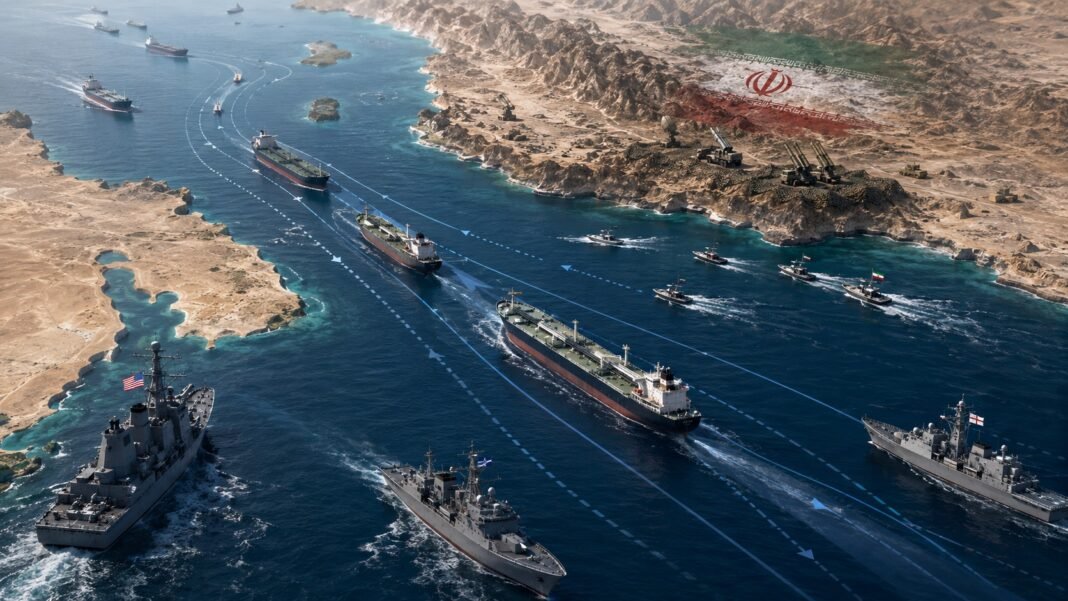
This is not only about Washington and Tehran. It is about tankers, insurance rates, oil prices, military escorts and the narrow sea corridor through which a major share of Gulf energy exports must pass. In that geography, Iran has something that cannot be disabled by one sanctions package or one airstrike: proximity.
The United States has overwhelming military, financial and diplomatic power. It can target Iranian networks. It can sanction shadow banking channels and vessels. It can move naval assets and warn Tehran that escalation will bring consequences. Washington did exactly that this week, imposing new sanctions on Iran’s Amin Exchange, related front companies and 19 vessels linked to Iranian petroleum and petrochemical shipments.
But sanctions do not physically open a strait. They raise the cost for Iran, restrict its room for maneuver and weaken its financial channels. They do not erase the map.
That is the uncomfortable part of the Hormuz crisis. Iran does not need to defeat the United States militarily to create a serious problem. It only needs to make passage through the Gulf more uncertain, more expensive and more politically risky. In a market built on timing, predictability and confidence, disruption itself becomes a weapon.
AP described the current standoff as a moment in which President Donald Trump’s hard-line policy toward Iran has run into the limits imposed by Tehran’s grip on the Strait of Hormuz. The report noted that Iran has refused to yield on major U.S. demands despite military and economic pressure, while both sides appear to believe time may still work in their favor.
That is what makes this crisis different from ordinary diplomatic pressure. Washington can escalate, but escalation carries its own price. A wider war could shake energy markets, pull Gulf states deeper into danger and force U.S. partners to decide how far they are prepared to go.
That last point matters. Reuters reported that NATO is not currently drawing up plans for a mission in the Strait of Hormuz, with such an operation requiring political consensus among all 32 members of the alliance. Several European governments remain wary of being pulled into a conflict with Iran under circumstances they do not fully control.
So the picture is more complicated than a simple contest between American power and Iranian defiance. The United States wants freedom of navigation to look like a universal principle. Many allies may agree with that principle. But agreeing with a principle is easier than joining a mission that could be read by Tehran as participation in a war.
Iran also faces heavy risks. Its economy is vulnerable, its oil trade is under pressure and its financial workarounds are increasingly exposed. Washington’s latest sanctions are not symbolic; they aim at the machinery that allows Tehran to move money and oil despite restrictions.
Still, Iran’s calculation appears to be based on endurance rather than quick victory. The goal is not to overpower the United States. The goal is to make the crisis costly enough that Washington, Gulf capitals, European governments and Asian energy buyers all feel pressure to seek an exit.
That is why Hormuz is so powerful as a geopolitical instrument. Iran can turn a regional confrontation into a global economic issue without controlling the world’s energy system. It only has to pressure one of its most sensitive chokepoints.
For Azerbaijan and the wider South Caucasus, this is not a distant story. Every major disruption in Gulf energy routes reshapes discussions about alternative corridors, Caspian energy, East-West transit and the strategic value of stable routes that bypass the most volatile parts of the Middle East. When Hormuz becomes risky, the world does not only look at oil prices. It also looks again at geography.
The lesson is not that Iran is winning. It is not that the United States is weak. The lesson is sharper and more uncomfortable: military superiority does not automatically solve a chokepoint crisis.
A superpower can dominate the skies, the seas and the sanctions system. But when the other side sits beside a narrow corridor through which the global economy must pass, the contest becomes less about raw strength and more about leverage, patience and political cost.
Hormuz is reminding Washington of something old but often forgotten. In geopolitics, sometimes the strongest card is not the biggest fleet or the loudest threat. Sometimes it is the narrow gate everyone still has to use.
AZE.US