By AZE.US Editorial Team
Ukraine’s strike on a vessel linked to Russia-Iran military logistics has shattered the image of the Caspian Sea as an isolated and secure space. For Azerbaijan, the risks extend beyond shipping to energy infrastructure and the Middle Corridor.
It took a single long-range strike to expose the limits of a Caspian security system that took the five littoral states more than two decades to negotiate.
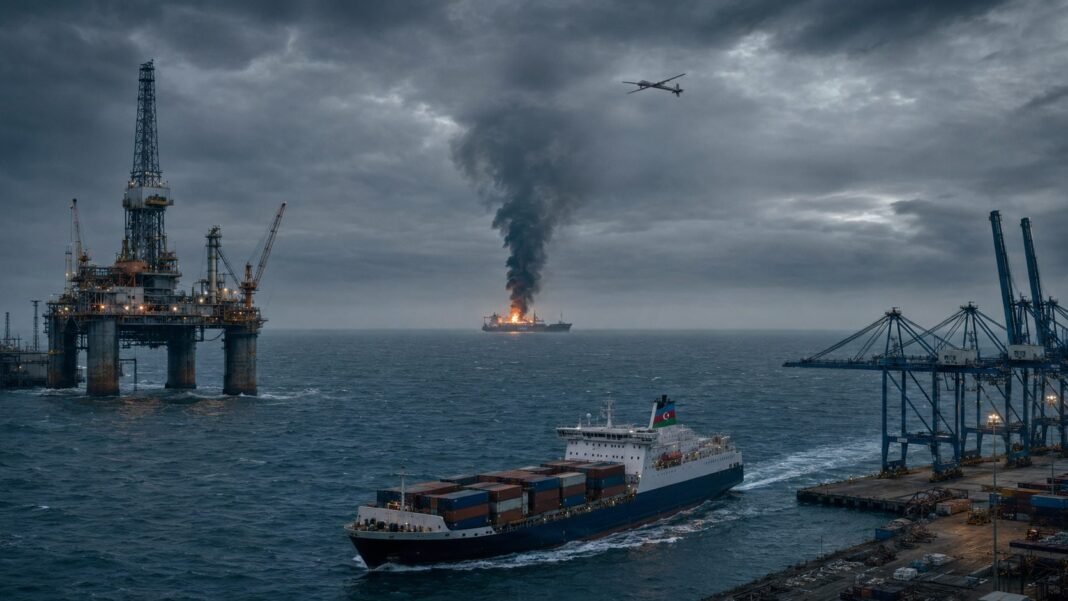
Ukraine said it successfully attacked vessels in the Caspian Sea that were involved in transporting military cargo between Russia and Iran. President Volodymyr Zelensky also reported a strike on a Russian warship.
Tehran presented a different account. According to the Iranian Foreign Ministry, Ukraine attacked an Iranian commercial vessel, causing an explosion that killed one sailor and injured another. Iran called the operation an act of aggression and warned that it would not go unanswered.
The dispute over whether the ship was civilian or part of a military supply network will continue. For Azerbaijan, Kazakhstan and Turkmenistan, however, the larger issue is already clear: a war that once appeared geographically distant has entered the Caspian Sea.
No foreign fleet or military base was required. A long-range drone was enough.
A Convention Designed for Yesterday’s Threats
The Convention on the Legal Status of the Caspian Sea, signed in Aktau in 2018, was the product of more than 20 years of negotiations among Azerbaijan, Iran, Kazakhstan, Russia and Turkmenistan.
One of its central principles was the exclusion of armed forces belonging to non-Caspian states. The parties also agreed not to allow their territory to be used for aggression against another signatory.
At the time, the principal concern was the physical military presence of an outside power: foreign warships, bases, troops or military infrastructure along the coast.
Modern warfare has changed that calculation.
An outside country no longer needs to deploy a fleet to the Caspian to attack a target there. It needs long-range drones, satellite intelligence and accurate coordinates. The operator may remain hundreds of miles away.
The convention determines whose armed forces may operate in the Caspian, but it provides no effective collective mechanism for responding when a vessel is attacked remotely from outside the region.
The situation is further complicated by Iran’s failure to complete ratification. The convention remains the political foundation of the regional order, but its ability to address current security threats is increasingly limited.
Russia and Iran Militarized the Route
Moscow and Tehran have historically opposed any military role for outside countries in the Caspian region. Even limited defense cooperation between Azerbaijan or Kazakhstan and Western or Turkish partners has often drawn criticism from Russia and Iran.
The latest incident raises an uncomfortable question: Can governments demand that neighboring states preserve the Caspian as an exclusively peaceful space while using it to transport military cargo?
If Ukraine’s account is correct, the Caspian became part of Russia-Iran military logistics long before the first Ukrainian strike reached its waters.
Kyiv is applying the same logic it uses when attacking Russian refineries, weapons depots and transportation hubs. Any facility or vessel supporting Russia’s ability to wage war can be treated as a potential military target.
That does not automatically make every strike lawful, particularly when a ship is formally designated as commercial and a civilian sailor is killed. But the use of maritime routes for military supplies inevitably increases the danger to the entire region.
Once civilian goods and weapons move through the same ports and aboard similar vessels, the distinction between commercial shipping and military logistics begins to erode.
Countries that are not involved in the conflict are then forced to carry part of the risk.
The Middle Corridor’s Weakest Link
For Azerbaijan, the Caspian is not a distant frontier. It is a central component of the country’s economic and foreign policy strategy.
The sea forms the critical maritime section of the Middle Corridor, connecting China and Central Asia with the South Caucasus, Turkey and Europe. The ports of Alat, Aktau and Turkmenbashi are expected to handle a growing share of trans-Caspian trade.
Until now, the corridor’s principal weaknesses were limited port capacity, a shortage of vessels, difficult weather conditions and slow customs procedures.
A military threat must now be added to that list.
Even occasional strikes could raise insurance costs, force shipping companies to reconsider routes and discourage investment in Caspian infrastructure. If attacks become more frequent, the Middle Corridor could lose one of its strongest advantages: its reputation as a secure alternative to routes through Russia and Iran.
Azerbaijan’s offshore energy infrastructure also enters a new security environment.
There is currently no indication that Azerbaijani platforms or pipelines are being targeted. Yet the presence of long-range drones over the Caspian means geography can no longer provide the protection it once did.
A navigation error, loss of control or incorrect identification of a vessel could produce an incident unrelated to the intended military operation.
Azerbaijan Needs a New Caspian Initiative
The attack cannot be treated solely as a dispute between Iran and Ukraine. It is a collective security issue for all five littoral states.
Azerbaijan should work with Kazakhstan and Turkmenistan to initiate urgent consultations on updating Caspian security mechanisms.
The agenda should include a regional system for sharing information about aerial threats, mandatory notification of hazardous or military-related shipments, clearer separation of civilian and military logistics, and coordinated procedures for responding to drones that threaten commercial navigation.
The protection of ports, offshore energy platforms, undersea infrastructure and ferry routes also requires a separate framework.
At the same time, Baku must avoid being drawn into either the Russia-Ukraine war or Iran’s confrontation with the United States and Israel.
Azerbaijani territory, airspace and transportation networks must not become platforms through which one party attacks another. Nor should civilian infrastructure be used for shipments that could turn it into a military target.
That position does not require Azerbaijan to choose sides. It is a defense of its own national interests and of the principle that Caspian trade must remain separate from military operations.
What Role Could Turkey Play?
Political analyst Ahmad Alili has also pointed to the potential role of Turkey.
Ankara maintains working relations with Russia, supports Ukraine and has a direct interest in the security of the Middle Corridor.
A Turkish military presence inside the Caspian would conflict with the established regional framework and face strong opposition from Russia and Iran. But that does not exclude Turkish technical, political or advisory support for protecting trans-Caspian routes.
Turkey could assist Azerbaijan and Central Asian countries with shore-based surveillance, counter-drone systems and the protection of transportation infrastructure without deploying forces into the sea itself.
Caspian security could also be discussed through existing regional formats, provided those mechanisms do not grant Russia or Iran the power to restrict Azerbaijan’s relations with Turkey, Europe or Central Asia.
The Caspian Needs New Rules
The 2018 convention was written for a different era. Its authors assumed that security could be maintained by preventing outside armed forces from entering the Caspian.
Today, a state can attack a target there without entering the sea at all.
That does not make the convention irrelevant. But its principles need to be supplemented to address long-range drones, satellite targeting, modern air defense and the use of commercial vessels for military shipments.
Russia and Iran must provide clear assurances that the Caspian will not become a military transportation corridor. Ukraine, meanwhile, must recognize that expanding its strike zone creates risks for countries that are not parties to the war.
Azerbaijan, Kazakhstan and Turkmenistan have a shared interest: The Caspian must become neither a military highway nor a new battlefield.
The first strike has already occurred. If the regional states respond only with statements and fail to establish new rules, the next incident could take place much closer to their ports, ships and energy infrastructure.
By then, it may be too late to begin discussing security.
AZE.US