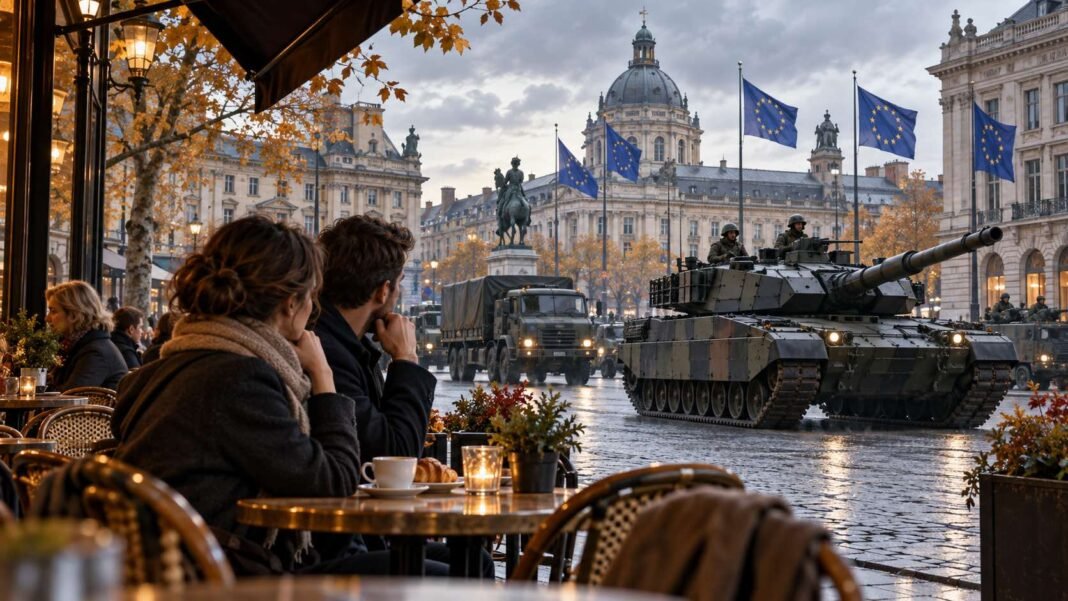
Europe can pledge billions for weapons. The harder task is convincing voters that security will require years of spending, political discipline and a rethink of familiar priorities. That is where the success or failure of Europe’s rearmament will be decided.
By AZE.US Editorial Team
For whom does the bell toll in Ukraine? For European capitals, that literary question has taken on an intensely practical meaning. The answer will shape how much governments spend on defense, which industries they rebuild and what price their societies are prepared to pay to preserve their way of life.
It is convenient to treat the war as Ukraine’s problem and assume that the rest of Europe can choose its level of involvement according to the mood of voters. But the consequences of the war’s outcome cannot be contained at Ukraine’s border. If force allows a state to consolidate territorial gains and impose limits on a neighbor’s independence, European governments will have to account for that precedent in their own security policies.
Supporting Ukraine therefore becomes part of Europe’s own defense. Governments must explain that connection to citizens tired of uncertainty and an unending public discussion of threats.
Billions Have Been Pledged. Where Are the Results?
The scale of the commitments is already large. At the NATO summit in The Hague in June 2025, allies agreed to a target of spending 5% of gross domestic product on defense and security-related needs by 2035. Under the Hague Summit Declaration, at least 3.5% is to go toward core defense requirements, while up to 1.5% may cover infrastructure, resilience and other security-related investment.
The European Union, meanwhile, established the Security Action for Europe, or SAFE, instrument, offering up to 150 billion euros in loans for joint defense procurement. These are borrowed funds that participating governments will have to repay.
But a long production chain separates a financial commitment from a combat-ready military. Europe needs factories, skilled workers, raw materials, testing, contracts and trained troops. Money becomes security only when ordered equipment reaches units, ammunition replenishes stockpiles and forces can operate together.
European rearmament should therefore be judged by output: how much has been produced, delivered and placed into service. Impressive budget figures cannot protect anyone by themselves.
Voters Have a Right to Ask About the Cost
Discussion of Europe often includes a condescending argument that Europeans have grown accustomed to comfort and will therefore be unable to endure a prolonged confrontation. That explanation is too simple.
A person who asks why the state can find money for weapons while housing becomes more expensive or hospitals lack doctors is asking a legitimate question. A government owes that person a concrete answer: What threat does it see, what capabilities does it intend to build and why are the proposed costs necessary?
Accountability for military budgets is a condition for a sustainable defense policy. Without it, every new spending package risks becoming another source of distrust.
It is especially dangerous to demand sacrifices from the public while ignoring inflated prices, inefficient procurement and competition among government agencies. Citizens will struggle to accept appeals to extraordinary responsibility if the state itself spends without discipline.
A long confrontation requires trust. Fear alone cannot provide it.
Fatigue Does Not Mean Surrender
Protests, parliamentary disputes and changes of government will accompany Europe’s defense buildup. A democratic society debates the cost of decisions in public, and those debates can look like weakness.
But dissatisfaction with spending does not automatically mean a willingness to accept any terms offered by Moscow. People can dispute the scale of aid to Ukraine, procurement mechanisms and negotiating terms while still regarding Russian military pressure as a threat.
At the same time, assuming that Europe will remain united under every circumstance would be an act of complacency. Public support must be continually renewed through clear goals and demonstrable results. Governments do not receive it indefinitely.
If citizens are promised a quick turning point year after year and then presented with another spending package without a clear explanation, disappointment is inevitable. Responsible policy must prepare the public for a long effort without quick victories or cheap solutions.
Russia Also Has to Pay
It would be equally risky to build Europe’s strategy around the expectation that Russia will soon exhaust its resources and be forced to stop.
A state’s ability to continue a war is not the same as the war being economically beneficial. Military spending can sustain certain industries while draining workers, capital and opportunities from the civilian economy. But the accumulation of those costs does not, by itself, set a date for the war to end.
The practical conclusion for Europe is straightforward: Planning must assume that the confrontation could last. Hope for an imminent crisis in Russia cannot replace Europe’s own industrial capacity, trained reserves and sustainable financing.
Consistency is therefore essential. A company will not expand production for an order lasting only a few months if it expects the government to decide soon afterward that the danger has passed.
Negotiations Need Leverage
The desire to end the war is natural. But the durability of any agreement also depends on how costly it would be to violate.
European defense policy should create conditions in which negotiations do not merely formalize the results of military pressure. That requires both Europe’s own deterrent capabilities and Ukraine’s ability to safeguard its security.
Europeans should also speak honestly about the limits of their role. Decisions about Ukraine’s future affect Ukrainians first and foremost. Providing support does not give outside governments the right to dispose of Ukrainian territory or promise concessions on Kyiv’s behalf.
A stronger Europe will carry more weight in diplomacy. A Europe that convinces itself in advance that resistance is impossible will mostly negotiate the price of retreat.
Security as a Social Contract
Europe’s willingness to rearm will be determined far beyond defense ministries. It depends on whether governments can connect military spending to a goal citizens understand: preserving their right to choose their own future.
That requires a functioning industrial base, transparent procurement, a fair distribution of the burden and an honest discussion of timelines. It also requires social policy that prevents defense from becoming an excuse for every decline in living standards.
Europe’s prosperity is worth defending precisely because it includes peaceful life, freedom and human dignity. Asking citizens to abandon those values in the name of protecting them would be a political dead end.
The bell in Ukraine can be heard across Europe. The answer must be a set of decisions capable of surviving the tests of time, budgets and public trust.
This editorial was originally published in Russian by Vesti Baku.