By AZE.US Editorial Team
The war between Russia and Ukraine is moving deeper into a phase where military pressure and psychological pressure are becoming harder to separate.
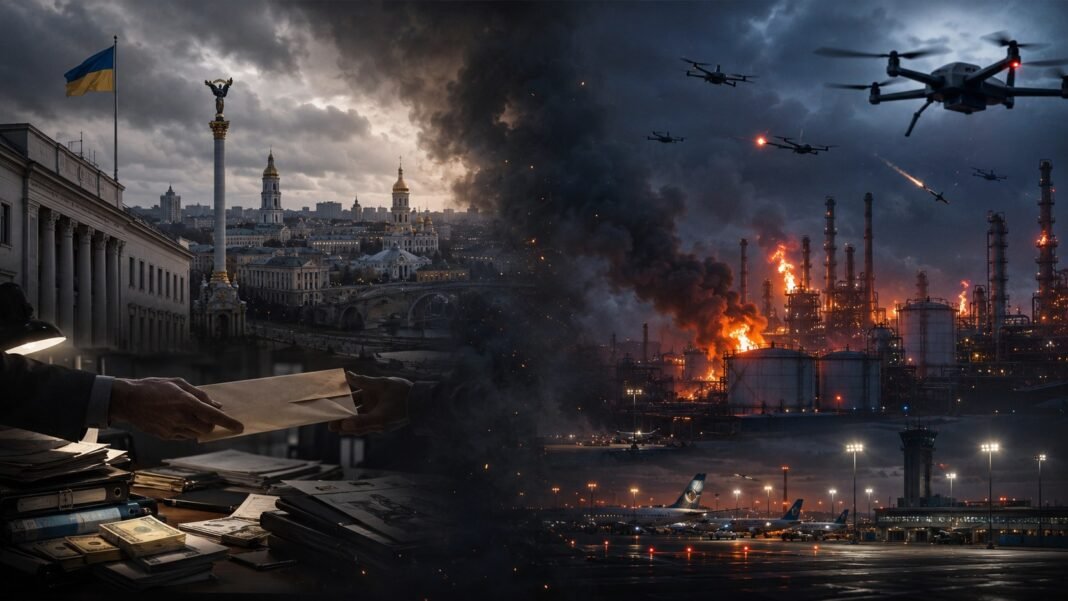
In recent days, two parallel storylines have sharpened that reality. In Ukraine, new corruption scandals have again raised uncomfortable questions about the political and moral resilience of the state at a time when it is still asking its citizens to endure war and its Western partners to keep providing money, weapons and patience.
In Russia, meanwhile, Ukrainian drone attacks on oil facilities and aviation-related infrastructure have added to a growing sense that the war is no longer something the Kremlin can fully keep at a distance from ordinary Russians.
Taken together, these developments matter far beyond the headline cycle. They suggest that this war is entering a more fragile and more dangerous stage - one in which internal strain may become almost as important as battlefield momentum.
For Kyiv, the corruption issue is not just a domestic embarrassment. It is a strategic liability. Ukraine’s strength since 2022 has not rested only on resistance or military innovation. It has also rested on moral capital - the ability to present itself as a state fighting for survival, reform and sovereignty against a larger aggressor. Every new corruption scandal chips away at that image.
That does not mean the Ukrainian state is collapsing, nor does it erase the basic reality of Russian aggression. But it does create a harder political atmosphere around President Volodymyr Zelenskyy and his team.
Western governments may continue backing Ukraine, but their publics are less patient than they were at the start of the war. If the image of Ukraine shifts from disciplined wartime resilience to familiar post-Soviet dysfunction, the political cost for Kyiv could grow.
This is the deeper danger. Corruption in wartime is not only about missing money or tainted contracts. It damages trust. It weakens social cohesion. It gives critics abroad new ammunition. And it creates the impression that while soldiers and civilians are carrying the burden, parts of the elite may still be operating by old rules.
At the same time, Russia is facing a different kind of erosion.
Ukrainian drone strikes on oil refineries and aviation-linked facilities do not change the map overnight. They do not mean Russia is about to lose control of the war. But they do something more subtle and, in some ways, more corrosive: they undermine the image of strategic depth and internal safety.
For years, the Kremlin has relied not only on military power but also on the narrative that the Russian state remains fundamentally stable, insulated and in control. That message becomes harder to sustain when fires break out at key industrial sites and when infrastructure tied to transport or energy comes under repeated pressure.
The economic effect matters, especially when energy infrastructure is involved. Oil remains central to Russia’s fiscal endurance and broader war capacity. But even beyond economics, the psychological impact is significant. Repeated drone strikes send a message to Russian society that distance is no longer protection. The war can reach inward. It can disrupt. It can embarrass. It can expose vulnerabilities in places the state once treated as secure.
That does not automatically produce public unrest. Russia’s political system is built to contain, suppress and redirect dissatisfaction. But morale does not have to turn into protest to become a problem. It can take the form of fatigue, cynicism, private anger and a growing sense that official confidence no longer matches lived reality.
This is why the current moment deserves more attention than a standard exchange of attacks would suggest.
Ukraine is showing that it can project force beyond the front line and threaten parts of Russia’s economic and logistical base. That is a real achievement and one of the clearest signs of how the war has evolved. But Ukraine is also being reminded that striking Russia is not enough if its own political system is seen as compromised or careless.
Russia, for its part, still retains the larger military machine and the capacity to keep inflicting serious damage on Ukraine. But its position is no longer as psychologically comfortable as the Kremlin would like to suggest. A state can absorb drone attacks, refinery fires and transport disruptions for a while. The harder question is how long it can do so without the image of control beginning to fray.
What is emerging, then, is a war of dual attrition.
On one track, there is the visible war: missiles, drones, refineries, cities, air defense and supply lines. On the other, there is the internal war: corruption scandals, public fatigue, elite credibility, social trust and the ability of both governments to convince their societies that the pain still serves a coherent purpose.
That second track may prove decisive over time.
Kyiv still has the advantage of international sympathy and a demonstrated capacity for adaptation. Russia still has the advantage of scale, resources and a political system built for prolonged confrontation. But both sides are also revealing where they are exposed.
Ukraine is militarily inventive but politically vulnerable. Russia is militarily powerful but increasingly less insulated than it claims.
This is why the war feels different now. It is no longer just a contest over trenches, towns and military stockpiles. It is becoming a contest over who can better absorb bad news, contain internal decay and keep national will from slipping.
And in that kind of war, nerves matter almost as much as firepower.
AZE.US