AZE.US
Azerbaijan is seeking to turn a new package of energy and investment agreements worth about $7.5 billion into broader economic and political leverage, officials and experts said after Baku Energy Week.
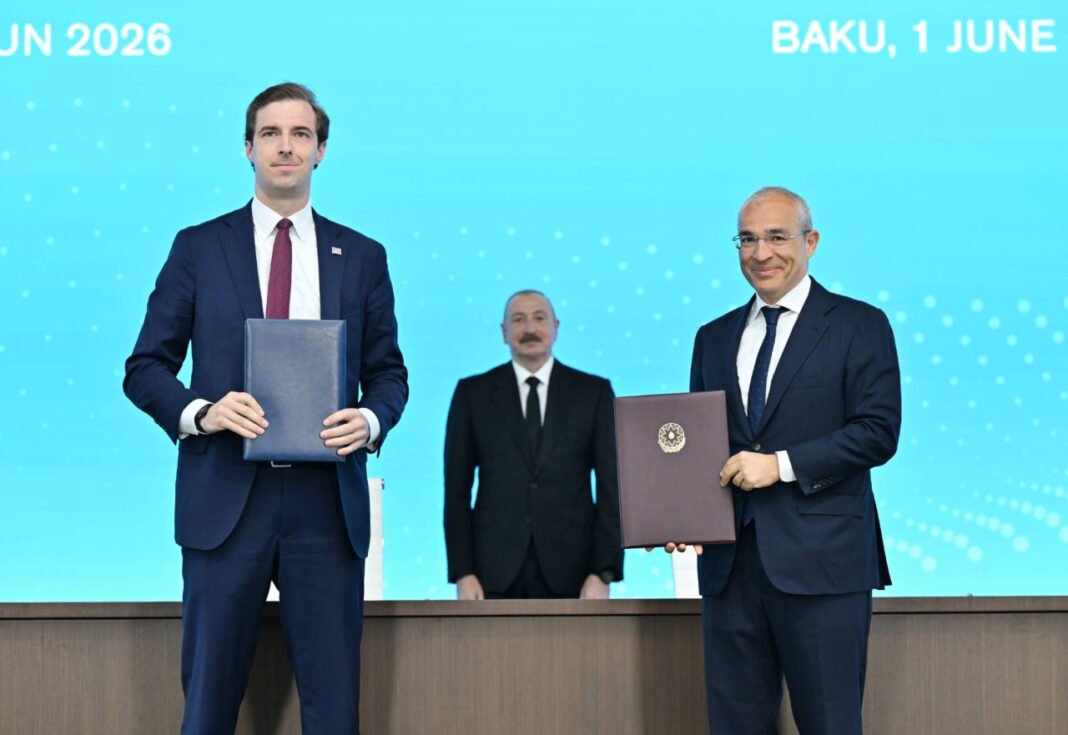
The agreements were signed during Baku Energy Week and the first Azerbaijan-U.S. Economic Dialogue, covering energy, finance, high technologies, industry and innovation. Some participants put the wider package of investment and cooperation memorandums at nearly $8 billion.
MP Mushfig Jafarov said the documents could open a new stage in Azerbaijan’s cooperation with foreign partners.
“These documents cover not only the energy sector, but also investment, digital technologies, industry and innovation,” Jafarov said, adding that foreign capital could support new production capacity, infrastructure upgrades and technology transfer.
Another lawmaker, Rovshan Muradov, said the agreements show that Azerbaijan is moving beyond the classic model of extraction and export. He said energy resources are now being used not only as a source of revenue, but also as long-term strategic capital for economic modernization and stronger international partnerships.
Officials and experts also pointed to the wider spillover effect of energy investment. According to Muradov, money flowing into the sector can stimulate engineering, logistics, construction, finance, insurance, digital management and professional services.
A major part of the discussion focused on Azerbaijan’s expanding gas geography. According to figures cited in the material, Azerbaijan exports natural gas to 16 countries, including 10 European Union members.
Political analyst Elkhan Shahinoglu said Azerbaijan’s energy policy is no longer limited to resource exports. He described it as a tool of regional influence and political dialogue. Shahinoglu singled out gas supplies to Syria as a new and notable direction for Baku’s energy diplomacy.
Green energy is also becoming part of the strategy. Experts cited the planned Black Sea cable project for exporting green electricity to Europe, as well as renewable energy projects involving BP, Masdar and other international companies.
Economist Khalid Kerimli said Azerbaijan’s current energy position grew out of the difficult conditions of the early 1990s, when the country faced war, poverty, political instability and mass displacement. He said the “Contract of the Century” laid the foundation for the country’s later energy strategy and helped turn Azerbaijan into an exporter of oil, gas and electricity.
Kerimli also noted Azerbaijan’s role as a transit route for Central Asian energy resources moving toward Western markets, including Kazakh oil shipped through Azerbaijani infrastructure and potential future gas flows from Central Asia.
The broader message from Baku Energy Week was clear: Azerbaijan wants to be seen not only as an oil and gas supplier, but also as a regional energy, transport and investment hub linking Europe, Turkey, the United States, the Middle East and Central Asia.
AZE.US