AZE.US
The TRIPP transport project is gradually acquiring the legal, financial and technical foundations needed to begin construction, while the long-discussed North-South corridor continues to face funding shortages, political uncertainty and questions over future cargo volumes.
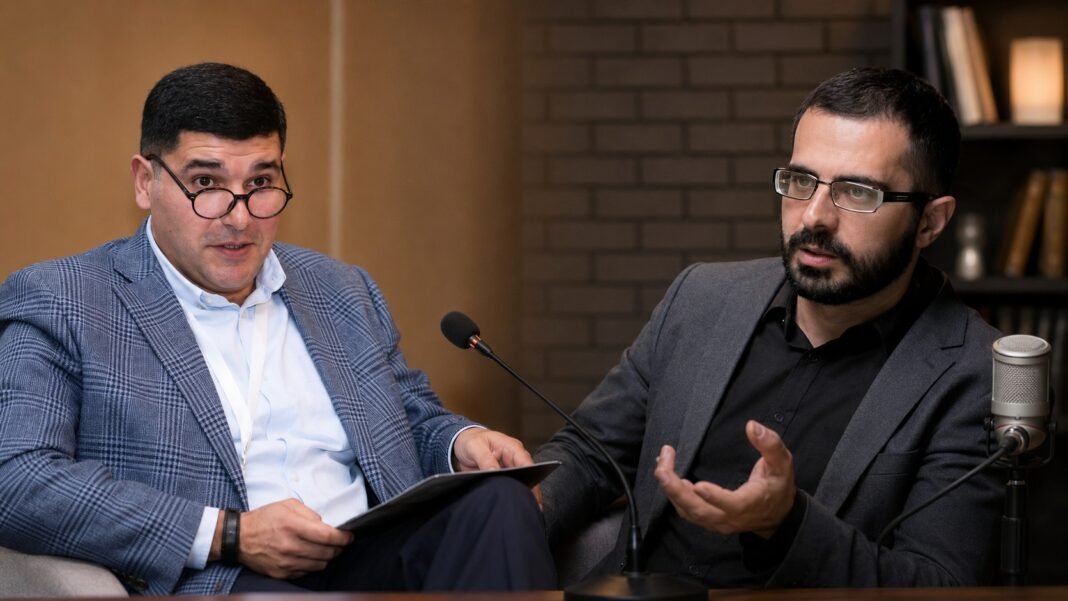
As AZE.US reports, Azerbaijani analyst Farhad Mammadov and Armenian analyst Samvel Meliksetyan compared the prospects of the two routes during a new episode of “Line of Contact” on the joint Armenian-Azerbaijani Press Clubs TV platform.
Armenia Begins Legal Approval Process
The Armenian government has approved a framework agreement linked to TRIPP and launched the process required for its ratification.
According to Meliksetyan, the agreement must first be reviewed by Armenia’s Constitutional Court before being submitted to parliament.
Questions could arise over tax benefits granted to companies participating in the project, but he said the overall legal framework is now moving forward.
The next stage is expected to include the creation of separate companies responsible for individual components, including railway construction, pipelines, electricity transmission lines and fiber-optic infrastructure.
Meliksetyan said work on the ground could begin by the end of the year or in early next year.
The first phase is expected to focus on restoring approximately 44 kilometers of railway through Armenian territory.
Representatives of U.S. engineering firm AECOM have already visited Armenia several times to assess the condition of the remaining rail infrastructure, estimate reconstruction costs and prepare technical studies.
New Investment Fund Draws Attention
The experts also discussed an investment fund headed by U.S. businessman Konstantin Sokolov.
Meliksetyan stressed that the fund is not the direct operator of TRIPP. It is a separate investment structure with initial capital of approximately $200 million.
The fund is expected to support logistics, infrastructure and natural-resource projects not only in Armenia, but also in Azerbaijan, Georgia and Central Asia.
Sokolov’s appointment has attracted particular attention because of his business assets in Armenia, including interests in telecommunications and a major copper and molybdenum deposit.
Farhad Mammadov said Azerbaijan is closely watching the development of the project’s financial and organizational structure.
According to him, U.S. involvement is becoming increasingly institutionalized as companies are formed, permits are processed and investment mechanisms are established.
The real test, however, will be the transition from paperwork to construction.
“Everyone is waiting for the bulldozers and excavators to start working,” Mammadov said.
North-South Corridor Still Lacks Key Elements
The analysts contrasted TRIPP with the International North-South Transport Corridor, which is intended to connect Russia, Azerbaijan and Iran.
Mammadov said Azerbaijan is interested in both the East-West and North-South routes. However, the East-West direction has received stronger political backing, clearer financing and greater international involvement.
The Middle Corridor is supported by the United States and the European Union and is also backed by countries in Central Asia and the South Caucasus.
The North-South route faces a much more difficult outlook.
More than 160 kilometers of railway still need to be built in Iran. The missing section passes through challenging terrain and requires substantial investment.
Mammadov argued that neither Russia nor Iran currently has the financial and organizational capacity to complete the project quickly.
Azerbaijan is continuing to develop its section of the route, but additional investment will depend on guaranteed cargo volumes.
“If there are volumes, there will be investment. If there are no volumes, there will be no investment,” he said.
Meliksetyan noted that announcements about the corridor’s imminent completion have been made for at least a decade.
Despite repeated agreements, loan discussions and political declarations, the missing railway link in Iran has still not been built.
The project also remains vulnerable to political instability surrounding Iran, regional security risks and uncertainty over whether future freight traffic would justify the cost.
Russia Has Limited Options
The experts were also skeptical about Moscow’s stated readiness to participate in the reopening of transport links between Azerbaijan and Armenia.
Meliksetyan said direct Russian participation in TRIPP is excluded by the project’s political and legal structure.
Russia could potentially invest in restoring other railway sections in Armenia, but so far it has shown little willingness to provide financing.
The two transport projects are therefore developing under very different conditions.
TRIPP is shorter, supported by international partners and already moving through legal, engineering and investment stages.
The North-South corridor remains larger, more expensive and heavily dependent on Russia and Iran, whose political and financial resources are increasingly constrained.
AZE.US