By AZE.US Editorial Team
For years, Azerbaijan was viewed internationally through a relatively narrow lens: the conflict with Armenia, energy exports to Europe, and its position between Russia, Turkey and Iran.
That description is no longer sufficient.
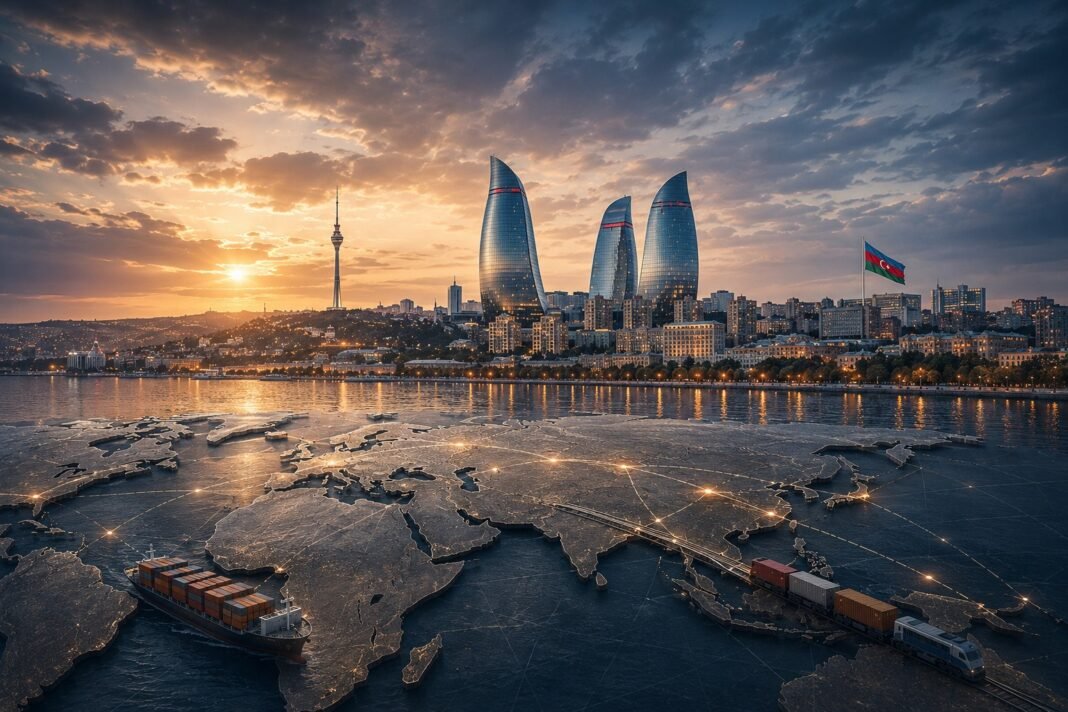
Baku is now trying to present Azerbaijan as a country with a wider international role, one that extends beyond the South Caucasus and into energy security, global transport routes, postwar reconstruction and regional diplomacy.
President Ilham Aliyev outlined much of this agenda during the Fourth Shusha Global Media Forum, where he spoke not only about Azerbaijan’s domestic priorities but also about the country’s place in a rapidly changing world.
Beyond Oil and Gas
Energy remains the foundation of Azerbaijan’s international influence.
Oil and gas exports helped Baku build strategic relationships with Turkey, Georgia and European countries, while also giving the government the financial resources to pursue a more independent foreign policy.
But Azerbaijan increasingly wants to move beyond the image of a traditional hydrocarbon supplier.
Baku is promoting cooperation in renewable energy, electricity transmission and future green energy projects linking the Caspian region with European markets.
The goal is no longer simply to sell fuel. Azerbaijan wants to become part of the infrastructure that will shape Europe’s future energy security.
The Middle Corridor as Political Capital
Transport and logistics form the second major pillar of Azerbaijan’s global agenda.
The war in Ukraine, sanctions against Russia and instability affecting maritime trade have increased demand for alternative routes between Asia and Europe.
That has raised the strategic value of the Middle Corridor, which connects Central Asia with Europe through the Caspian Sea, Azerbaijan, Georgia and Turkey.
For Baku, the corridor is more than a commercial project. It is also a source of political influence.
Every additional shipment passing through Azerbaijani ports, railways and roads strengthens the country’s importance to China, Central Asia, Turkey and Europe.
This is why Azerbaijan continues to invest in the Port of Baku, railway infrastructure and the expansion of regional transport capacity.
Geography, once seen mainly as a vulnerability, is now being turned into an economic and diplomatic asset.
Reconstruction as an International Model
The rebuilding of Karabakh and East Zangezur is also becoming part of Azerbaijan’s external message.
Baku presents the reconstruction effort not only as a domestic program but as a model of postwar recovery financed largely through national resources.
Roads, airports, housing, schools, energy facilities and public services are being built alongside demining operations and the gradual return of displaced residents.
Azerbaijan believes this experience could eventually be applied elsewhere.
Its construction companies, engineers and infrastructure specialists could participate in future rebuilding projects in countries affected by war, including Ukraine.
In this sense, reconstruction is becoming more than a national obligation. It is being developed as a potential area of international expertise.
Peace With Armenia and Azerbaijan’s Reputation
A peace agreement with Armenia would also serve a broader purpose for Baku.
Azerbaijan wants to move from being seen primarily as the military victor of a long conflict to being recognized as a state capable of shaping a stable regional order.
A lasting settlement, open communications and predictable relations with Yerevan would strengthen Azerbaijan’s claim that it is not only defending its own interests but also building a new political and economic framework for the South Caucasus.
That matters at a time when successful conflict resolution has become increasingly rare.
If Azerbaijan and Armenia complete the peace process without a new escalation, Baku will gain additional diplomatic weight well beyond the region.
Balancing Major Powers
Azerbaijan’s foreign policy is also built around avoiding excessive dependence on any single power center.
Baku maintains close ties with Turkey, deepens cooperation with Europe, expands relations with Central Asia and China, and develops partnerships with Pakistan and Middle Eastern states.
At the same time, it seeks to preserve working relations with Russia and Iran, even when those ties become difficult.
This is not neutrality in the conventional sense. It is a form of pragmatic balancing.
Azerbaijan does not want to become a junior partner in someone else’s geopolitical confrontation. It wants to use its location, resources and transport network to preserve maximum freedom of action.
In a world where alliances are becoming more transactional, that approach may prove increasingly valuable.
Shusha as a Message
The decision to hold an international media forum in Shusha is itself part of this strategy.
Baku is turning a city closely associated with war and national victory into a platform for global debate.
The message is deliberate: Azerbaijan considers the conflict phase to be over and wants international attention to shift toward reconstruction, connectivity and future cooperation.
Shusha is therefore becoming not only a symbol of the past but also an instrument of Azerbaijan’s diplomatic branding.
A Wider Ambition
Azerbaijan does not have the resources of a global power, and Baku is not pretending otherwise.
But it does possess several assets that have become more valuable in the current international environment: energy infrastructure, strategic geography, transport routes, financial capacity and experience in large-scale reconstruction.
The central question is whether Azerbaijan can turn these advantages into durable influence.
That will require more than pipelines, ports and political messaging. Long-term success will also depend on institutional quality, predictability and the ability to offer partners not only access to routes and resources but also stability.
Baku’s ambition is now clear.
Azerbaijan no longer wants to be viewed only as a regional actor. It wants to become a country whose decisions matter to a much wider circle of states.
AZE.US