AZE.US
Azerbaijan is preparing for an economy in which oil remains important, but can no longer serve as the country’s only strategic anchor.
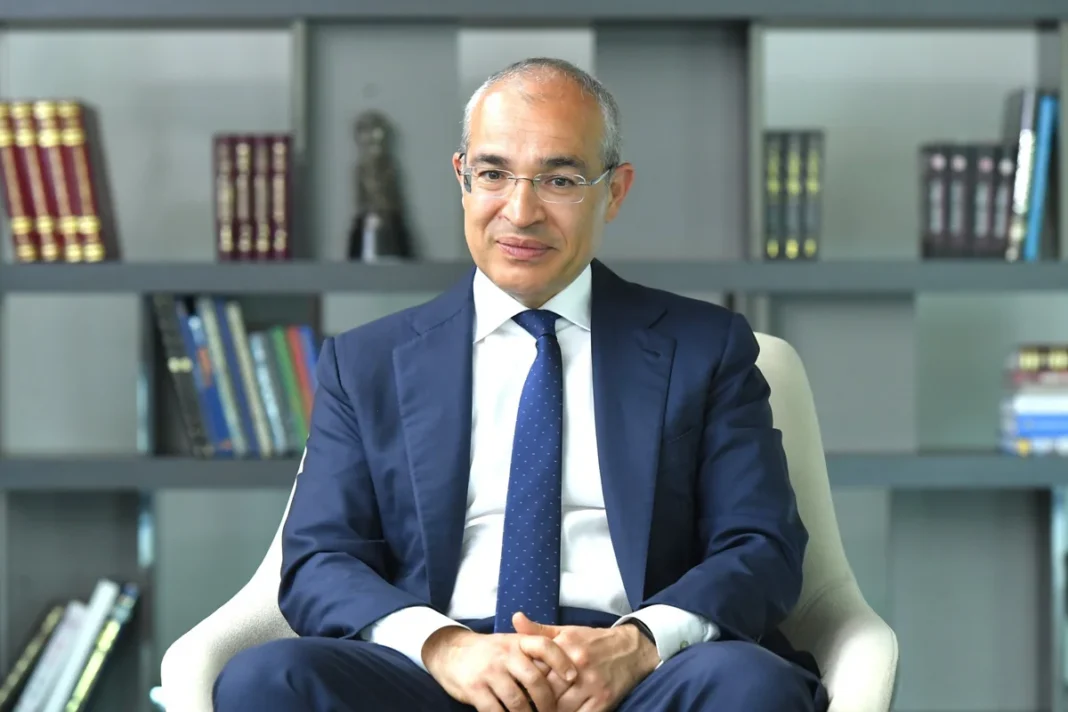
That was the central message from Economy Minister Mikayil Jabbarov’s wide-ranging interview with ITV and AZERTAC, where he outlined the government’s view of the country’s next economic phase: more non-oil exports, stronger industrial capacity, digital infrastructure, energy diversification and the reintegration of Karabakh and Eastern Zangezur into national economic life.
Jabbarov said Azerbaijan’s oil production peaked 16 years ago, in 2010, when the country produced nearly 51 million tons of oil. By 2025, production had fallen to 27.7 million tons.
Gas output has grown, but the minister made clear that, in value terms, gas is not a full replacement for oil. The implication is blunt: Azerbaijan will remain an energy country for decades, but the old model is no longer enough.
The government’s answer is to think of energy more broadly, not only as extraction, but also as refining, transit, infrastructure, foreign projects and SOCAR’s expansion into outside markets.
Jabbarov pointed to Azerbaijan’s role in supplying natural gas to 16 countries, SOCAR’s assets in Turkey, new activity in Africa, Israel, Uzbekistan and the acquisition of a major downstream position in Italy. In this model, Azerbaijan does not simply export raw resources. It tries to turn energy expertise, capital and infrastructure into a wider source of income.
The second major signal was about the non-oil economy.
According to Jabbarov, more than 71.5% of Azerbaijan’s economy in 2025 came from the non-oil sector. Around 20 years earlier, that figure was below 45%.
That is a major structural shift. But the minister also made clear that the current level is still not enough.
The real challenge is not only producing more outside oil and gas. It is whether Azerbaijan can sell more goods and services abroad. A small domestic market cannot carry a large long-term growth model on its own.
Jabbarov said non-oil exports have nearly doubled over the past six years and rose by more than 17% in the first four months of this year. But he described an export breakthrough as a long process, dependent on four elements: quality products, branding, reliable logistics and accessible finance.
That is where the country’s next economic test lies.
Azerbaijan wants to expand non-oil industry, mining, metallurgy, chemicals, agriculture, transport and logistics, tourism and professional services. It also wants more exports not only in physical goods, but in services that bring foreign currency into the country.
The third major signal was the new role assigned to digital infrastructure and Karabakh.
Jabbarov described digitalization not as a separate sector, but as a basic condition for competitiveness across the economy. In 2026, digital transformation road maps are expected to be prepared for 15 selected enterprises.
He also said Azerbaijan expects announcements in the coming months on new data centers with well-known technology partners. The logic is clear: the country has energy resources, relative investment stability and telecom links. If those advantages are used properly, data centers and artificial intelligence infrastructure could become export-oriented services.
Karabakh and Eastern Zangezur were presented in the same long-term frame.
Jabbarov said the return to those territories was first of all a national goal, not a purely economic project. But he also stressed that the return must be made economically sustainable. People who move back need jobs, business activity and income.
In the Aghdam Industrial Park, 31 business entities have received resident status and 5 more have non-resident status. 13 enterprises are already operating there. In the Araz Valley Economic Zone, there are 20 residents and 3 non-residents.
The government is trying to build not only roads, housing and utilities, but also industrial, logistics, mining, agricultural and educational capacity.
Azerbaijan’s next economic phase, as described by Jabbarov, is therefore not a simple move “away from oil.” It is more complex.
Oil and gas remain central. But the country is trying to build additional engines: non-oil exports, energy infrastructure, industrial parks, digital services, transport corridors and the economic return of liberated territories.
The key question is whether these new sources of growth can mature fast enough to reduce the country’s dependence on oil income, before the old model loses more of its strength.
AZE.US