By AZE.US Editorial Team
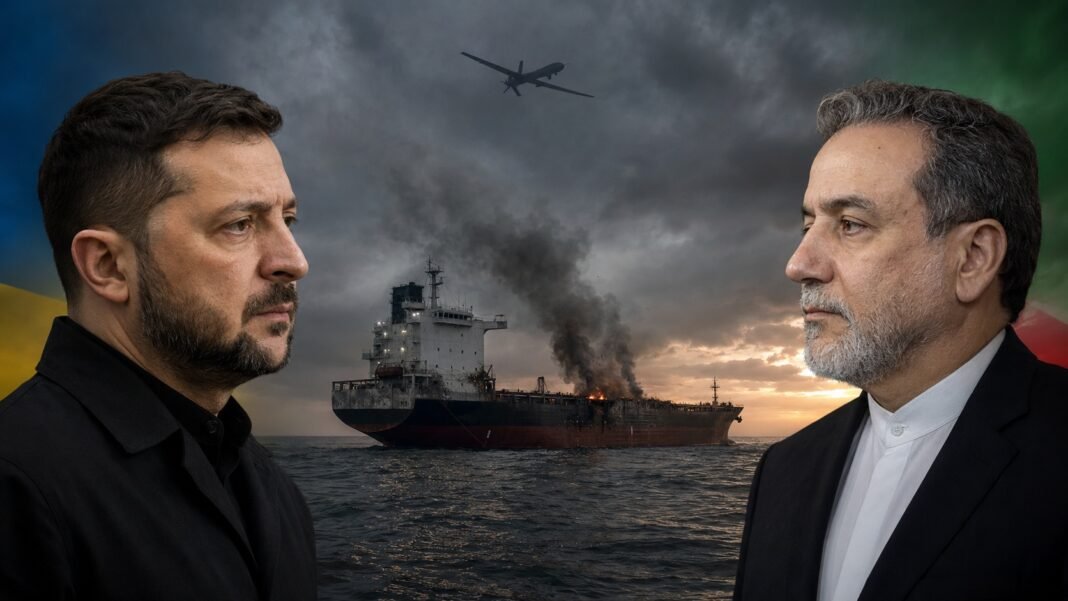
A Ukrainian strike on an Iranian vessel in the Caspian Sea has pushed a long-running shadow conflict into the open, raising the risk that the wars in Ukraine and the Middle East could merge into a much wider confrontation.
Until July 25, Iran and Ukraine could maintain a diplomatic fiction: the two countries were not at war.
Tehran insisted that it was not a participant in Russia’s invasion of Ukraine. Kyiv accused Iran of providing the drone technology Russia has used to attack Ukrainian cities, but Ukrainian forces generally directed their retaliation against Russian territory and Russian military infrastructure.
The strike in the Caspian Sea shattered that distinction.
Ukraine said its forces had carried out successful long-range attacks against vessels involved in transporting military cargo between Russia and Iran, as well as a Russian warship. President Volodymyr Zelensky publicly confirmed the operation, presenting it as another effort to disrupt the supply network supporting Moscow’s war.
Iran described the incident very differently.
According to the Iranian Foreign Ministry, Ukraine attacked an Iranian commercial vessel, causing an explosion that killed one sailor and injured another. Tehran summoned Ukraine’s chargé d’affaires, delivered a formal protest and called the strike an act of aggression in violation of the United Nations Charter.
Iran also warned that it would defend its national security and interests.
Ebrahim Azizi, chairman of the Iranian parliament’s National Security and Foreign Policy Committee, was even more direct.
“Ukraine may soon understand that Iran leaves no action unanswered,” he wrote on X, adding that the list of countries that had miscalculated in dealing with Iran was continuing to grow.
This was more than routine diplomatic rhetoric. It marked the moment when a years-long proxy confrontation began moving toward a direct conflict.
A War That Officially Did Not Exist
From Ukraine’s perspective, Iranian-linked vessels in the Caspian are not ordinary commercial ships. Kyiv views the route connecting Iranian and Russian ports as part of Moscow’s military logistics network, potentially carrying drone components, ammunition and other equipment used against Ukraine.
The Ukrainian calculation is straightforward: if a vessel transports material for the Russian military, it becomes part of the war infrastructure regardless of the flag it flies or its official civilian designation.
Iran applies the opposite logic. For Tehran, an attack on an Iranian-flagged ship that kills an Iranian citizen is an attack on Iran itself.
That distinction matters.
Ukraine had previously targeted Russian facilities connected to Iranian military supplies. This time, however, the target was identified by Tehran as Iranian, and Kyiv publicly acknowledged striking vessels involved in military cargo shipments linked to Iran.
It will now be more difficult for Tehran to limit its response to a diplomatic protest.
Iran has built much of its deterrence strategy around the promise of retaliation. Its response does not always come immediately, directly or in the same theater where the original attack occurred. It can be delayed, asymmetric or carried out through partners.
But no response at all could be interpreted as weakness – both inside Iran and by its regional adversaries.
The question is therefore not whether Tehran wants a full-scale war with Ukraine. It almost certainly does not. The question is whether Iran can preserve its credibility without triggering a cycle of escalation that it may no longer be able to control.
Kyiv Is Expanding the Geography of the War
The Ukrainian operation also demonstrated that Kyiv no longer considers the Caspian Sea a secure rear area for Russia.
Long-range strikes against shipping and infrastructure around Russia’s Astrakhan region carry both military and psychological significance. They send a message to Moscow and its partners that distance no longer guarantees protection and that assisting Russia’s war effort comes with a cost.
The immediate logic may be compelling. Destroying a shipment before it reaches the Russian military is more efficient than attempting to intercept hundreds of drones after they are launched at Ukrainian cities.
But the strategy also creates a serious risk.
Disabling a particular weapons shipment may provide Ukraine with a tactical advantage. Turning Iran from an arms supplier into an independent military adversary could become a strategic liability.
Tehran has ballistic missiles, long-range drones, cyber capabilities and a network of regional partners. It could increase military assistance to Russia, transfer more advanced weapons, target Ukrainian interests outside the country or choose an indirect form of retaliation.
Even a limited response would alter the nature of the conflict. Ukraine would have to confront not only Russia but also the possibility of direct Iranian operations.
Two Wars Are Beginning to Merge
The broader context makes the Caspian strike particularly dangerous.
Ukraine has offered its drone-interception expertise to U.S. partners facing Iranian attacks in the Middle East. Iran, meanwhile, has accused Kyiv of assisting Israel. Iranian Foreign Minister Abbas Araghchi alleged that the attack on the vessel was carried out at Israel’s direction and was intended to draw Europe deeper into the conflict.
Tehran has presented no public evidence supporting that claim. Yet escalation is often driven not only by verifiable facts but also by what governments believe – or choose to portray – as reality.
Ukraine increasingly sees Iran as an active partner in Russia’s war. Iran increasingly portrays Ukraine as part of a U.S.- and Israeli-led campaign against the Islamic Republic.
Each country is beginning to view the other not as an independent adversary but as an extension of its principal enemy.
That is how regional wars stop being regional.
Moscow can now connect its war against Ukraine to the confrontation in the Middle East. Tehran can use the Ukrainian strike to justify deeper military cooperation with Russia. Kyiv, in turn, can argue that the entire Russia-Iran supply chain is a legitimate target.
The result is a cycle in which every attack becomes the justification for the next one.
The Caspian Is No Longer a Sanctuary
For Azerbaijan and the other Caspian states, this confrontation carries consequences far beyond relations between Tehran and Kyiv.
The Caspian Sea has traditionally been viewed as an enclosed strategic space, partially insulated from major external conflicts by geography and its special legal regime. That sense of immunity is disappearing.
Once commercial vessels become military targets, the risks increase for shipping routes, ports, offshore energy infrastructure and civilian navigation. A targeting error, misidentified vessel or malfunctioning drone could affect a country that has no involvement in the war.
For Baku, maintaining distance from the confrontation will require more than declarations of neutrality. Azerbaijan will need tighter monitoring of cargo movements, its airspace and critical Caspian infrastructure to prevent any suspicion that its territory or transportation networks are being used by either side.
A single strike does not mean that Iran and Ukraine are already at war. But it has removed the buffer that allowed both governments to pretend they were not fighting each other.
Any Iranian retaliation could now provoke another Ukrainian response. Every new attack on Caspian logistics could expand the list of potential targets. Each side will insist that it is merely responding to the other.
Azizi said Ukraine had miscalculated. That may be Iranian rhetoric preceding a carefully limited response. But the larger miscalculation may extend well beyond Kyiv.
A war that began in Ukraine has reached the Caspian Sea. It now risks merging with a Middle Eastern conflict that has already demonstrated how quickly borders can lose their meaning.
AZE.US