By AZE.US Editorial Team
Ukraine has intensified its campaign against Russian logistics around Crimea, raising a key question: is Moscow beginning to lose reliable access to the peninsula?
The answer, for now, is more complicated than a simple yes or no.
Russia is not physically losing Crimea at this stage. The Crimean Bridge still exists, Moscow still has a land corridor through occupied southern Ukraine, and some maritime and air routes remain available. But the old sense of Crimea as a secure Russian rear base is increasingly gone.
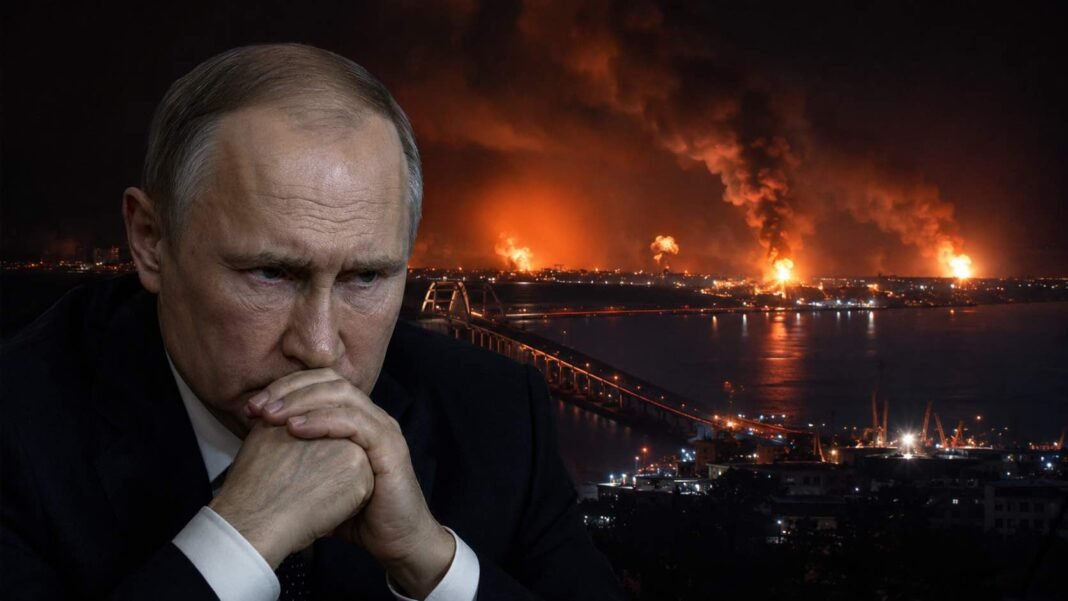
In recent days, Ukrainian strikes have targeted fuel and military infrastructure linked to Crimea. On June 21, attacks hit facilities connected to oil logistics on both sides of the Crimean Bridge, including the Kerch area in occupied Crimea and sites in Russia’s Krasnodar region.
After the strikes, Russian-installed authorities in Crimea suspended civilian gasoline sales. Fuel was restricted for government agencies and services considered essential for the functioning and security of the region. Russian-installed officials said four people were killed and 28 wounded in the attack.
That decision is important because it points to a deeper problem for Moscow. Crimea is not only facing another night of drone strikes. It is facing growing pressure on the systems that keep the peninsula supplied.
Ukraine appears to be targeting several layers of Russia’s access to Crimea at the same time: fuel depots, oil terminals, ferry routes, military logistics, air defense systems and roads used to move equipment and supplies through occupied territory.
The ferry issue is especially significant. Ukrainian officials say railway ferries, which could carry large volumes of fuel and cargo to Crimea, are currently not operating. Conventional ferries remain in use, but they cannot fully replace the capacity of railway ferries. That makes the Crimean Bridge and the land corridor even more important, and therefore even more vulnerable.
Ukraine’s strategy is clear. Kyiv does not need to launch an immediate ground operation into Crimea in order to change the military equation. It can instead make the peninsula harder, slower and more expensive for Russia to supply.
If fuel, ammunition, equipment and personnel become more difficult to move into Crimea, the peninsula gradually becomes a heavier burden for Moscow. It remains valuable, but less secure. It remains under Russian control, but less useful as a military platform.
Ukraine has also claimed strikes on Russian air defense assets, including S-400 radar stations and Pantsir systems. If confirmed, those attacks would matter because weakening air defense around Crimea can make future strikes on ports, depots, bases and transport hubs easier to carry out.
This is why the latest developments should not be described as Russia “losing Crimea” in the immediate sense. There is no evidence of an imminent collapse of Russian control over the peninsula.
But Russia may be losing something else: the ability to treat Crimea as a safe rear area.
For Moscow, that is a serious strategic problem. Crimea is not only a symbol of Russia’s war and annexation policy. It is also a military hub for operations in the Black Sea and southern Ukraine. If Ukraine can keep hitting the infrastructure that connects Crimea to Russia, the cost of holding the peninsula will continue to rise.
The latest fuel restrictions, ferry problems and strikes on oil infrastructure suggest that Crimea is becoming increasingly fragile as a logistical asset.
In practical terms, Ukraine is not taking Crimea today. But it is tightening pressure around it.
The main takeaway is this: Russia still controls Crimea, but its access to the peninsula is becoming less secure, less predictable and far more vulnerable to Ukrainian strikes.
AZE.US