AZE.US
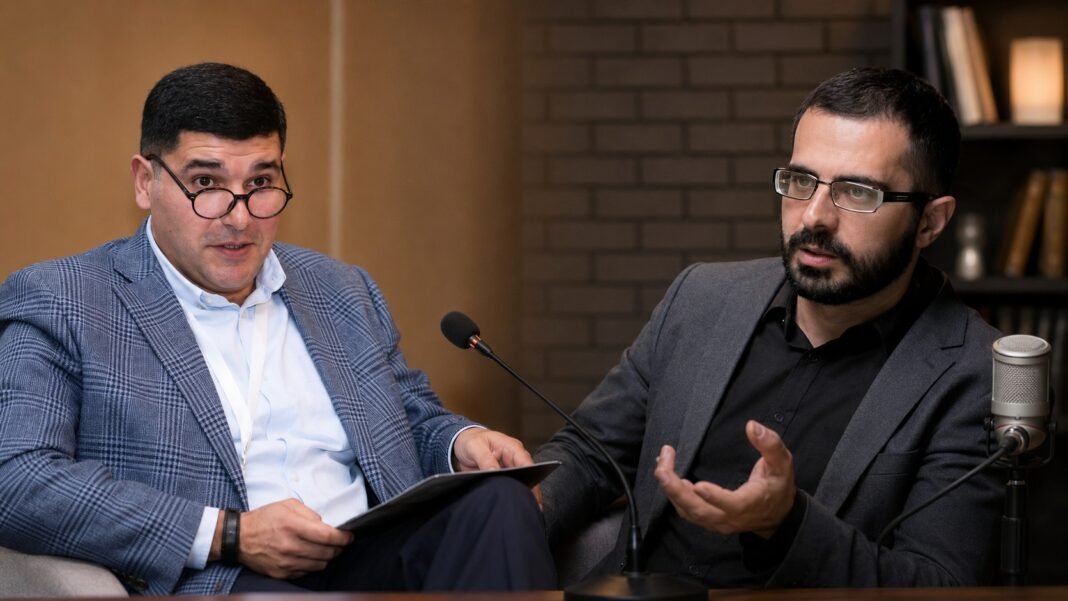
The normalization of relations between Azerbaijan and Russia does not mean a return to the old regional order, according to Azerbaijani analyst Farhad Mammadov and Armenian analyst Samvel Meliksetyan.
The South Caucasus has changed, Moscow’s influence has weakened and the countries of the region are increasingly pursuing more independent foreign policies, the experts said during a new episode of “Line of Contact” on the joint Armenian-Azerbaijani Press Clubs TV platform.
A New Normal Between Baku and Moscow
The discussion followed Azerbaijani President Ilham Aliyev’s statement that relations with Russia had fully normalized after the serious crisis triggered by the crash of an AZAL passenger plane.
Mammadov said Azerbaijan-Russia relations were traditionally built on five pillars: high-level political dialogue, economic cooperation, humanitarian ties, military-technical cooperation and Russia’s participation in the Armenia-Azerbaijan settlement process through the OSCE Minsk Group.
Two of those pillars have now largely disappeared.
The Minsk Group no longer exists, and Baku does not envision a renewed Russian role in the Armenia-Azerbaijan peace process. Military-technical cooperation has also lost importance as Russia faces difficulties not only in supplying new weapons, but also in servicing previously delivered military equipment.
Political contacts, trade and humanitarian ties remain, but the substance of the relationship has changed.
“The new normal is pragmatism without an emotional component,” Mammadov said.
He noted that Aliyev has not visited Russia since the crisis, while contacts at the presidential level have remained limited. At the same time, communication between the two foreign ministries and intergovernmental bodies continues.
Economic relations also remain significant. However, Mammadov argued that much of the increase in bilateral trade measured in U.S. dollars reflects higher prices rather than a substantial rise in physical volumes.
The broader message from Baku, he said, is that the South Caucasus is being reshaped without Russia playing the decisive role it once held.
Moscow must now account for the growing sovereignty of regional states and abandon approaches that dominated its policy for decades.
No Return to the Previous Model
Meliksetyan agreed that the end of the crisis between Baku and Moscow does not mean the restoration of their former relationship.
The confrontational phase may have ended, he said, but the previous level of closeness is unlikely to return.
Similar changes are taking place across the post-Soviet region.
Kazakhstan is expanding ties with the European Union, the United States and Asian partners. Even Belarus, despite its deep dependence on Russia, is seeking a degree of balance through closer engagement with China.
Armenia-Russia relations are undergoing an even deeper transformation.
According to Meliksetyan, the relationship was historically centered on security. After the developments of 2022 and 2023, that foundation weakened significantly, making a return to the old structure increasingly unlikely.
He also said the AZAL crisis demonstrated that differences between Russia and Azerbaijan were more serious than some observers had assumed.
In parts of the Armenian expert community, the dispute was initially viewed as temporary and tactical. Later developments, Meliksetyan argued, showed that the divergence of interests was more fundamental.
Moscow Cannot Restore Its Old Influence
The experts also addressed claims frequently heard in Russia that Moscow could recover its lost influence in the South Caucasus after the war in Ukraine ends.
Mammadov described that scenario as unrealistic.
“It is impossible to restore everything in the form it once had. The institutions to return to no longer exist,” he said.
The OSCE Minsk Group is gone, and the return of Russian peacekeepers to Karabakh is not a realistic option.
Russia still retains important levers in Armenia, including control over railway infrastructure, the presence of Russian border guards and mechanisms linked to the Eurasian Economic Union.
However, the war in Ukraine continues to reduce Moscow’s financial, political and organizational capacity.
Mammadov also pointed to the growing number of contacts between Azerbaijani and Armenian leaders and officials from the United States and Europe.
Western political involvement in the region has expanded, while visits by senior Russian leaders have become less frequent.
Meliksetyan said Russia does not have sufficient resources to restore its former position simultaneously in Armenia, Azerbaijan, Kazakhstan, Uzbekistan and other post-Soviet states.
Moscow could remain an important partner, he argued, but only if it abandons pressure, coercion and attempts to impose its interests on neighboring countries.
Continuing the old model would further weaken Russia’s regional position.
The “3+3” Format Has Produced Little
The analysts also discussed the “3+3” regional platform, which was designed to bring together Azerbaijan, Armenia, Georgia, Russia, Turkey and Iran.
Mammadov said the initiative has always reflected the interests of the South Caucasus’ larger neighbors more than those of the regional states themselves.
The format has never functioned as a true “3+3” mechanism because Georgia refuses to participate while Russia continues to control Abkhazia and the Tskhinvali region.
Moscow, he argued, cannot call for regional cooperation while maintaining military control over territories internationally recognized as part of one of the proposed participants.
Meliksetyan described the platform as largely symbolic.
Meetings were held in Tehran and Istanbul, but no major decisions were implemented.
Russia periodically calls for the format to be revived, yet those statements have produced few practical results.
The South Caucasus is therefore moving toward a more decentralized regional order.
Russia will remain an important neighbor and trading partner, but it no longer has the institutions, resources or political leverage required to determine the region’s future on its own.
AZE.US