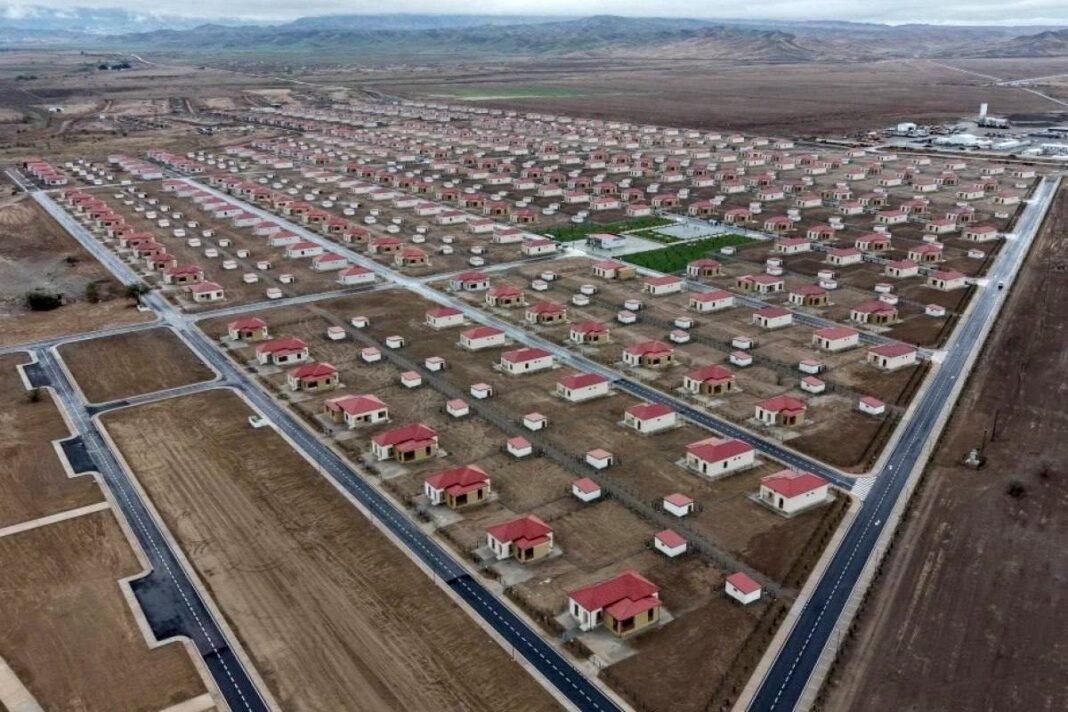
An Azerbaijani architect has sharply criticized the design of the newly opened Soltanli village in the Jabrayil district, saying rows of nearly identical houses create a barracks-like settlement rather than a modern and distinctive community.
Architect Elchin T. Aliyev published the criticism on Facebook after President Ilham Aliyev and first lady Mehriban Aliyeva attended the Nov. 6 opening of the village’s first phase. He accompanied his post with an aerial photograph of the development.
The criticism concerns the same Soltanli resettlement project that opened to returning residents this week.
“I think the officials who organized the head of state’s visit to this village seriously put the president in a difficult position,” Aliyev wrote.
Houses Were Built, but Where Is the Architecture?
Aliyev’s main objections concern the settlement’s master plan. He said the development relies on the mechanical repetition of similar houses arranged along a rectangular street grid, with little spatial variety or architectural identity.
He argued that the planners appeared to have focused on placing residential structures across the site instead of creating a contemporary settlement designed around residents’ daily lives.
The architect used exceptionally harsh language, comparing the layout to a barracks and, at one point, to a concentration camp. That comparison was Aliyev’s own characterization of the monotonous plan; it was not an official assessment of the project.
His broader argument was that modern urban planning requires more than homes, roads and utilities. Public spaces, landscaping, pedestrian comfort, places for social interaction and a recognizable local character also shape whether a settlement feels livable, he said.
Questions About Foreign Designers
Aliyev also questioned why foreign specialists were used for what he described as a basic planning scheme.
The master plan was jointly prepared by Hungary’s KESZ Group and the Baku State Design Institute under a commission from Azerbaijan’s State Committee for Urban Planning and Architecture, according to previously published project information.
“Could such a primitive planning scheme really not have been drawn with our own resources, without using foreign specialists?” Aliyev asked.
He also criticized the absence of publicly available information about the cost of the design work and the terms under which the contractors were selected.
“I would not pay a single manat for such a primitive project,” he wrote.
Aliyev called for public answers about who approved the plan, how much the design cost and whether the expense was justified. He also expressed hope that law-enforcement bodies would eventually examine the financial side of the project.
The lack of publicly accessible cost information does not itself establish corruption or any other wrongdoing. Aliyev’s statement raises questions about transparency and responsibility for the quality of the design.
Official Project Includes 420 Homes
Official information describes Soltanli as a large reconstruction project covering 108.5 hectares. Its first phase includes 420 single-family houses with two, three, four or five rooms.
The homes have water, electricity, natural gas, solar panels and high-speed internet. The village also has paved roads, a two-story administrative building, a medical unit, a multifunctional service building and a 140-seat nursery-kindergarten.
President Aliyev and the first lady attended the opening on Nov. 6, according to the Azerbaijani presidency. The village was occupied in 1993 and returned to Azerbaijani control in October 2020.
The official figures show the scale of the work and the social and engineering infrastructure provided. Aliyev’s criticism focuses on a different question: whether those elements are enough to create an attractive, varied and durable living environment.
The debate matters because the design choices made during reconstruction will shape daily life for returning residents for decades. Beyond the number of completed homes, the public questions concern design quality, procurement transparency and who bears responsibility for the approved plans.
Sources: Vesti Baku, Office of the President of Azerbaijan and Trend.