By AZE.US Editorial Team
President Ilham Aliyev’s state visit to Kyrgyzstan was significant not only because Baku and Bishkek signed a treaty on allied relations.
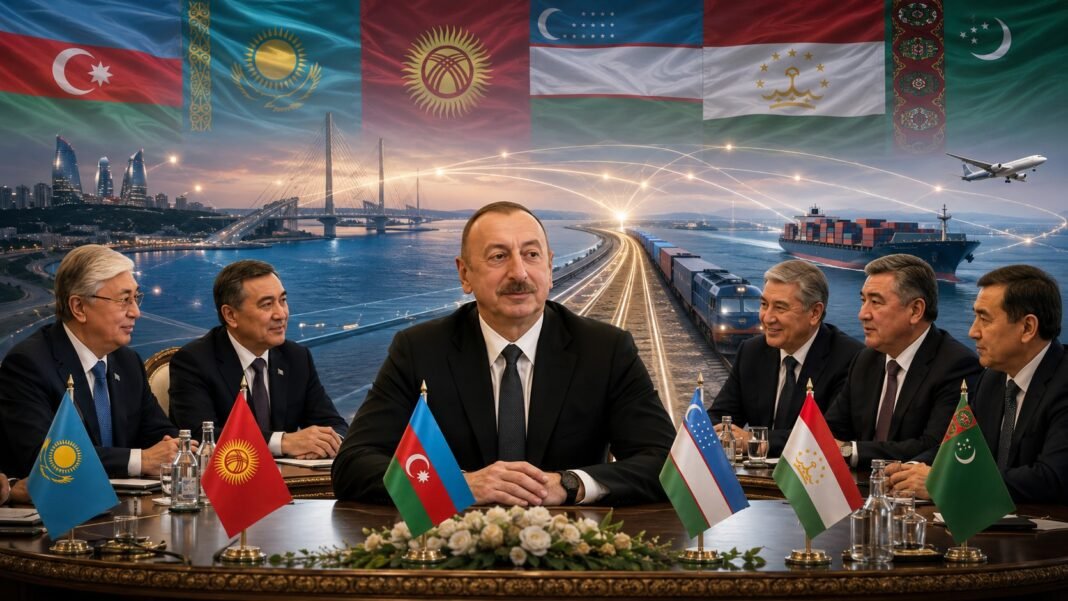
The meeting in Cholpon-Ata also formalized a broader geopolitical shift: Azerbaijan participated in a gathering of Central Asian leaders as a full member of the regional format.
Aliyev had previously attended such meetings as an honorary guest. Azerbaijan’s inclusion as a full participant reflects the country’s rapidly expanding political, economic and transportation ties with Kazakhstan, Kyrgyzstan, Uzbekistan, Tajikistan and Turkmenistan.
The meeting brought together the leaders of Azerbaijan and the five Central Asian states, who signed the Cholpon-Ata Declaration following their discussions.
The new format effectively extends Central Asia’s political geography to the western shore of the Caspian Sea.
Aliyev described Azerbaijan and Central Asia as an emerging single geopolitical and geo-economic space.
“Previously, I participated as an honorary guest, while now I am taking part as a full member of the team,” the Azerbaijani president said.
The shift is based on more than cultural and linguistic ties among Turkic states.
Azerbaijan is becoming Central Asia’s principal western gateway. Routes crossing the Caspian Sea, Azerbaijan, Georgia and Turkey provide regional countries with access to European markets while reducing their dependence on transportation networks running through Russia or Iran.
That is why Azerbaijan’s role in the Middle Corridor featured prominently during the talks in Kyrgyzstan.
For Baku, full participation in the Central Asian format also increases its political influence. Azerbaijan will be able to contribute to regional discussions not merely as an external partner, but as part of an increasingly coordinated political and economic grouping.
The intensity of recent diplomatic contacts shows that the process began well before the Cholpon-Ata meeting.
Aliyev said he had visited Central Asian countries 16 times since the beginning of 2023, while regional leaders had made 26 visits to Azerbaijan during the same period.
The new alliance treaty with Kyrgyzstan is another element of this strategy. Azerbaijan has already developed close relations with Kazakhstan, Uzbekistan and Turkmenistan through transportation, energy, investment and security projects.
These bilateral partnerships are now gradually being incorporated into a broader regional framework.
For Central Asian states, Azerbaijan strengthens connections with the South Caucasus, Turkey and Europe. For Baku, the new status consolidates its position as the main bridge between the eastern and western shores of the Caspian.
Aliyev’s visit to Kyrgyzstan should therefore be viewed as more than another step in Azerbaijani-Kyrgyz relations.
Cholpon-Ata marked the emergence of a wider political space in which Azerbaijan has become a full participant in the Central Asian dialogue and a key link between the region and Western markets.
AZE.US