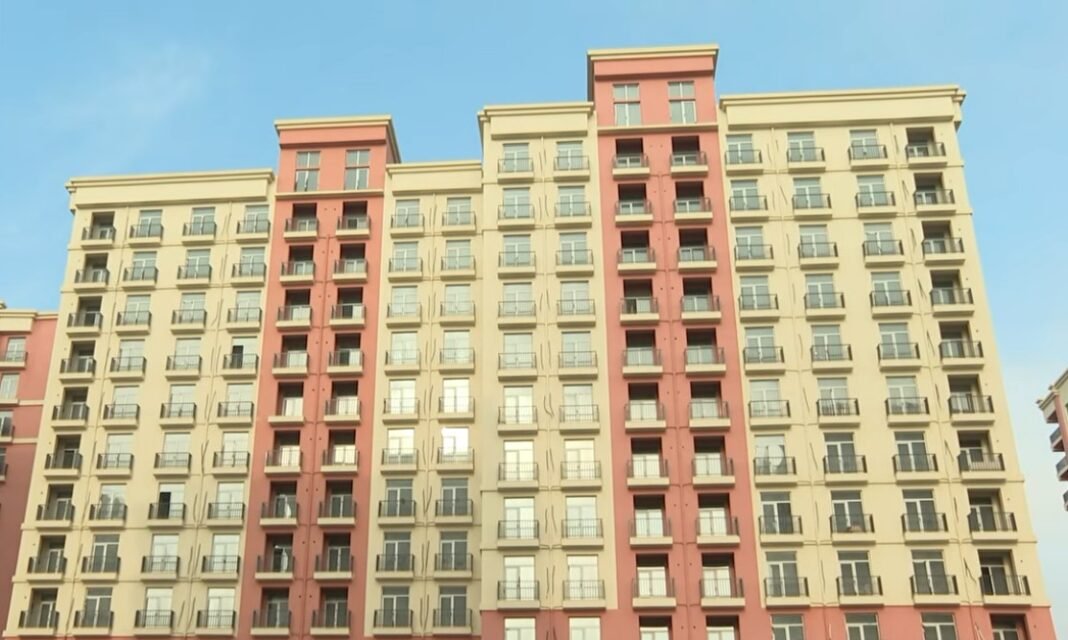
Spacious apartments in Baku’s new-build market are becoming increasingly difficult for middle-income families to afford, with three-room homes costing hundreds of thousands of manats and four-room units often approaching half a million.
The market had changed noticeably by November 2026 compared with the beginning of the year. Earlier concerns centered mainly on a shortage of multiroom apartments in some new residential complexes. The bigger issue now is their price.
According to the Azerbaijan Chamber of Appraisers, the median price per square meter in new buildings was 2,850 manats in September. That was 2.8% higher than in August and 8% above the December 2025 level.
The median price of a new-build apartment reached 271,000 manats for a unit measuring 95 square meters.
A separate study published by the Azerbaijan Society of Appraisers on Nov. 3 showed further increases. In October, prices for apartments in Baku’s new buildings were 14% higher than a year earlier and rose 1.1% in one month.
What Larger Apartments Cost
Property-platform data illustrate the scale of the affordability problem. EmlakBaza statistics put the median price of a two-room apartment in a new building at about 170,000 manats. The figure rises to 280,000 manats for a three-room home and about 465,000 manats for a four-room apartment.
Moving from a two-room to a three-room unit therefore requires roughly another 110,000 manats. A four-room home demands a much larger additional outlay.
Individual listings also show wide differences across the capital. Four-room apartments in Masazir can be found for about 190,000 to 255,000 manats. Listings in Yasamal include properties at around 285,000 manats, while prices in Ahmadli range from about 290,000 to 360,000 manats. In more expensive districts, prices can exceed 500,000 to 700,000 manats.
Those figures are examples from individual advertisements, not district averages. Prices vary with size, renovation, the property’s legal status, floor level and location.
Why Developers Favor Smaller Units
Market participants said as early as January that the declining supply of spacious homes was linked to buyers’ limited purchasing power.
Realtor Telman Huseynov said at the time that smaller apartments were easier to sell because their total price was significantly lower. He also said some large apartments were being divided into several smaller units for resale.
Real estate expert Elnur Azadov likewise attributed demand for compact housing to household income, mortgage terms and rising construction costs.
The problem had become more pronounced by November. Smaller apartments can appeal to developers because each purchase requires a lower budget and the pool of potential buyers is larger. A large apartment, even with a relatively low price per square meter, requires far more capital and may take longer to sell.
Three-room apartments have not disappeared. Listings show a substantial number remain on the market. The sharper difference is between the three- and four-room segments, with far fewer four-room units available.
Family Needs and Household Budgets Diverge
For many buyers, the main problem is not the absence of choice but the gap between their needs and their finances. A family with two children may need at least three rooms, but the price of such a home in a new building can be well beyond what ordinary incomes and mortgage financing can support.
Buyers may have to accept less space, move farther from the center, consider the secondary market or postpone a purchase. Even when a larger apartment has a lower price per square meter, the total transaction cost remains the principal barrier.
The purchase price is only part of the burden. Renovations, furniture, residential-complex service fees and utility bills add to household costs.
Why Prices Keep Rising
Ayan Gambarova, deputy chair of the Azerbaijan Chamber of Appraisers, identified several forces behind rising prices in comments published Nov. 3: the concentration of population and economic activity in Baku, migration from the regions, interest from overseas buyers and the use of real estate as an investment.
Limited land, construction costs and insufficient housing supply in sought-after areas also play a role. But rising property values do not automatically mean that household purchasing power is increasing.
That imbalance is becoming central to Baku’s housing market: apartment prices are rising faster than many families can expand their budgets.
Outlook for Three- and Four-Room Homes
The next phase will depend on buyer income, mortgage conditions, construction volumes and the cost of new projects. In Baku’s expensive districts, spacious apartments may increasingly be aimed at affluent buyers. Demand for family-size housing will remain in more affordable areas, but the final price will be decisive.
Large apartments are still being built and sold. For a significant share of buyers, however, they are shifting from an ordinary family purchase to an expensive acquisition.
Source: Vesti Baku.