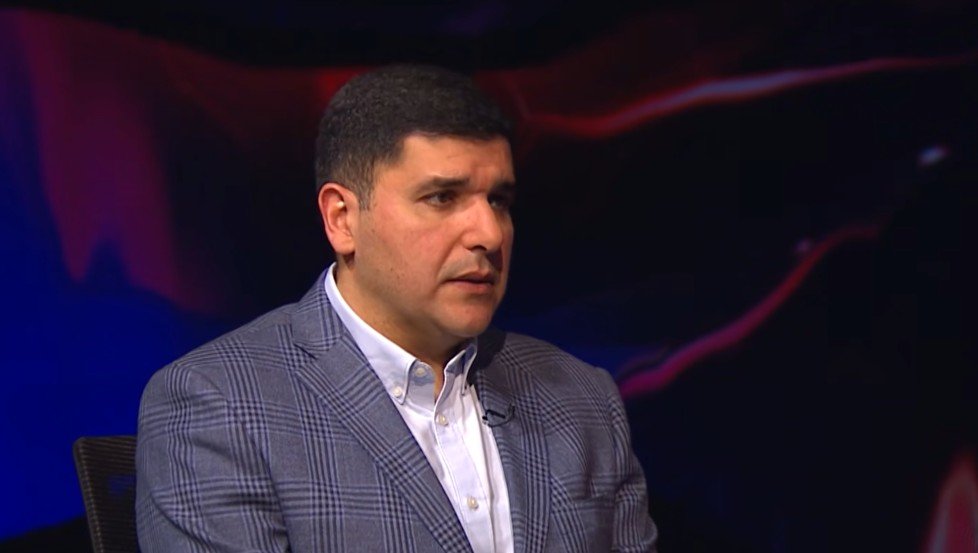
Democratic control of both chambers of the U.S. Congress will require Azerbaijan to adjust its approach to Washington, accelerate the TRIPP transport project and prepare for stronger pressure from Armenian lobbying groups, Azerbaijani foreign policy specialist Farhad Mamedov said.
Mamedov, deputy chairman of the Center of Analysis of International Relations, made the assessment in an interview with the YouTube program “A Contemporary Conversation With Rasim Babayev.” His comments were reported by Vesti Baku.
Democrats won control of the House and Senate in the Nov. 3 midterm elections, creating divided government for the final two years of President Donald Trump’s term. The new Congress is due to convene Jan. 3, 2027.
Section 907 and Pressure on Baku
Mamedov said one of the most important consequences for Azerbaijan could be a more difficult path toward the full repeal of Section 907 of the Freedom Support Act, which restricts direct U.S. assistance to the Azerbaijani government.
He stressed that suspending the restriction is not the same as repealing it. In his view, Armenian advocacy groups are likely to use the new congressional majority to press for additional conditions in U.S. relations with Azerbaijan.
Those demands could include the release of Armenian detainees held in Azerbaijan and issues connected to the Armenian-Azerbaijani settlement, he said. Such initiatives could complicate bilateral cooperation even if the Trump administration remains interested in advancing the peace process.
From a “Maximum Plan” to a “Minimum Plan”
Mamedov said Baku should reassess its immediate diplomatic priorities. If the full repeal of Section 907 had been a central objective, a more realistic goal now would be to place the U.S.-Azerbaijan strategic partnership on firmer institutional foundations.
That would mean broadening cooperation and creating durable mechanisms that would be harder to reverse after another change of power in Washington. Azerbaijan should use the remaining two years of Trump’s presidency to lock in agreements already reached, he said.
TRIPP and the Peace Process
Mamedov also called for faster implementation of TRIPP while the Trump administration remains committed to the transport initiative. He said Armenia’s government likewise has an interest in making the project irreversible.
He did not expect Washington to abandon support for an Armenian-Azerbaijani peace settlement. The main issues are being discussed directly by Baku and Yerevan without third-party mediation, he noted, though Congress could create additional political obstacles on the U.S. side.
China, Ukraine and Iran
The election result could also affect wider U.S. foreign policy, Mamedov said. He predicted that Beijing would take Trump’s weaker political position into account, reducing the president’s ability to conclude long-term agreements with China.
He rejected scenarios envisioning a division of global spheres of influence among the United States, China and Russia as unrealistic.
On Ukraine, Mamedov said the stronger Democratic position, coupled with the party’s support for Kyiv, could make a settlement on Trump’s preferred terms more difficult.
Turning to Iran, he said he could not rule out new U.S. strikes before the new Congress begins work. He emphasized, however, that no decision was certain and that several regional governments wanted to prevent further escalation.
Why Baku Is Reaching Out to India
Mamedov said Azerbaijan’s effort to normalize relations with India should not be interpreted as a retreat from its strategic partnership with Pakistan.
Baku wants to resolve disagreements with New Delhi, including friction in the Shanghai Cooperation Organization and BRICS, while preserving economic ties that continued even during periods of political tension, he said.
He also dismissed claims that Azerbaijan could join a supposed alignment of India, Israel, Greece and Cyprus directed against Turkey and Pakistan.
Russia and the Organization of Turkic States
Mamedov also addressed Kazakh President Kassym-Jomart Tokayev’s suggestion that Russia could participate in the Organization of Turkic States. He said Kazakhstan may have raised the idea at Moscow’s request, but the statement did not mean that an accession process had begun.
Language-based membership criteria and other practical barriers leave a substantial gap between a political proposal and implementation, he said.
Mamedov’s central conclusion was that Democratic control of Congress does not mean Washington will abandon cooperation with Azerbaijan. It does, however, change the conditions under which Baku must manage the relationship. He said Azerbaijan’s priorities for the next two years should be strengthening the strategic partnership, advancing TRIPP and insulating the bilateral agenda from additional political conditions.