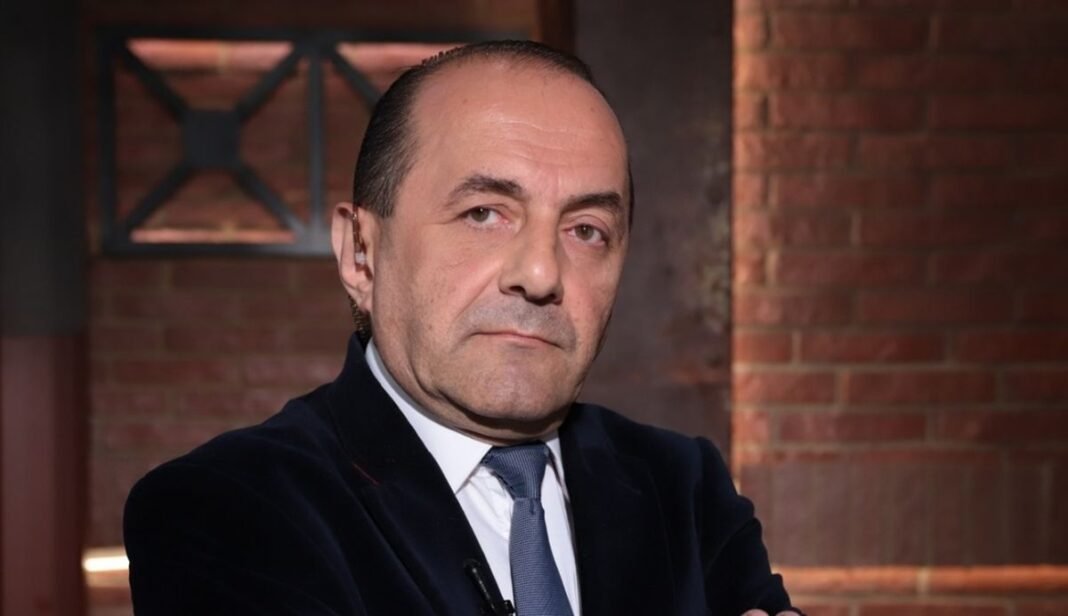
Armenia has a greater interest than Azerbaijan in signing a peace agreement quickly because the deal is critical to its long-term security and the durability of its statehood, Armenian political analyst Ruben Mehrabyan said.
Azerbaijan, by contrast, has greater political room to continue negotiations and does not face the same urgency, Mehrabyan, deputy chairman of Armenia’s For the Republic party, said in a Russian-language interview with Noyan Tapan. His comments were reported by Vesti Baku.
Responding to Prime Minister Nikol Pashinyan’s statement that peace with Azerbaijan should become a foundation for the endurance of Armenian statehood, Mehrabyan agreed that normalization was essential. Armenia’s future is directly tied to relations with its neighbors, especially Azerbaijan, he said.
The two countries’ interests in the timing of an agreement, however, do not fully coincide.
Why Baku Can Afford to Wait
Mehrabyan said a peace treaty would produce larger and more immediate changes for Armenia than for Azerbaijan.
Yerevan wants to formalize the post-conflict reality and remove strategic uncertainty as soon as possible. Baku, in his assessment, has more room for diplomatic maneuver and can use the time to seek answers on issues it considers essential to a final settlement.
That does not mean Azerbaijan is uninterested in peace, Mehrabyan said. A predictable situation along the long Armenian-Azerbaijani border serves both countries. The difference is principally one of urgency.
TRIPP and Russia’s Regional Role
Mehrabyan devoted much of the interview to TRIPP and competition between the United States and Russia over transport links in the South Caucasus.
He said the new route would serve not only Armenia and Azerbaijan but also Washington’s broader Eurasian strategy. He described TRIPP as part of a transport system that could expand regional access to global markets without dependence on Russia.
Moscow does not want to lose its traditional leverage, but its ability to influence the project is limited, Mehrabyan argued. He said Russia and the other parties interested in the route do not share the same strategic objectives.
TRIPP could be implemented technically even before a final Armenian-Azerbaijani peace treaty is signed, he said. A full agreement, however, would make the project more predictable and attractive to investors.
Could Armenia Replace Its Russian Rail Operator?
Mehrabyan also discussed the future of Armenian rail infrastructure, which is operated under concession by a Russian company.
He supported ending the Russian concession, arguing that it complicates efforts to attract international investment and develop new transport projects. Sanctions affecting Russian entities make the present management model less attractive to foreign partners, he said.
Mehrabyan proposed an international consortium that could include Kazakhstan. Astana could play an important role because of its position in trans-Caspian transport routes and its connections with Central Asia, he said.
Any review of the concession must also account for Armenia’s legal obligations, Mehrabyan acknowledged. The dispute could be resolved through an agreement with Russia or through legal proceedings.
Energy Dependence on Moscow
Mehrabyan also criticized Russian proposals for the future of Armenian nuclear power.
He said Yerevan should consider alternative technology, including U.S. small modular reactors, instead of deepening its energy dependence on Moscow.
Armenia’s energy future should be connected to new generating capacity, digital infrastructure and data centers, he argued, adding that Russian proposals increasingly fail to match the country’s long-term economic interests.
Would U.S. Political Change Alter the Project?
Mehrabyan said U.S. interest in transport routes through Armenia and Azerbaijan was strategic and did not depend solely on President Donald Trump.
Changes in the balance of power in Congress should therefore not automatically reverse U.S. support for regional projects, he said. Washington has a broader interest in strengthening ties with the South Caucasus and Central Asia.
Mehrabyan separately criticized Trump’s approach to the Russia-Ukraine war, accusing the president of taking an insufficiently firm line toward Moscow. Concessions to Russia would not bring a settlement closer while the Kremlin continued to pursue its objectives militarily, he argued.
Peace and a New Regional Competition
Mehrabyan said the end of the active phase of the Armenian-Azerbaijani conflict had moved the region into a new period of competition over investment, transport corridors and economic opportunities.
Armenia’s central task is to secure a peace agreement quickly and create conditions for participation in international infrastructure projects, he said. Azerbaijan has greater freedom of action and can use the negotiating process to pursue its own demands.
Both countries want peace, Mehrabyan concluded, but formalizing it quickly is more urgent for Armenia.