By AZE.US Editorial Team
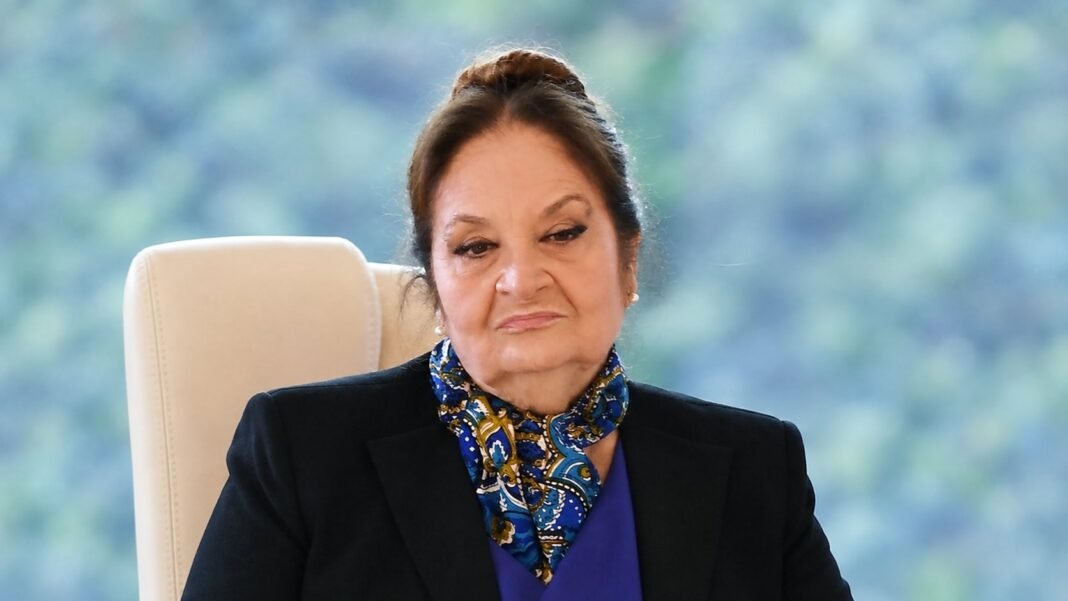
The Union of Cinematographers of Azerbaijan has again elected 81-year-old People’s Artist Shafiqa Mammadova as its chair during a conference held at Baku’s Nizami Cinema Center.
The procedure may have been completed, but the central question remains unanswered: Why, amid a prolonged crisis in Azerbaijani cinema, has the industry’s leading professional organization once again turned to a figure representing the old establishment?
Mammadova’s contribution to Azerbaijani culture is beyond dispute. But distinguished titles, a long acting career and public recognition do not automatically amount to a program for developing an entire industry.
Azerbaijani cinema does not merely need a respected symbolic figure. It needs leadership capable of securing financing, supporting young directors and screenwriters, building international co-productions, placing films on global streaming platforms and explaining transparently how resources are distributed.
An Election Without a Choice
Mammadova was the only candidate nominated by the union’s board at its Aug. 28 meeting.
The Independent Cinema Platform had demanded that an alternative candidate, People’s Artist and professor Hamida Omarova, be placed on the agenda. However, APA reported that Omarova did not formally nominate herself at the conference.
As a result, the election proceeded without genuine competition.
That is more troubling than the new chair’s age. If the country’s principal filmmakers’ association cannot offer several candidates, competing programs and an open debate over its future, the word “election” becomes little more than a formality.
This is Mammadova’s second term as head of the organization. She previously served from December 2022 to March 2024. The public therefore has every right to ask what reforms were launched during her first tenure, what measurable results were achieved and why she is now considered the best person to lead the union out of crisis.
No convincing answers have yet been offered.
Azerbaijan’s Culture of Lifelong Leadership
The problem extends far beyond the film industry.
Azerbaijan has long maintained a culture in which senior officials and cultural figures remain in leadership positions for decades. Posts at academies, creative unions, state institutions and even parliament are often treated almost as lifetime appointments.
Anar, the 88-year-old chairman of the Writers’ Union of Azerbaijan, is another prominent example. His literary achievements are unquestionable. But why are the country’s largest cultural institutions seemingly unable to prepare a new generation of leaders?
If an organization remains dependent on one individual for decades, that is not necessarily evidence of stability. It may instead reveal institutional weakness.
A genuine leader must do more than retain a position. Leadership also means preparing successors, creating space for competition and knowing when to transfer responsibility.
Age alone should never be grounds for exclusion. Youth does not guarantee talent, integrity or management skills. Yet when an elderly figure who has already led an organization is returned to the same position without a competitive process, the public is entitled to question whether any real renewal is intended.
That question is especially relevant in cinema – an industry shaped by new ideas, technologies, audiences and forms of storytelling.
A Union Trapped in Crisis
The latest election followed months of uncertainty within the organization.
The crisis began after the death of union chairman and People’s Artist Rasim Balayev in March 2026. Ali Isa Jabbarov was elected chairman in May, but the result was never legally formalized.
A new conference has now been held, yet instead of an open contest between different programs, the union was again presented with a single candidate.
This sequence of events does little to restore confidence. It creates the impression of a struggle over a position at a time when the public expects a struggle for the future of Azerbaijani cinema.
Where Is the New Azerbaijani Cinema?
Azerbaijani audiences have the right to expect national films in the competitive programs of Cannes, Berlin and Venice, on major streaming platforms and in international distribution.
Achieving that goal requires new directors, ambitious screenplays, independent producers, transparent funding competitions and access to international markets.
The union should present a measurable plan: How many young filmmakers will it support? What international partnerships will it pursue? How will it attract private investment? Who will decide which projects receive assistance?
Institutional reform is also overdue. Chairmanships should have term limits. Candidates should be nominated openly and required to publish their programs. Financial reports should be accessible, and younger filmmakers should receive genuine voting power within the organization’s governing bodies.
Azerbaijani cinema must not become a museum of past achievements. Honoring veteran artists is necessary, but turning professional unions into institutions of lifelong prestige closes the door to the next generation.
The decisive question is not whether an 81-year-old can lead an organization. It is why a country with thousands of educated, ambitious and creative young people repeatedly fails to produce new leaders for its cultural institutions.
Until that question is answered, the latest election will be seen not as the beginning of reform, but as another victory of the past over the future.
AZE.US