AZE.US
The military campaign against Iran failed to remove the government in Tehran, while the resulting regional realignment has created new diplomatic and economic opportunities for Azerbaijan, according to Middle East expert Ruslan Suleymanov.
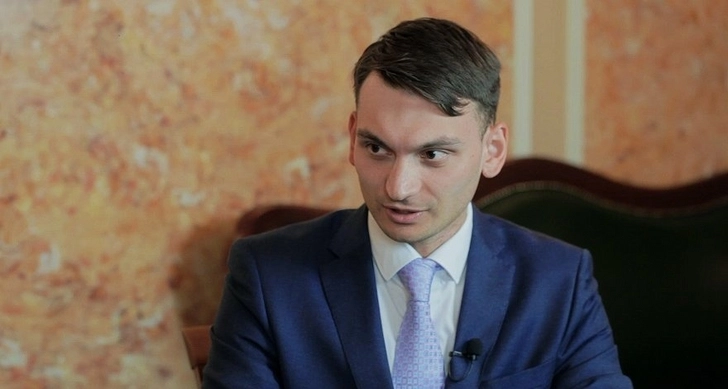
Suleymanov, an expert at the NEST International Center, made the assessment in an interview with journalist Rasim Babayev’s YouTube channel, “Modern Conversation.”
The interview covered the conflict involving Iran, the changing security architecture in the Persian Gulf, developments in Afghanistan and Syria, and Azerbaijan’s growing presence across the broader region.
Iran’s Government Survived and Became More Repressive
Suleymanov said the confrontation between Washington and Tehran had reached a deadlock and failed to produce the outcome initially expected by the United States.
Iran’s ruling system survived the military pressure and became more repressive and radicalized, he said.
“The government in Tehran survived. It did not merely survive - it became stronger, harsher and more radical,” Suleymanov said.
Many senior Iranian officials lived through the eight-year Iran-Iraq War and are prepared for a prolonged conflict of attrition, according to the analyst.
Military strikes have not forced Tehran to change its negotiating position, while additional sanctions are producing limited results because Iran has operated under various restrictions for more than four decades.
Suleymanov said Washington now faces two broad options: continue applying military and economic pressure or return to negotiations and accept mutual concessions.
He argued that the U.S. president would seek an agreement presented as stronger than the 2015 nuclear deal reached under Barack Obama. The sides, however, remain far from such a compromise.
Repression Grows, but Opposition Lacks a Leader
Iranian society remains deeply divided, Suleymanov said.
The government retains committed supporters, particularly among religious communities, public officials and families linked to state institutions. At the same time, a large section of society opposes the political system.
Some Iranians want reforms within the existing framework, while others demand a complete change of government. Another group favors restoring the monarchy under the Pahlavi dynasty.
However, Iran’s protest movement still lacks a unified political leader and an agreed alternative program. Economic hardship alone is therefore unlikely to produce a rapid change of government, Suleymanov argued.
He also said that prolonged foreign attacks weakened support for the war even among some of the Iranian government’s most determined domestic opponents.
Strait of Hormuz Becomes Tehran’s Main Leverage
Suleymanov identified the Strait of Hormuz as one of the most important strategic consequences of the conflict.
Before the war, Iran primarily threatened to restrict shipping through the waterway. Its ability to disrupt oil and gas transportation has now become a permanent factor affecting the global economy, he said.
The strait may offer Tehran more leverage than its regional proxy forces.
“Iranian authorities realized they have a more effective instrument than their proxies: the Strait of Hormuz,” Suleymanov said. “It allows them to influence not only the United States but the entire global economy.”
Iran-aligned groups have not disappeared, he added. Hezbollah remains active in Lebanon, while the Houthis in Yemen retain the ability to threaten Red Sea shipping and launch attacks across the region.
Nevertheless, the Strait of Hormuz is becoming the central element of Iran’s deterrence strategy.
Gulf States No Longer Rely Exclusively on Washington
The conflict has also changed how Gulf Arab states approach their security.
The United States is no longer viewed as an unconditional guarantor of the Gulf monarchies, although American forces remain in the region, Suleymanov said.
Saudi Arabia is expanding cooperation with Turkey and Pakistan, including consultations and intelligence exchanges. The United Arab Emirates, meanwhile, has developed a close partnership with Israel.
These relationships point to the gradual emergence of regional security arrangements that do not depend exclusively on Washington.
According to Suleymanov, such partnerships do not necessarily increase the risk of war. They could instead serve as a deterrent to Iran, Israel and the United States, as regional governments seek to prevent any single power from dominating the Middle East.
Afghanistan: Less Opium, but Deeper Poverty
Suleymanov also discussed his recent visit to Afghanistan.
Five years after returning to power, the Taliban has consolidated its authority, while the activity of terrorist groups - particularly the Afghan branch of ISIS - has been reduced, although isolated threats remain.
One of the most significant changes has been the campaign against narcotics production. Citing United Nations data, Suleymanov said the area used for opium poppy cultivation had fallen by approximately 95%.
Kabul has become safer, and people suffering from severe drug addiction have largely disappeared from the streets after being transferred to rehabilitation facilities.
The humanitarian situation, however, continues to deteriorate.
Annual foreign assistance has fallen from more than $4 billion in 2021 to slightly above $1 billion. At the same time, around 4 million Afghan refugees have been forced to return from Iran and Pakistan.
That influx increased Afghanistan’s population by roughly 10% and placed additional pressure on the economy and major cities.
Afghan Currency Strengthened Nearly 30%
Despite international isolation and sanctions, Afghanistan’s economy has not completely collapsed.
Suleymanov partly attributed that resilience to the Taliban’s decision to retain many officials from the previous government, particularly economic and financial specialists. Some were educated at U.S. universities.
Taliban representatives took senior leadership positions, but experienced civil servants continue handling much of the government’s daily economic work.
Afghanistan’s national currency has strengthened substantially. One U.S. dollar traded at around 100 afghanis or more in late 2021, compared with approximately 65 afghanis now, according to figures cited in the interview.
The stronger currency has not translated into prosperity for most Afghans. Poverty remains widespread, and the country’s social and economic problems continue to deepen.
Azerbaijan’s ASAN Service Model Expands in Kabul
Suleymanov described the Afghan public-service system modeled on Azerbaijan’s ASAN Service as one of the most successful examples of cooperation between Baku and Kabul.
The project was launched before the Taliban returned to power and continued operating under the new government.
“Three years ago, it occupied a relatively small building. Now it has become an entire complex,” Suleymanov said. “Afghans actively use it to pay taxes and obtain official documents.”
The Azerbaijani model was designed to provide multiple government services through a centralized, transparent and accessible system.
Afghan officials also value Baku’s decision to establish a diplomatic presence in the country. Azerbaijan has not formally recognized the Islamic Emirate, but its embassy has operated in Kabul since February 2024.
According to Suleymanov, Afghan authorities see the embassy as evidence that Azerbaijan is prepared to build practical relations under the country’s new political reality.
Azerbaijani Communities in Afghanistan Are Losing Their Language
A central goal of Suleymanov’s visit was to study ethnic Azerbaijani communities in Afghanistan, including the Qizilbash, Afshars and Marvis.
Their most urgent problem is the gradual loss of Azerbaijani identity and language, he said.
Some communities continue preserving their heritage. Afshars live in Kabul, while the Marvi community is concentrated in Herat.
Azerbaijan’s embassy has supported Azerbaijani-language courses by providing books, textbooks and technical equipment.
Other Turkic groups with historical Azerbaijani connections - including Bayats, Seljuks and Qajars - have largely assimilated and now speak local languages such as Dari and Pashto.
“They still feel a historical connection with Azerbaijan,” Suleymanov said. “Speaking with them in Azerbaijani felt like direct contact with history.”
He expressed hope that language and cultural programs would be expanded beyond Kabul, particularly for the Marvi community in Herat.
Azerbaijani Gas Strengthens Ties With Syria
The interview also focused on Azerbaijan’s growing relationship with Syria.
Baku has reopened its embassy in Damascus, while contacts and official visits between the two governments have increased.
Azerbaijani natural gas supplied through Turkey has become an important element in the relationship, particularly as Syria struggles with energy shortages and extensive wartime destruction.
Suleymanov said Syrians appreciated Azerbaijan’s assistance, although Baku’s influence could not yet be compared with that of Turkey, which maintains a much larger political, economic and security presence.
Azerbaijan nevertheless has substantial opportunities to expand its role in Syria through energy cooperation, reconstruction and diplomacy.
Baku Could Become a Regional Mediator
Suleymanov identified mediation as one of Azerbaijan’s most promising roles in the Middle East.
Baku has already hosted contacts between Syrian and Israeli representatives. If that process continues, Azerbaijan could strengthen its position as a regional diplomatic intermediary.
“Azerbaijan has established a strong foundation for becoming a regional mediator,” he said.
The authorities in Damascus are not prepared for an open military confrontation with Israel and are attempting to address security disputes through negotiations.
Syria is simultaneously maintaining relations with Turkey, the United States and Russia, using the competing interests of outside powers to stabilize the new government.
Azerbaijan’s energy projects, diplomatic presence and ability to maintain working relations with opposing sides could allow Baku to expand its political influence well beyond the South Caucasus, Suleymanov concluded.
AZE.US