By AZE.US Editorial Team
Vladimir Putin went to Beijing for more than another round of protocol. He went for a picture the Kremlin badly needed: Russia not isolated, Russia not cornered, Russia still seated beside one of the world’s most powerful leaders.
He got the picture.
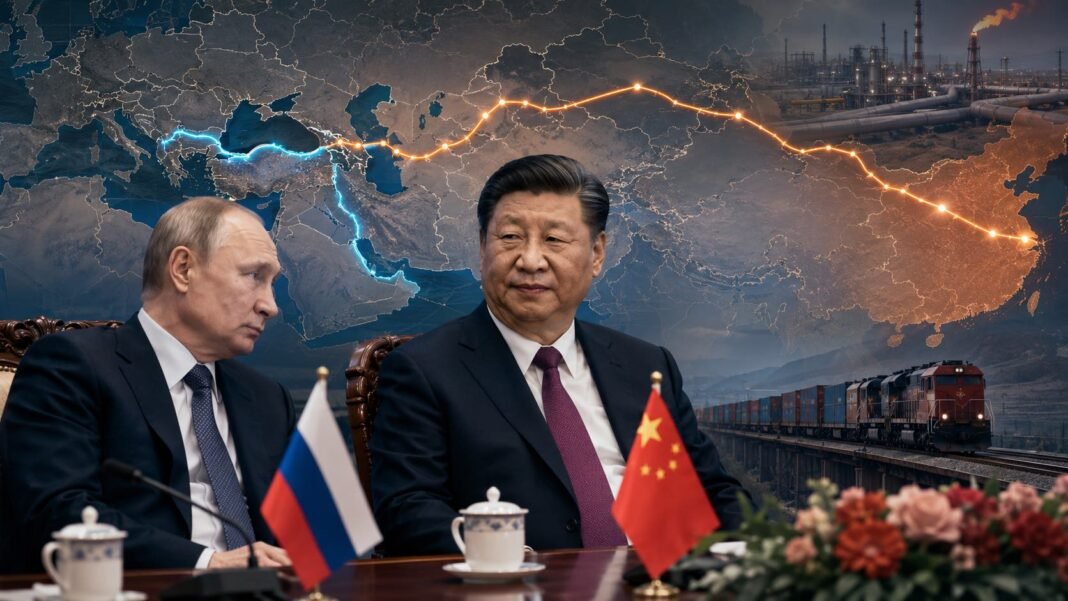
There was the familiar choreography of high diplomacy: honor guards, warm statements, strategic language, criticism of U.S. policy and declarations about a changing world order. Chinese President Xi Jinping hosted Putin only days after receiving U.S. President Donald Trump, giving Beijing the chance to show that both Washington and Moscow now come to China’s door. AP described the closely timed visits as a sign of China’s different but simultaneous approaches to the United States and Russia, with Putin’s trip producing more than 40 agreements but no final breakthrough on the long-discussed Power of Siberia 2 pipeline.
That missing pipeline deal was the real story.
For Moscow, Power of Siberia 2 is not just another energy project. It is supposed to carry Russian gas to China through Mongolia and help compensate for the European market Russia has largely lost since the invasion of Ukraine.
The existing Power of Siberia route already sends more than 38 billion cubic meters of gas a year from eastern Siberia to China, while the proposed second route could bring another major flow from Russia’s northern gas heartland. Reuters reported that the Kremlin spoke of a general understanding on the project, but key details and a timetable remain unresolved.
In diplomatic language, “understanding” can sound elegant. In energy markets, it often means the cheque has not been signed.
That is why Putin’s China visit should not be read only through the official language of partnership. It should be read through what did not happen. Beijing embraced Moscow politically, but it did not hand Russia the gas agreement it has been chasing for years.
The difference matters.
Putin needed the visit to show strength. Xi needed it to show centrality. Putin wanted to prove that Russia still has a great-power partner. Xi showed that China is the place where both partners and rivals now come to negotiate. One leader was looking for strategic oxygen. The other was displaying strategic altitude.
Russia is useful to China. It provides energy, diplomatic weight, military pressure on the West and a permanent seat at the U.N. Security Council. It forces Washington to divide its attention. But usefulness is not equality. China can value Russia without paying Russia’s preferred price.
That is the quiet hierarchy behind the smiles.
Beijing wants Russian gas, but not on Moscow’s emotional schedule. It wants routes, discounts, leverage and optionality. China has other suppliers, liquefied natural gas markets, Central Asian flows and the patience to negotiate. Russia, by contrast, needs a long-term Asian buyer far more urgently than China needs a new Russian pipeline tomorrow.
The market seemed to understand this faster than the political language did. Reuters reported that Gazprom shares continued to fall after the company’s decision not to pay dividends and the failure to secure a Power of Siberia 2 deal during Putin’s Beijing visit. The reaction was not about symbolism. Investors were looking for numbers, timelines and contracts. They received another cloud of uncertainty.
For the West, the visit still carries an uncomfortable message. Sanctions have not turned Russia into a lonely island. Moscow still has access to China, and the Russia-China relationship remains one of the central geopolitical facts of the decade.
But for Moscow, the picture is not as triumphant as the Kremlin would like. The deeper Russia moves into China’s orbit, the more visible the imbalance becomes. Europe was a rich and difficult customer. China is a powerful and patient one. Europe argued. China calculates.
For the South Caucasus, the meaning lies not in the ceremonial language from Beijing, but in the map behind it.
If Russia’s traditional energy and transport routes remain politically toxic, the search for alternatives becomes more serious. China does not want to depend on one corridor, one supplier, one sea route or one geopolitical risk. It wants options.
That is where the Middle Corridor, running from Central Asia across the Caspian Sea through Azerbaijan, Georgia and Türkiye toward Europe, gains more strategic weight.
Azerbaijan is not the main actor in Putin’s talks with Xi. But it sits on one of the routes that becomes more important when old routes become too expensive, too sanctioned or too exposed. In the new geography of trade, being a corridor is not a secondary role. It is a form of power.
Baku should read the Beijing visit with cold eyes. Russia did not disappear. China did not abandon Russia. The anti-Western tone between Moscow and Beijing remains strong. But the visit also showed that China is not simply underwriting Russian ambition. It is bargaining with it.
That gives smaller but strategically placed states room to maneuver.
Azerbaijan’s advantage is not to shout about a new world order. It is to make itself useful in the parts of that order where cargo, energy, ports, railways, customs, insurance and political predictability matter. The more great powers argue over routes, the more valuable stable geography becomes.
Putin left Beijing with the optics of partnership. Xi kept the stronger hand. The gas contract stayed for later.
And sometimes in geopolitics, the agreement that is not signed says more than all the statements that are.
AZE.US