By AZE.US Editorial Team
Nikol Pashinyan’s election victory has revived a tempting headline: Armenia is leaving Russia and moving toward the West.
That sounds clean. It is also too simple.
What is happening in Armenia is not a clean break with Moscow. It is a slower, more complicated attempt to reduce strategic dependence without triggering a full-scale rupture. This is not a divorce yet. It is a negotiation over the terms of dependence.
And that negotiation is only beginning.
During the campaign, Russia applied pressure and Europe offered support. Moscow signaled consequences. Brussels sent political encouragement and financial gestures. Pashinyan turned that external tension into an argument for Armenian voters: the old system had failed, and Armenia needed more room to maneuver.
But election campaigns end. Geography does not.
Now both sides will ask harder questions.
The West will want to know whether Armenia’s European rhetoric is serious. Is Yerevan ready to change institutions, standards, security habits and economic rules, or does it only want Western political cover?
Russia’s question will be blunter: what happens to our base, our treaties, our companies, our railway, our gas and our role inside Armenia?
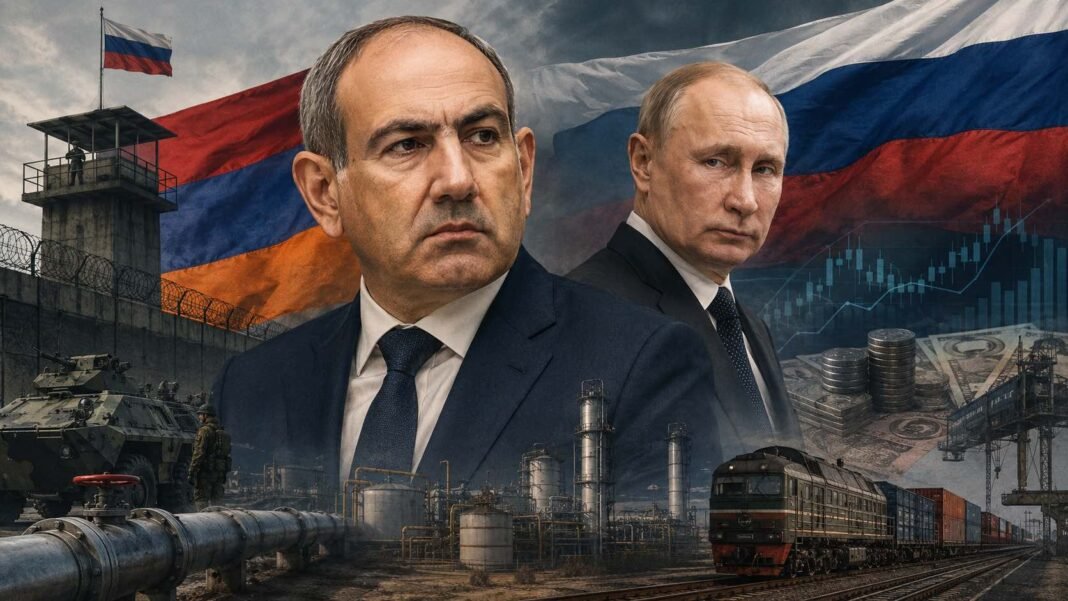
That is the part often missed in outside commentary. Russia’s presence in Armenia is not just sentimental. It is not only Soviet memory, Orthodox symbolism or old military language. It is infrastructure.
It is a military base. It is gas. It is the railway. It is large assets owned or controlled by Russian state-linked companies. It is the Eurasian Economic Union. It is the CSTO, even if Armenia has frozen its practical participation and openly distanced itself from the alliance.
So the phrase “Armenia is leaving Russia” is not yet accurate.
A better formulation is this: Armenia is trying to become a country that has options.
Pashinyan, for all his sharp rhetoric, is acting more pragmatically than dramatically. He is not announcing an immediate break with Moscow. He is not entering the European Union tomorrow. He is trying to widen Armenia’s bargaining space.
That means the real road for Armenia does not run only through Brussels.
It runs through the region.
If Armenia wants to escape its historic dependency, it must do more than criticize Russia. It must open communications with Türkiye and Azerbaijan, diversify its economy, regain more control over critical infrastructure and accept the new balance of power in the South Caucasus.
That is what Moscow fears more than speeches about democracy.
Russia can tolerate Armenian talk about Europe. It can complain about NATO contacts. It can bargain over the CSTO and the Eurasian Economic Union. But if Armenia begins to integrate economically into the region through Türkiye and Azerbaijan, the old machinery of dependency starts to weaken.
Not immediately. But seriously.
At the same time, Moscow’s pressure tools are not as unlimited as they look. Gas threats sound powerful, but the region has alternatives. Pressure on Armenian labor migrants in Russia is also not a magic button. Harsh moves would hurt Armenia, but they would also disturb networks inside Russia itself, where Armenian business and social ties have long been embedded.
Russia can create problems for Yerevan. But it cannot easily restore the old Armenia by decree.
That is why Moscow will not only threaten. It will bargain.
There are plenty of issues on the table. Who will build or modernize Armenia’s nuclear power capacity, Russia or the United States? What happens to the railway concession? What price will Armenia pay for gas? Can Yerevan move closer to Europe while remaining tied to Eurasian structures?
These are not symbolic questions. They are measured in billions, contracts and control.
Europe, too, has limits. Armenia is not a heavy financial burden for the West compared with Ukraine. A support package of 50 million euros is useful as a signal, but it does not transform the Armenian economy. It is political encouragement, not a new economic model.
And Armenia is not Ukraine. Its geography is more constrained. It cannot reach Europe by jumping over the South Caucasus. Without normalization with its neighbors, the European track remains more slogan than road.
That is why the outcome of Armenia’s election matters to Baku.
If Pashinyan uses his victory to move toward a real peace agreement, open communications and abandon revanchist illusions, Armenia may gain something it has rarely had in practice: sovereignty backed by economics, not just speeches.
But if Yerevan again tries to take money from the West, discounts from Russia and avoid hard decisions with Azerbaijan, it will stay inside the same trap. Only the sign above the trap will look more European.
Historic vassal thinking is not broken by declarations. It is broken when a state stops living on other people’s guarantees and starts paying the price for its own decisions.
Pashinyan now has a window of opportunity.
But a window is not a door.
It lets you see a new path. Walking through it is much harder.
AZE.US