By AZE.US Editorial Team
Car ownership in Azerbaijan is again moving closer to a luxury purchase, as average prices rise and buyers increasingly rely on loans to enter the market.
According to the Azerbaijan Appraisers Chamber, the average market price of a car in the country reached 30,480 manats in April. That was 9.2% higher than in December 2025 and 1.9% above March. The overall trading activity index also increased, reaching 110.5 points in April.
The price pressure is not limited to premium cars. The chamber said SUVs and crossovers recorded one of the strongest increases, with their average market value reaching 39,100 manats, up 11.1% from December. Economy-class cars rose by 10%, middle-class cars by 7.6%, and premium vehicles by 4.1%.
For ordinary buyers, this means the market has become heavier even before they reach the luxury segment. A car that looked affordable a few months ago may now require either a larger upfront payment, a longer loan or a compromise on age, mileage and condition.
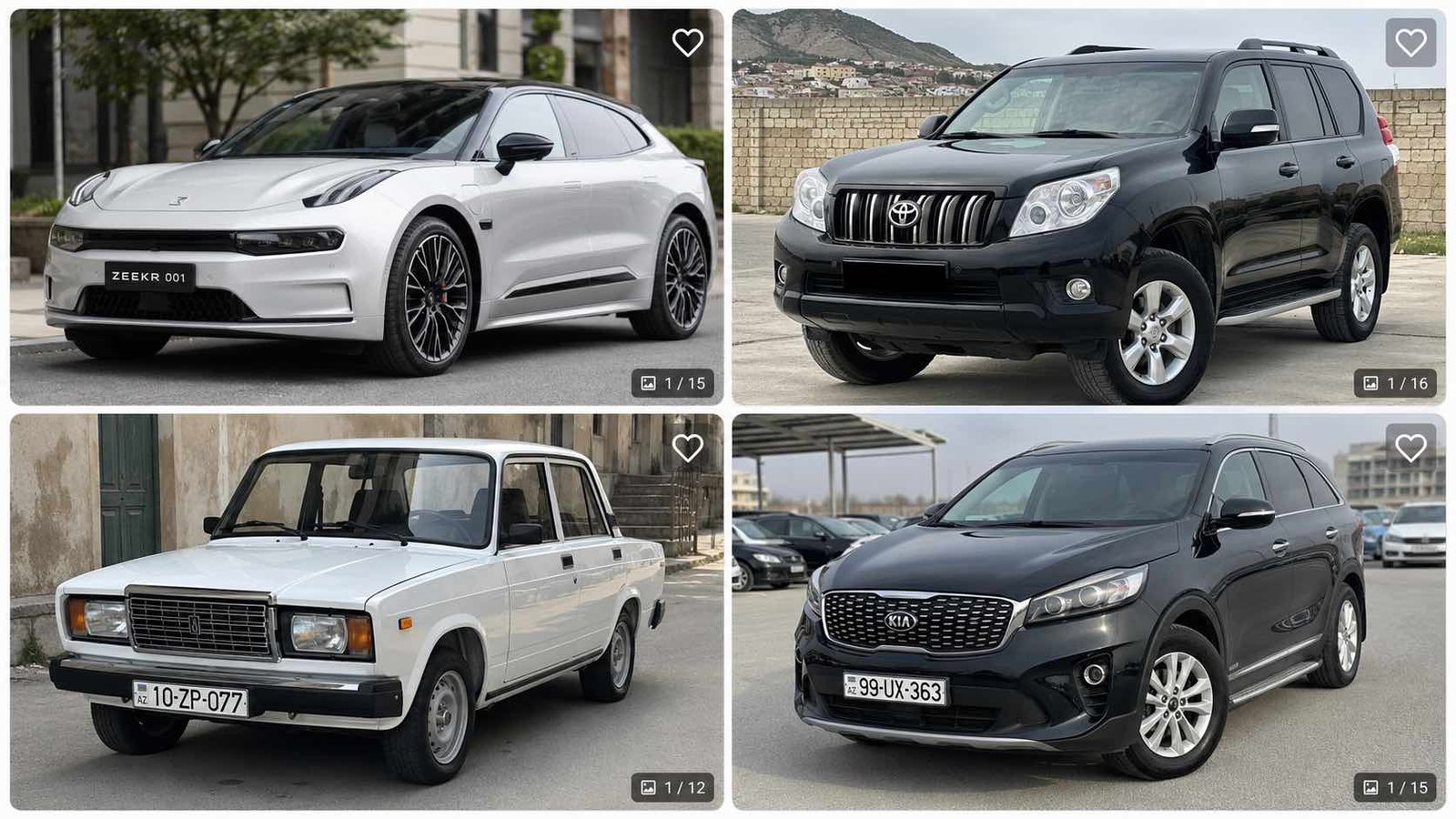
Vesti Baku reviewed current listings for several popular and symbolic models, including Toyota Prius, ZEEKR, LADA 2107, Kia Sorento and Toyota Land Cruiser Prado. These listings do not show final transaction prices, but they do show the numbers buyers see when they begin searching.
The picture is uneven. Older mass-market models still form the lower end of the market, but even there prices remain meaningful for family budgets. At the other end, Chinese electric and hybrid vehicles such as ZEEKR are no longer seen simply as “cheap Chinese cars.” They increasingly sit in a higher price category and help push the visible upper range of the market higher.
That shift is part of a broader change in Azerbaijan’s car imports. In 2025, the country imported 123,319 vehicles worth $2.4 billion, a rise of 34.3% in volume and 29.4% in value compared with 2024, according to customs data cited by Report. Passenger car imports alone reached 113,840 units, worth $2.1 billion.
Hybrid imports also surged. Azerbaijan imported 73,678 hybrid vehicles in 2025, worth $1.428 billion. China accounted for 62,488 of those hybrids, a 4.8-fold increase from the previous year.
But the live market is more complicated than the import numbers suggest. Sellers say some buyers who rushed into Chinese cars are now reconsidering. According to comments from the market, part of the demand is shifting back toward German and European brands after some buyers found that certain Chinese models did not fully meet their expectations.
At the same time, sellers say the strongest demand remains around familiar brands, especially Hyundai and Kia. Mercedes still attracts interest in some segments, while demand for several other models, including Ford Fusion, is described as weaker.
The market is not booming, however. Sellers describe demand as sluggish. Warmer weather has not produced a clear rush of buyers. Cars are available, but buyers are more cautious, more selective and more aggressive in bargaining.
One seller described the logic simply: if a car is normally offered for about 35,000 manats, a real buyer may appear when the seller is ready to accept 30,000 manats. In other words, cars are still selling, but only when the price looks convincing.
Buyers are also paying more attention to condition. According to sellers, cars with air conditioning, a sunroof, solid working condition and a production year of 2015 or newer are more likely to attract interest. For many buyers, the priority is not simply the cheapest car, but a car that will not immediately require additional repairs.
The lower and middle segments remain especially sensitive. Sellers say cars priced up to roughly 15,000-19,000 manats attract more attention, while more expensive vehicles move more slowly unless they are highly liquid models or offered with a visible discount.
Credit is another sign of pressure. The Azerbaijan Appraisers Chamber said the share of car sales made through loans rose to 48% in April, up 8 percentage points from December and 1 point from March.
That means the market is not only becoming more expensive. It is also becoming more debt-driven. Nearly every second car sale now involves a loan mechanism, meaning the real cost for many buyers may be higher than the listed price once interest and repayment terms are included.
The structure of demand is changing as well. Used cars accounted for 72% of the market in April, while new cars made up 28%. The share of hybrid and electric vehicles rose from 5% in December to 9.5% in April, while diesel vehicles declined from 19% to 16%.
This creates the main paradox of Azerbaijan’s car market: prices are rising even as sellers complain about weak demand. The explanation is not a simple buying frenzy. It is a mix of import structure, demand for liquid models, the growth of hybrid and electric vehicles, and sellers’ reluctance to sharply lower expectations.
For buyers, the result is less comfortable. A reliable car with a known brand, good condition and a clean history is not getting cheaper. Even in a slow market, such vehicles remain expensive.
That is why the phrase “a car is becoming a luxury again” no longer sounds exaggerated in Azerbaijan. For many families, buying a car is increasingly becoming one of the largest financial decisions after housing.
AZE.US