AZE.US
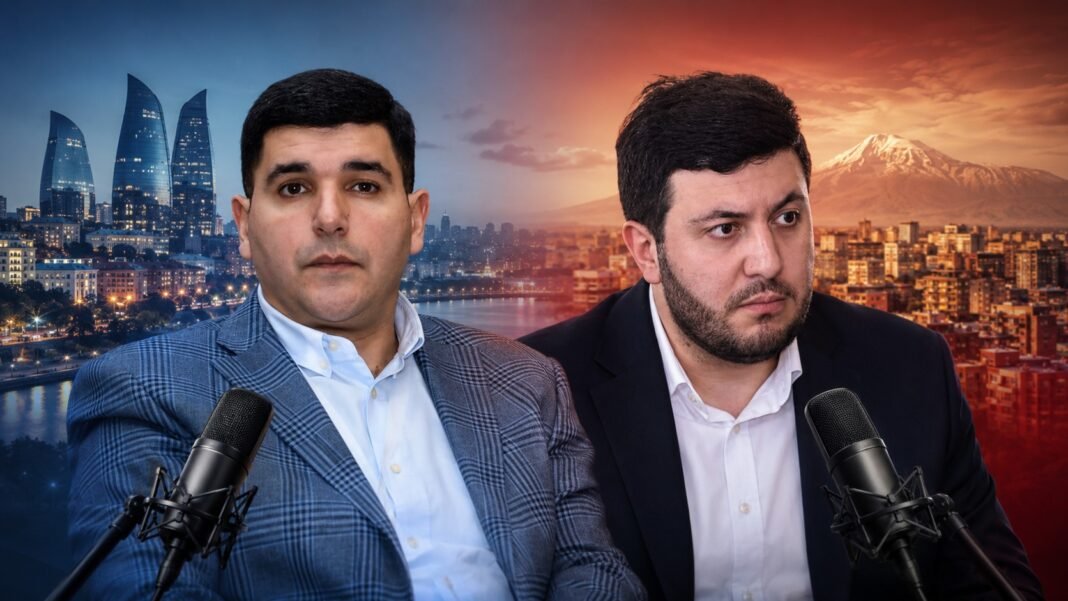
In a new episode of the “Events of the Week” program on Press Club TV, experts Farhad Mammadov from Baku and Areg Kochinyan from Yerevan discussed the key developments in the South Caucasus, including the post-election situation in Armenia, the peace process, economic diversification, and the role of external powers.
Kochinyan said Armenia’s opposition is not seeking a recount of the election results, but rather their annulment and a new vote. However, he noted that the opposition currently lacks the resources to seriously destabilize the situation.
“The opposition appeals to Russia, and Russia appeals to the opposition,” Kochinyan said, adding that Moscow is effectively questioning the legitimacy of Armenia’s new authorities.
Commenting on the influence of external forces on the Armenian-Azerbaijani peace process, Farhad Mammadov said the peace agenda is being shaped by the governments of Azerbaijan and Armenia, while certain circles in the north, south and west oppose parts of it.
According to him, both countries currently have legitimate governments that support the peace agenda, meaning the process will continue, although its pace may vary.
“The main thing is that the two countries, the two governments, have managed to form this peace agenda and keep it within a constructive framework,” Mammadov said.
He stressed that the activity of some lobbying groups abroad may create additional obstacles. As an example, Mammadov pointed to initiatives in the U.S. Congress that are perceived in Baku as attempts to pressure Azerbaijan.
The experts also discussed economic contacts and the opening of communications. Mammadov said economic interaction between Azerbaijan and Armenia is already developing where practical opportunities exist.
According to him, the focus is likely to be on industrial goods, fuel and lubricants, and raw materials rather than consumer products. He suggested that new items could appear in bilateral trade by the end of the year.
“It will be very interesting to see whether we can reach, for example, $50 million in trade turnover,” Mammadov said.
Kochinyan, for his part, noted that after the elections, Prime Minister Nikol Pashinyan continues the same line on Armenian-Azerbaijani normalization that he promoted during the campaign. He said Armenian society understood these messages and voted for Pashinyan with them in mind.
Speaking about the meeting between Armen Grigoryan and Hikmet Hajiyev, Kochinyan said it was significant that the first high-ranking foreign official to visit Armenia after the elections was a representative of Azerbaijan.
He said the normalization process now includes not three, but five tracks: delimitation and demarcation, the opening of communications, a peace treaty, economic cooperation, and contacts between societies, experts and media representatives.
Mammadov also commented on possible mutual participation in major international events, including the European Political Community summit in Baku and climate-related events in Armenia. He said participation in each other’s international forums is part of the logic of peaceful coexistence.
In the final part of the program, the experts discussed the Turkish factor. Kochinyan said normalization with Turkey is perceived more calmly in Armenia than the Armenian-Azerbaijani track, because emotions around relations with Azerbaijan remain more recent.
Mammadov, speaking about the roles of Ankara and Moscow, said the peace process increases the sovereignty of the countries in the region.
“No matter how strong the allied relations between Turkey and Azerbaijan are, Ankara cannot make decisions instead of us,” he said.
According to Mammadov, Russia has been gradually losing its former positions in the region since 2020, while its pressure on Armenia is linked in part to the desire to preserve strategic assets and influence.
He concluded that transformations in the South Caucasus will continue, and external actors will have to adapt to the new regional reality.
AZE.US