AZE.US
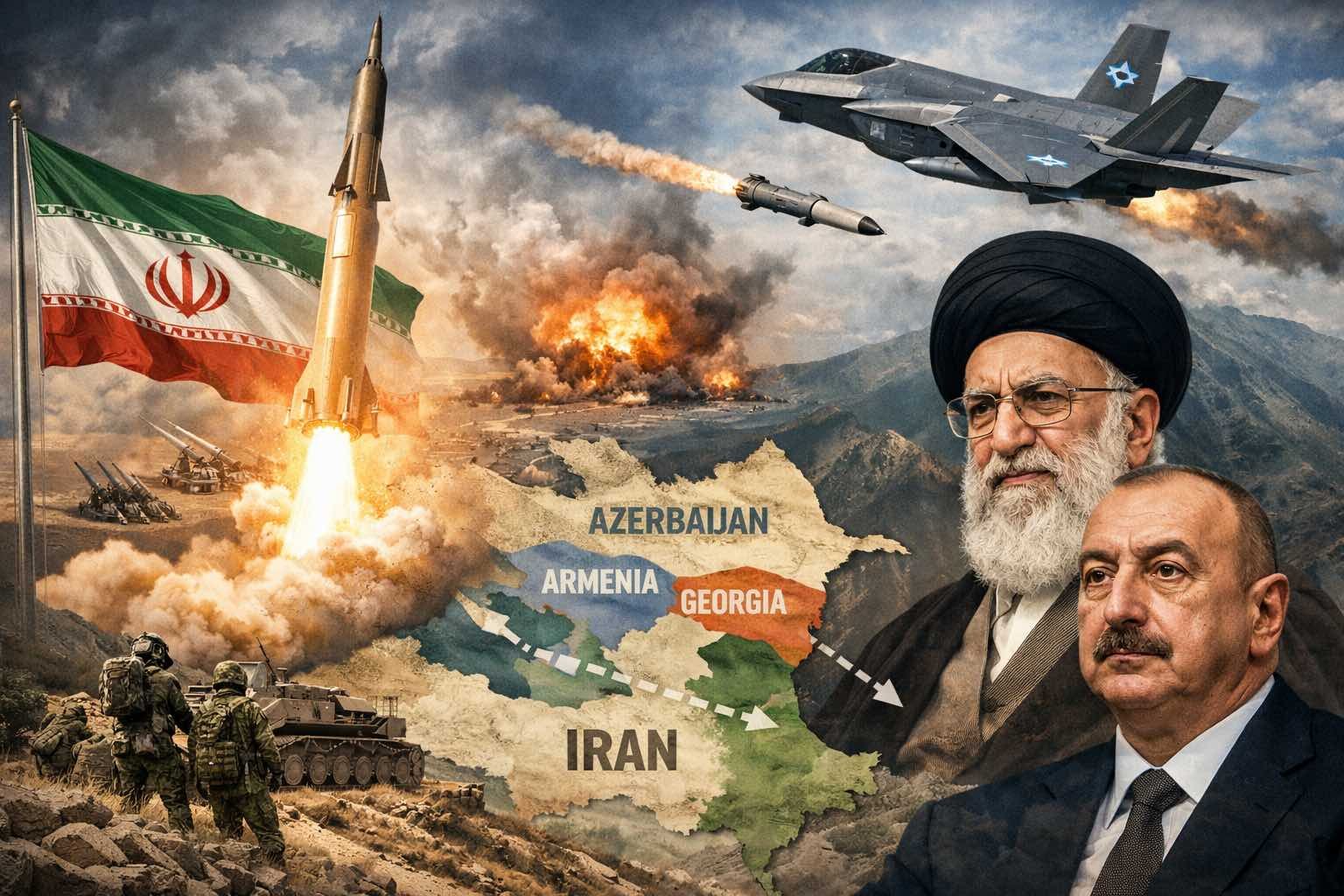
The military operation launched by the United States and Israel against Iran has triggered not only security concerns in the Persian Gulf, but also strategic reassessments across neighboring regions. For the South Caucasus – situated directly north of Iran – the stakes are tangible.
Experts generally outline four main scenarios for how events inside Iran could unfold. Each would produce a different risk profile for Azerbaijan, Armenia and Georgia.
1. Hardline Consolidation
One possibility is the consolidation of power by hardline elements, particularly within the Islamic Revolutionary Guard Corps (IRGC). Under this scenario, Iran could become more securitized, more ideologically rigid and more isolated.
For the South Caucasus, this would likely mean:
-
increased military signaling near northern borders;
-
heightened rhetoric toward regional governments;
-
greater unpredictability in cross-border security dynamics.
However, a consolidated hardline structure could also prioritize internal stability over external escalation, limiting direct spillover.
2. Reformist Rebalancing
A second scenario envisions reform-oriented political forces gaining greater influence, seeking economic stabilization and recalibrated relations with Western and regional actors.
This would likely reduce tensions in the near term and create space for pragmatic engagement with neighboring states. Azerbaijan, in particular, would benefit from a stable and economically focused Iran, especially in trade, transit and border management.
3. Regime Transition
A broader political transformation – whether gradual or abrupt – would introduce significant short-term uncertainty. The absence of a clearly recognized alternative leadership structure raises the risk of institutional fragmentation.
For the South Caucasus, the key question would be continuity:
-
Would existing transport and energy agreements remain intact?
-
Would border security mechanisms hold?
-
How would Tehran’s regional posture shift during transition?
Uncertainty alone could temporarily disrupt infrastructure corridors and investor confidence.
4. Internal Destabilization
The most disruptive scenario involves internal fragmentation or prolonged instability. This would carry the highest risk of spillover effects:
-
refugee flows toward neighboring states;
-
non-state armed actors operating near borders;
-
disruption of trade routes and transit corridors.
For Azerbaijan, which shares a long land border with Iran, stability in adjacent Iranian provinces would be essential to prevent security or humanitarian pressure.
Strategic Calculus In Baku
So far, Azerbaijan has maintained a cautious and restrained diplomatic posture, emphasizing regional stability and non-interference. This approach reflects a clear priority: preventing escalation from turning its southern border into a zone of volatility.
At the same time, Tehran appears increasingly preoccupied with internal developments, limiting its capacity to project influence northward. That dynamic may reduce short-term pressure on the South Caucasus, even as long-term uncertainty remains.
A Region Watching Closely
The South Caucasus has already undergone major geopolitical shifts in recent years. A destabilized Iran would introduce an additional variable into an already sensitive security architecture.
For now, the dominant priority for regional governments is straightforward: contain risks, preserve border stability and avoid entanglement in a broader confrontation.
How Iran’s internal trajectory evolves will determine whether the South Caucasus faces manageable turbulence – or a new phase of strategic strain.