AZE.US
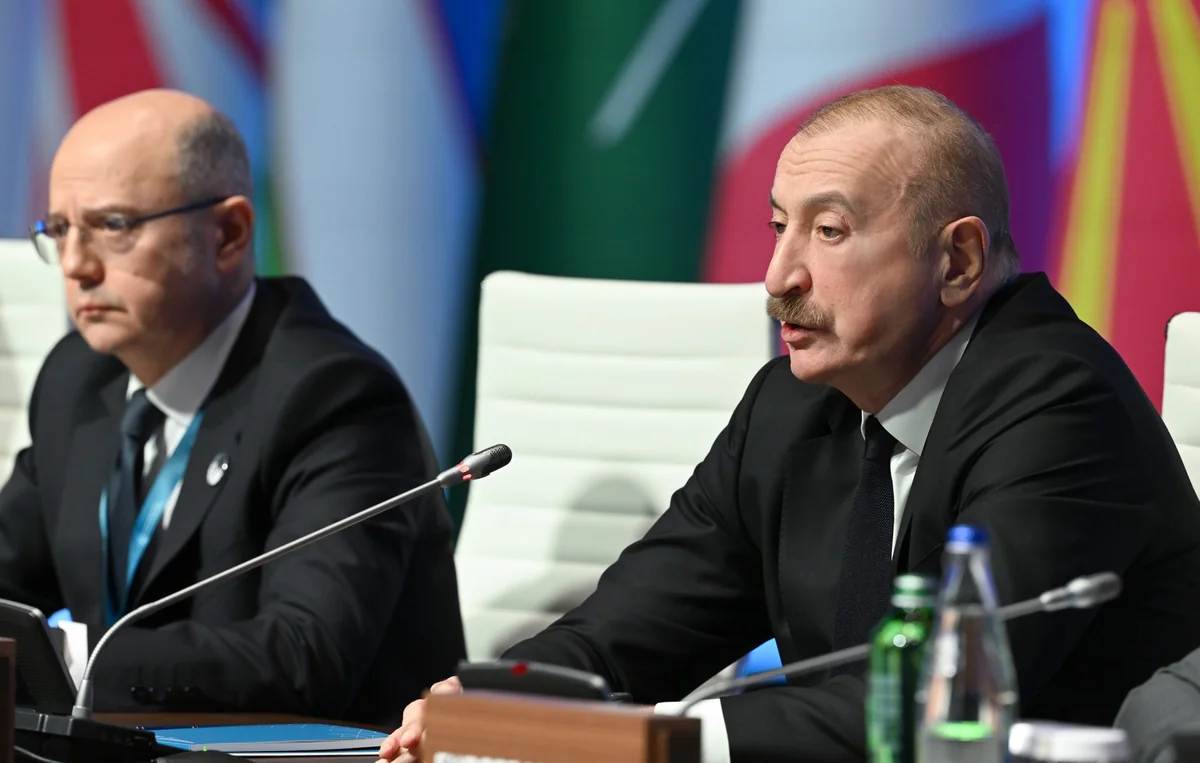
Azerbaijan signaled a new phase in its energy strategy on Tuesday as officials gathered in Baku for the 12th Ministerial Meeting of the Southern Gas Corridor Advisory Council and the 4th Ministerial Meeting on Green Energy.
President Ilham Aliyev told participants that Azerbaijan now supplies natural gas to 16 countries, up from 12 a year earlier. Ten of those importers are European Union member states.
“Azerbaijan ranks first in the world by the number of countries receiving its gas via pipeline,” Aliyev said, noting that the Southern Gas Corridor (SGC) is currently operating at full capacity.
Infrastructure Expansion Needed
Aliyev said further export growth would require expansion of existing pipeline infrastructure and new interconnectors. Azerbaijan aims to maximize exports while diversifying both markets and transit routes.
The president also confirmed that Azerbaijan has begun supplying 1.5 billion cubic meters (bcm) of gas to Syria, describing the move as a contribution to easing electricity shortages in the country.
New Production Wave
Additional volumes are expected from several upstream projects. Production from deep gas layers at the Azeri-Chirag-Gunashli block is expected to begin this year. The full-scale development of the Absheron field is projected within two to three years, potentially tripling its output.
A new phase of production at Shah Deniz is anticipated in 2028, while the second phase of the Umid field is also expected to come online. At peak levels, these projects could add 10-15 bcm annually, according to official projections.
Green Energy Shift
Alongside fossil fuel expansion, Azerbaijan is accelerating renewable development. A 240-megawatt wind power plant – the largest in the region – was inaugurated in January, financed and built by ACWA Power. A 230-MW solar plant developed by Masdar was completed in 2023.
Aliyev said Azerbaijan expects to generate 6-8 gigawatts of renewable electricity by 2032. Part of that output would replace domestic gas-fired generation, freeing more gas for export. Additional volumes may be transmitted via planned subsea electricity cables linking Azerbaijan with Europe through the Black Sea, and with Central Asia.
He argued for a pragmatic energy transition, stating that fossil fuels remain essential to global stability.
EU Perspective
European Commissioner for Energy and Housing Dan Jørgensen described Azerbaijan as a reliable energy partner for the European Union.
He noted that EU dependence on Russian gas has fallen from 45% in 2022 to 12% in 2025, with further reductions planned. Since late 2020, more than 50 bcm of Caspian gas has reached Europe through the Trans Adriatic Pipeline, he said.
Jørgensen emphasized that the EU intends to remain a stable buyer of Azerbaijani gas while expanding cooperation on renewables, electrification, and cross-border power connections.
Broader Energy Footprint
Officials also highlighted Azerbaijan’s growing international energy presence. The country has acquired major power generation assets in Türkiye and signed an agreement to build a 500-MW plant in Serbia. Azerbaijani-linked refining capacity in the Mediterranean region now totals approximately 22 million tons annually.
The Southern Gas Corridor Advisory Council, launched in 2015, has evolved into a central platform coordinating energy strategy between Azerbaijan, European partners, and regional stakeholders.