By AZE.US Editorial Team
The war with Iran is increasingly shifting from a source of political mobilization into an electoral liability for the leaders of the United States and Israel. Tehran understands this – and appears determined to use time as another weapon.
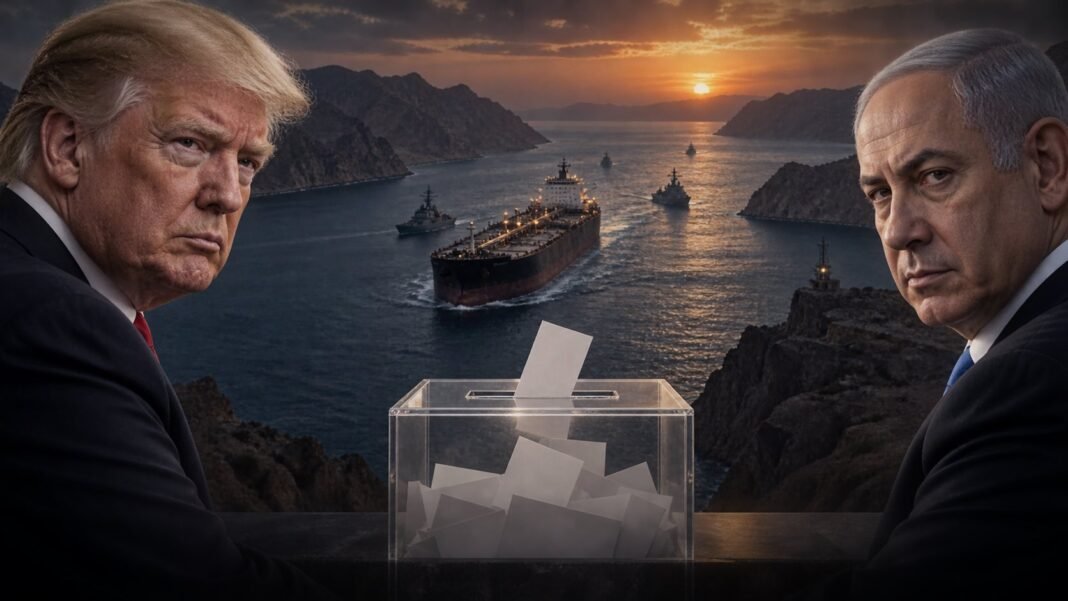
A statement by Mohammad Bagher Zolghadr, a political adviser to Iran’s supreme leader, that the Strait of Hormuz will not reopen while Donald Trump and Benjamin Netanyahu remain in power may sound like another piece of wartime rhetoric. Behind it, however, lies a clear political calculation.
Tehran is effectively signaling that it views the upcoming elections in the United States and Israel as an extension of the conflict by other means. If Iran cannot force its opponents to accept its terms on the battlefield or at the negotiating table, it can try to make the confrontation increasingly costly for their voters.
In this strategy, the Strait of Hormuz is more than a geographical chokepoint. It is a lever capable of affecting oil markets, shipping costs, insurance premiums and, ultimately, the prices consumers see at gas stations and in stores.
Tehran Is Betting on Time
Zolghadr delivered his warning during an event marking 200 days of what Iran describes as national resistance. His message was aimed not only at Washington and Jerusalem but also at Iranian society: Tehran wants to demonstrate that it will not retreat under military and economic pressure.
At the same time, Iran has not abandoned diplomacy. Iranian representatives have been negotiating through Oman and discussing possible conditions for restoring navigation. The understanding reached through Muscat does not provide for the immediate reopening of the strait. Instead, it creates a framework for a possible reopening if Washington meets conditions set by Tehran.
There is no contradiction between negotiations and threats. Iran is offering a deal while simultaneously increasing the cost of rejecting it. The longer disruptions to shipping and pressure on energy markets continue, the greater the political burden on the Trump administration.
The War Is Becoming a Liability for Trump
At the beginning of an international conflict, an incumbent government can often rally the public around the flag. That effect rarely lasts indefinitely. When a war drags on, the promised quick victory fails to materialize and prices rise, voters eventually ask: What has actually been achieved?
That moment is particularly dangerous for Trump. His political identity was built partly on promises to end wars, force adversaries to make concessions and secure rapid agreements. A prolonged campaign against Iran contradicts all three claims.
According to polling reported by The New York Times, 51% of American voters said they intended to support Democratic congressional candidates, compared with 43% for Republicans. Trump’s job approval stood at only 38%.
A single national survey cannot guarantee a Democratic “blue wave,” much less predict individual congressional districts. Nevertheless, the numbers point to a broader danger. For most Americans, the Strait of Hormuz is geographically distant. Higher fuel, transportation and consumer prices are not. It is through household budgets that geopolitics enters the voting booth.
Netanyahu Faces His Own Crossroads
Benjamin Netanyahu confronts a similar problem. At a Likud gathering in Tel Aviv, he used road signs pointing in different directions and asked supporters whether Israel should turn right or left. He rejected calls for a Palestinian state and promised to continue the struggle.
Israel’s real crossroads, however, is more complicated than the campaign-stage metaphor. Netanyahu must persuade voters that years of war have strengthened the country’s security rather than created a seemingly endless cycle of new threats. His opponents associate the prolonged fighting, international isolation and internal divisions with the prime minister’s own decisions.
In the October 27 election, winning the largest number of seats will not be enough for Likud. Netanyahu must assemble a coalition controlling at least 61 of the Knesset’s 120 seats. The longer the fighting continues without a decisive result, the harder it becomes to explain why maintaining the existing course will deliver security.
Iran Does Not Need to Win – It Needs to Wait
Tehran is unlikely to believe it can determine the outcome of the U.S. or Israeli elections. It can, however, try to intensify the forces working against both leaders: high energy prices, war fatigue, doubts about the effectiveness of the military campaign and fears of further escalation.
Zolghadr’s statement should therefore be understood strategically rather than literally. It is a warning that Iran is prepared to play a long game. But that strategy carries serious risks for Tehran as well. Iran’s economy is under immense pressure, while prolonged confrontation consumes military, financial and political resources.
The coming weeks will become a contest of political endurance. Trump and Netanyahu will try to demonstrate that their pressure on Iran is producing results. Tehran will seek to prove that it can withstand that pressure longer than their governments can retain public support.
The central question is no longer only who controls the Strait of Hormuz. It is also which side will be the first to lose control of the political situation at home.
AZE.US