AZE.US
A drone strike on Azerbaijan’s Nakhchivan Autonomous Republic has raised new concerns that the confrontation around Iran is beginning to spill beyond the Middle East and into neighboring regions, including the South Caucasus.
Analysts say the incident may signal a widening of the conflict’s geography rather than a direct attempt to open a new front.
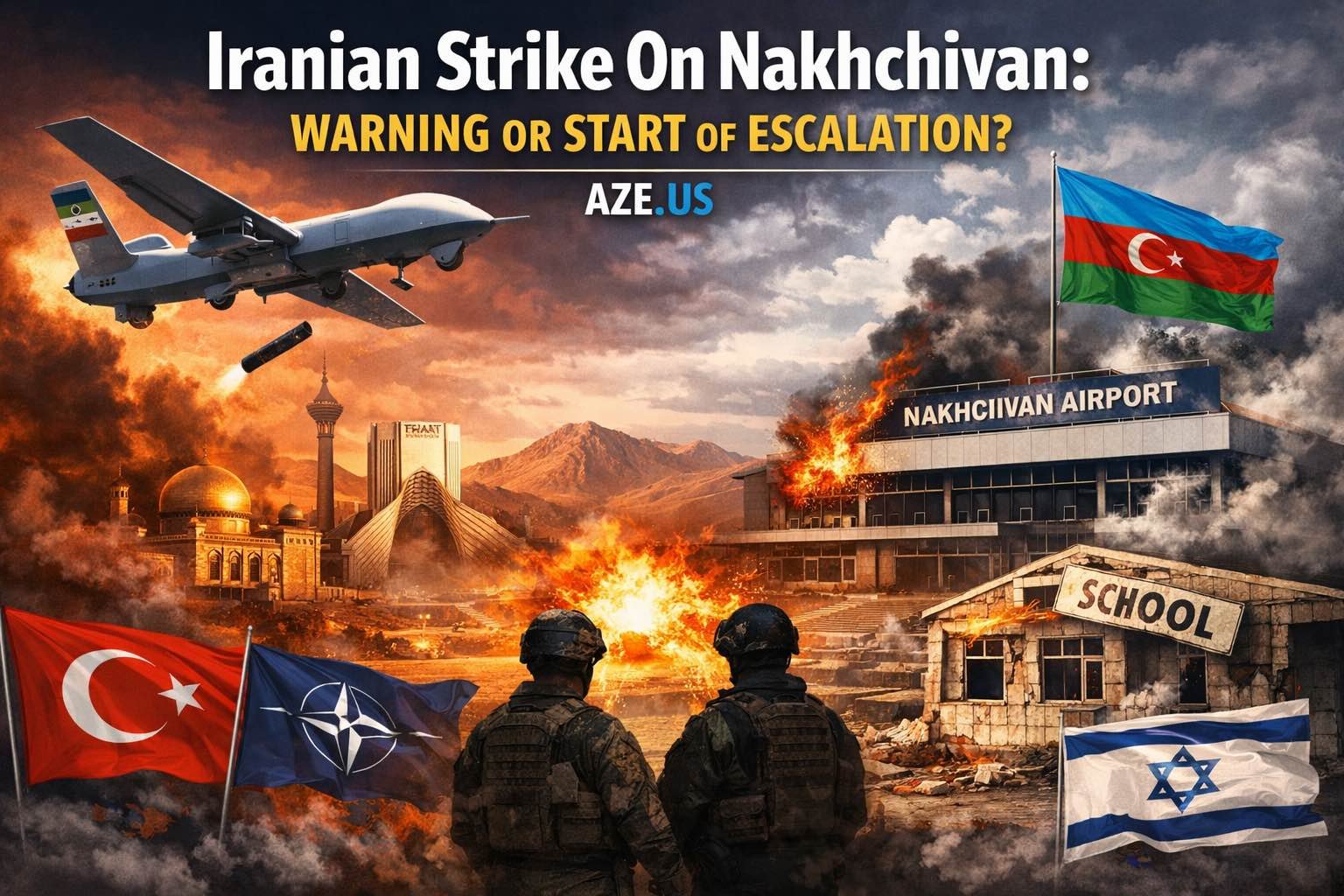
The attack occurred earlier on March 5, when drones launched from Iranian territory struck targets in Nakhchivan. One drone exploded near a secondary school in the Babek district village of Shakarabad, damaging the building’s windows and facade. Another drone hit the terminal building of Nakhchivan International Airport, injuring two civilians.
Azerbaijan’s Foreign Ministry condemned the strike, warning that Baku reserves the right to take appropriate response measures.
Conflict Reaching Beyond The Middle East
According to regional analysts, the incident reflects the logic of Iran’s long-standing strategy of asymmetric warfare.
Tehran is widely seen as unlikely to prevail in a direct military confrontation with stronger adversaries such as the United States or Israel. Instead, it has historically relied on indirect pressure, proxy forces, and geographically dispersed operations designed to complicate the strategic environment for its opponents.
In that context, attacks outside the immediate battlefield may serve multiple purposes: signaling resolve, deterring perceived adversaries, and demonstrating the ability to expand the theater of confrontation.
Some observers say the strike on Nakhchivan may be part of that broader signaling strategy.
Azerbaijan In A Sensitive Position
Azerbaijan occupies a complex position in the current regional landscape.
Iran has repeatedly accused Baku of allowing Israeli influence near its borders, while Azerbaijan has consistently rejected those claims and maintained that its foreign policy is independent.
At the same time, Azerbaijan’s close strategic partnership with Turkey adds another layer of sensitivity. Under the Shusha Declaration, the two countries maintain deep security cooperation, raising the stakes if tensions between Iran and Azerbaijan were to escalate further.
For that reason, analysts believe Tehran may be cautious about pushing the confrontation too far.
A direct escalation against Azerbaijan could risk drawing in Turkey, a NATO member, dramatically expanding the scope of the crisis.
A Regional Signal Rather Than A New Front
Several experts believe the strike may have been intended less as a military operation and more as a political signal.
In this interpretation, Iran may be demonstrating that it is prepared to respond not only against direct military targets but also against states it perceives as aligned with its adversaries.
Such signaling tactics have been used before in Middle Eastern conflicts, where limited strikes are sometimes meant to shape the behavior of regional actors without triggering full-scale war.
Risk Of Wider Instability
Despite the limited scale of the incident, the strike highlights how quickly regional tensions can spread.
The South Caucasus sits at the crossroads of multiple geopolitical fault lines – involving Iran, Turkey, Russia, and Western interests – meaning that even isolated incidents can carry wider implications.
If the broader confrontation around Iran intensifies, analysts warn that peripheral regions like the Caucasus could increasingly find themselves drawn into the strategic ripple effects.
For now, the situation remains fluid. Whether the Nakhchivan incident proves to be an isolated warning or the first sign of a broader escalation may depend on how both Tehran and Baku respond in the coming days.