By Leyla Mammadli for Aze.US
The Middle East is once again sliding toward a dangerous inflection point. Rising military and political tensions around Iran are no longer confined to regional rivalries – they now test the durability of the global balance of power.
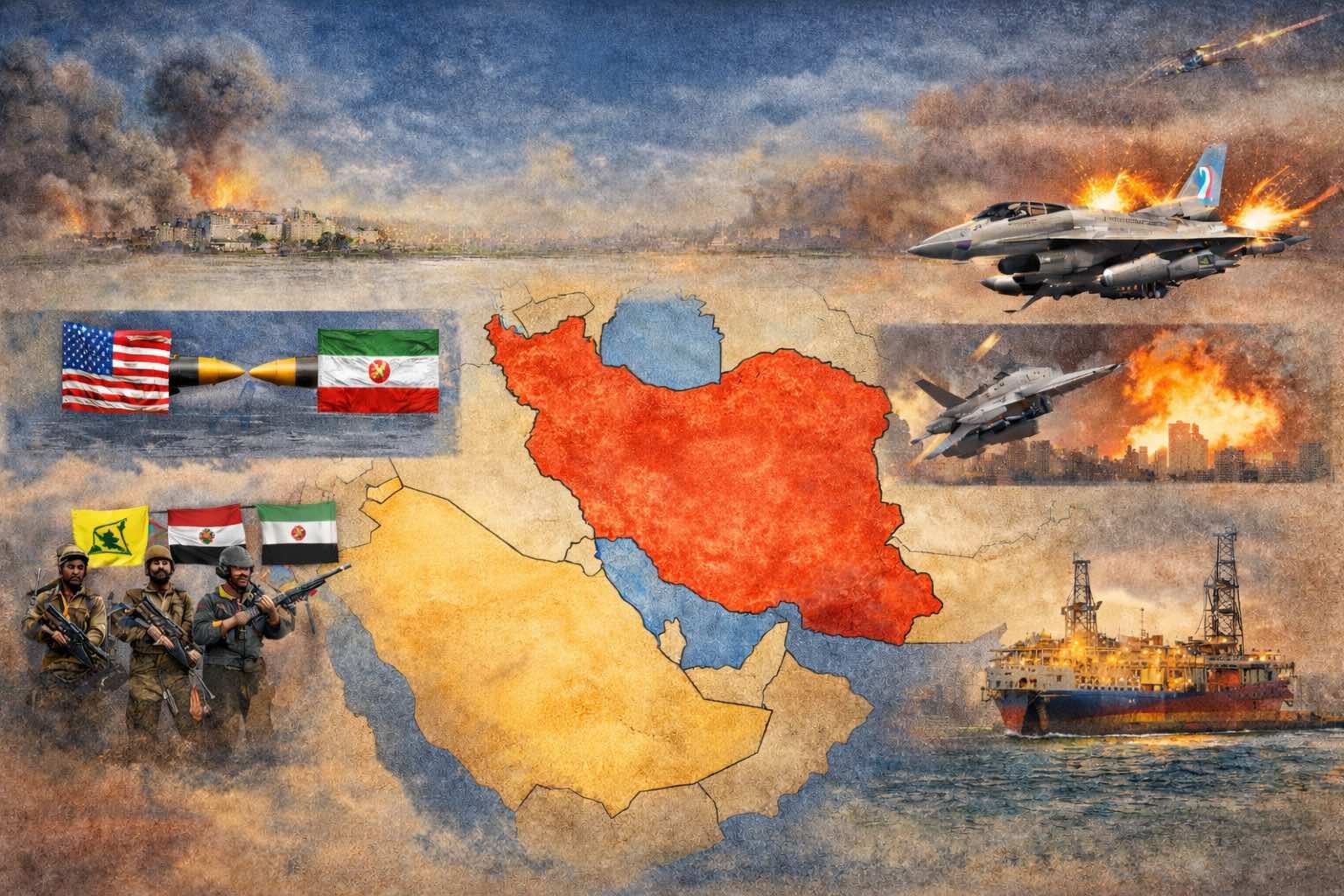
What is unfolding is not a single crisis, but a layered confrontation: U.S.-Iran hostility, Israel’s security calculus, Gulf states’ strategic anxieties, and a network of proxy actors stretching from Lebanon to Yemen. Together, these factors form a volatile geopolitical knot.
U.S.-Iran: Deterrence Or Drift Toward Escalation?
The United States has long viewed Iran’s nuclear ambitions as a strategic threat. Since Washington withdrew from the 2015 nuclear deal during the administration of Donald Trump, diplomatic trust has eroded and leverage has narrowed.
Today, the standoff operates in a grey zone – sanctions, cyber operations, maritime incidents and indirect confrontations rather than open warfare. Yet the underlying dispute remains unresolved: how close Iran is willing to move toward nuclear weapons capability, and how far Washington is prepared to go to stop it.
This is a competition shaped less by declarations and more by thresholds. The danger lies not in rhetoric, but in miscalculation.
Israel’s Red Line
Israel views Iran’s military and nuclear trajectory as an existential issue. Israeli air operations targeting Iranian-linked infrastructure in Syria have become routine, signaling a long-term strategy of containment.
If Tehran were to cross what Israeli leadership defines as a “point of no return,” a preventive strike scenario would no longer be theoretical. Such a move would almost certainly pull the United States into a broader confrontation, directly or indirectly.
The Proxy Dimension
Iran’s regional network – Hezbollah in Lebanon, armed groups in Iraq, and the Houthis in Yemen – provides Tehran with strategic depth and leverage. For Gulf states such as Saudi Arabia and the United Arab Emirates, this influence is viewed as destabilizing.
The result is not a classic interstate war, but a sustained shadow conflict. Escalation can occur through third parties, often without formal declarations, blurring accountability and raising the risk of unintended expansion.
Energy Shock Risk
Any major disruption involving Iran carries immediate implications for global energy markets. The Strait of Hormuz remains one of the world’s most sensitive maritime chokepoints. Even limited instability there could drive sharp increases in oil and gas prices, amplifying inflationary pressures in Europe and Asia.
In this sense, the Iranian file is inseparable from global economic stability.
Why It Matters For The South Caucasus
For Azerbaijan, developments around Iran carry particular sensitivity. Baku shares a long land border with Iran while maintaining strategic ties with Israel and Western partners. Navigating this landscape requires careful balance.
Domestic stability in northern Iran, where millions of ethnic Azerbaijanis reside, also adds a social dimension to geopolitical risk. Any internal unrest or external intervention could produce cross-border implications, including security and migration concerns.
A World War Scenario?
A full-scale global war remains unlikely under current conditions. Major powers appear more interested in controlled competition than open confrontation.
The greater risk lies in escalation without intention – a strike misread, a retaliation overextended, or diplomatic channels collapsing at a critical moment.
Iran today represents one of the system’s most fragile pressure points. Whether this tension remains contained or evolves into something larger will depend less on rhetoric and more on restraint.