AZE.US
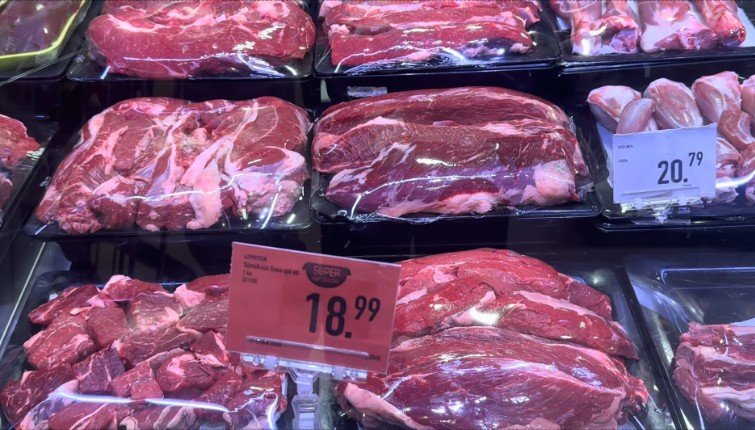
A kilogram of meat can be bought for 11–13 manats ($6.50–$7.65) in Kazakhstan, while prices in Baku have reached 18 manats ($10.60).
Azerbaijani journalist Zaira Akifgizi argues that the difference reflects deeper problems involving farmland access, animal feed and the organization of agriculture.
Akifgizi, who is currently in Aktau (Kazakhstan), said her family paid 40,000 tenge for 10.5 kilograms of meat. That works out to about 3,800 tenge, or 13 manats, per kilogram.
According to her observations, Azerbaijani vendors in Aktau sell meat at that price, while Kazakh sellers offer it for about 11 manats per kilogram. Buyers purchasing more than five kilograms may pay even less.
In Baku, meanwhile, beef is commonly sold for around 17–18 manats per kilogram, with prices at some outlets even higher.
The comparison raises a simple question: If Kazakhstan can maintain relatively affordable meat prices, why is the same product considerably more expensive in Azerbaijan, which also has farmland and pasture suitable for livestock farming?
Farmland Exists, but Villagers Struggle to Access It
Akifgizi, originally from Gariseyribend village in Azerbaijan’s Kurdamir district, said fertile land is available in the area, but local residents who want to farm often struggle to obtain plots.
“A resident applies for land and is told that none is available. At the same time, we see people from other districts acquiring hundreds of hectares in the same area,” she wrote.
Greater access to farmland would allow villagers to grow wheat, barley, alfalfa, corn and other crops used as animal feed, she said.
Lower feed costs would make livestock farming more viable. As livestock production expands, the supply of meat and dairy products would increase, potentially easing pressure on consumer prices.
Why Can Local Produce Cost More at Home?
The problem is not limited to meat. Akifgizi recalled seeing locally grown watermelons sold for 1 manat per kilogram in Azerbaijan’s Nakhchivan region, while some supermarkets in Baku offered watermelons at lower prices.
The result is a paradox: produce can sometimes cost more where it is grown than in the capital.
Part of the harvest may be sent abroad, reducing domestic supply and pushing up prices. When exporters fail to sell the produce overseas, however, videos sometimes emerge showing unwanted fruit and vegetables being discarded.
“If the product cannot be sold abroad, why not offer it to Azerbaijani consumers at a more affordable price?” Akifgizi asked. “The farmer would still earn money, consumers would pay less, and the harvest would not be destroyed.”
The Answer May Lie in Azerbaijan’s Villages
Akifgizi said bringing down food prices would require a broader review of land distribution, stronger support for small farmers and the development of an affordable domestic feed supply.
If rural residents can earn a living in their own communities, they will be less likely to move to Baku in search of work. That could slow the depopulation of villages while expanding domestic food production and competition.
“We often look for complicated formulas to solve major economic problems,” she wrote. “Yet the answer may be in the land itself and in the hands of the villagers. They simply need the opportunity to work.”
Akifgizi concluded by addressing Agriculture Minister Majnun Mammadov directly: “What does Kazakhstan have that we do not?”
AZE.US