AZE.US
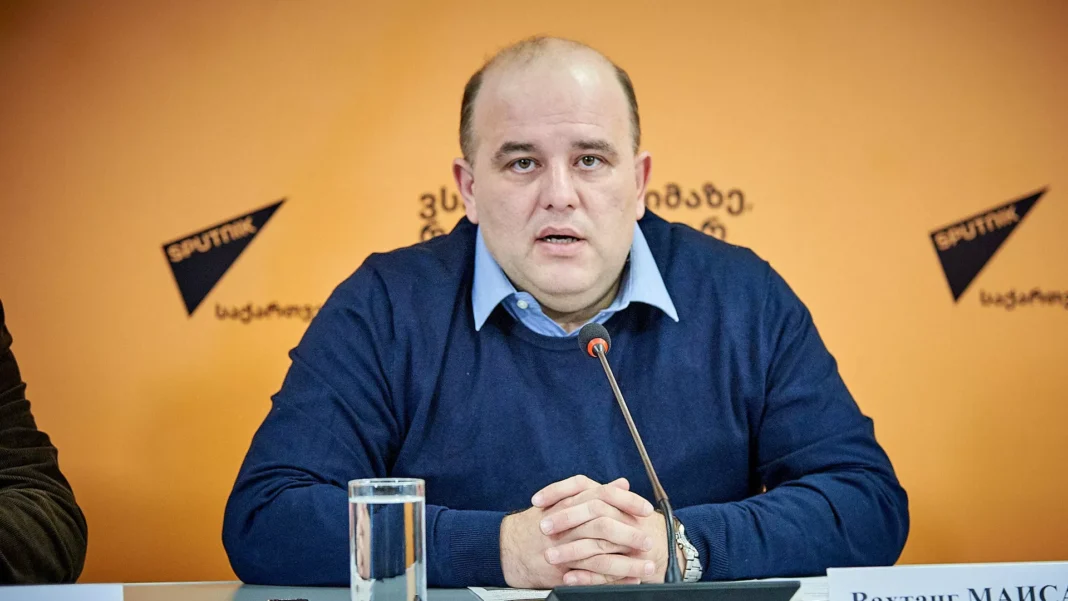
Azerbaijan has emerged as an independent middle power whose influence increasingly extends beyond the South Caucasus, while parts of Russia’s political establishment have yet to accept that new reality, Georgian political scientist Vakhtang Maisaya said.
Maisaya, head of geopolitical studies at the Georgian Center for Strategic Analysis, made the remarks in an interview with Rasim Babayev’s independent YouTube program, A Modern Conversation.
He argued that the recent wave of anti-Azerbaijani rhetoric in parts of the Russian media reflects a deeper frustration with Baku’s independent foreign policy rather than an isolated dispute involving individual commentators.
Moscow Is Confronting a Different Azerbaijan
The interview addressed insulting statements and threats allegedly made against Azerbaijan by several Russian media figures, as well as a provocative demonstration near an Azerbaijani diplomatic property in central Moscow.
Maisaya described the developments as an example of “sharp power,” a term used for political, informational and psychological pressure employed by authoritarian governments to influence other countries.
He said official Russian assurances about preserving relations with Baku increasingly conflict with the actions of certain political and media circles inside Russia.
The analyst also questioned how activists were able to display anti-Azerbaijani posters, take photographs and leave the area without immediate police intervention despite Moscow’s extensive surveillance system.
In his view, the incident raises questions about which groups within the Russian establishment may benefit from undermining dialogue between Moscow and Baku.
“Russia is not accustomed to speaking on equal terms with former Soviet republics that it continues to view as its satellites,” Maisaya said.
He argued that the current tensions are rooted in Russia’s difficulty accepting Azerbaijan as a sovereign state capable of pursuing its own policies and rejecting decisions that do not serve its national interests.
Azerbaijan Has Become a Middle Power
Maisaya described Azerbaijan as a “middle power” - a country that is not a global superpower but possesses enough political, economic and military capacity to shape developments across its region.
In his assessment, Baku now plays a leading role not only in the South Caucasus but also across an emerging Caucasus-Central Asia geopolitical space.
Azerbaijan’s expanding relations with Kazakhstan, Uzbekistan and other Central Asian countries, its position along the Middle Corridor and its independent partnerships with Turkey, Europe, the United States and China have made the country a key center of Eurasian transportation and diplomacy.
Maisaya said parts of the Russian establishment have not fully recognized that Azerbaijan is no longer willing to operate within a hierarchy dominated by Moscow.
He described the gap between Russia’s traditional view of the post-Soviet region and the current balance of power as a form of “cognitive dissonance” within the Russian political elite.
Pressure on Baku Over Its Ukraine Policy
The discussion also covered Russian strikes that damaged facilities operated by Azerbaijan’s state energy company SOCAR in Ukraine, as well as Azerbaijani diplomatic properties affected during the war.
Maisaya linked those incidents to Moscow’s irritation over Azerbaijan’s political and humanitarian support for Ukraine.
He said Baku’s assistance to Kyiv corresponds with Azerbaijan’s national interests and demonstrates the independence of its foreign policy.
The analyst also supported the Azerbaijani Foreign Ministry’s response to the demonstration near its diplomatic facility in Moscow. He stressed that host governments are responsible for protecting foreign missions under the Vienna Convention on Diplomatic Relations.
Azerbaijan, Georgia and Turkey Form an Informal Alliance
Maisaya described cooperation among Azerbaijan, Georgia and Turkey as one of the main pillars of regional security.
In his view, the partnership has expanded beyond energy pipelines and transportation projects to include cooperation among intelligence services, law enforcement agencies and institutions responsible for counterterrorism and preventing cross-border sabotage.
“An informal political alliance among Azerbaijan, Georgia and Turkey is effectively operating and already producing results,” he said.
The three countries occupy a strategic corridor linking the Caspian region and Central Asia with Turkey and European markets. Their cooperation is therefore critical to protecting major energy and freight routes.
Maisaya said Azerbaijan is increasingly acting not only in defense of its national interests but also as one of the principal international representatives of the South Caucasus.
“Azerbaijan will raise not only its national flag but also the flag of the entire Caucasus - the idea of solidarity and the resilience of our region,” he said.
Georgia Tightens Its Security Controls
Turning to developments in Georgia, Maisaya supported stricter scrutiny of foreign nationals and expanded powers for the country’s criminal police.
He said the large influx of Russian citizens following Moscow’s mobilization announcement in 2022 caught Georgian authorities unprepared. Tbilisi is now attempting to prevent foreign intelligence officers and potential saboteurs from entering the country under the cover of relocation or migration.
Maisaya claimed that Georgian security agencies had previously uncovered networks connected to Russian intelligence and disrupted several terrorist threats. He declined to provide operational details and noted that investigations were continuing.
Cooperation with Azerbaijan and Turkey is particularly important in countering such risks, he said.
Pashinyan Is Dismantling Russia’s Influence in Armenia
The interview also examined political changes in Armenia and Prime Minister Nikol Pashinyan’s proposed concept of a “Fourth Republic.”
Maisaya noted that the new political framework does not center on claims to Karabakh. He interpreted that omission as an attempt to abandon territorial revisionism and build Armenian statehood within the country’s internationally recognized borders.
He described Pashinyan’s confrontation with figures from Armenia’s former political establishment as part of a broader effort to dismantle what he called the architecture of Russian influence and the autocratic political system associated with the former Karabakh clan.
Maisaya avoided commenting on the legal merits of individual cases or Pashinyan’s dispute with the Armenian Apostolic Church. He said his assessment concerned the geopolitical direction of Armenia’s transformation.
According to the analyst, Yerevan’s westward turn, the normalization process with Azerbaijan and the planned TRIPP transit project could create a new regional system in which Baku and Yerevan make key decisions without intervention from outside powers.
The South Caucasus Is Leaving Russia’s Orbit
Maisaya said the central trend reshaping the region is the gradual erosion of Russia’s former dominance in the South Caucasus.
Azerbaijan already conducts a fully independent foreign policy. Armenia is attempting to reduce its political and economic dependence on Moscow. Georgia, despite its complicated domestic environment, is strengthening its security controls while maintaining its strategic partnership with Azerbaijan and Turkey.
In this emerging regional structure, Maisaya sees Azerbaijan as the pivotal state connecting the South Caucasus with Central Asia, Turkey and Western markets.
Anti-Azerbaijani campaigns in the Russian media may generate further tensions, he concluded, but they cannot restore the previous regional order in which Moscow expected to determine the rules for its neighbors.
AZE.US