By AZE.US Editorial Team
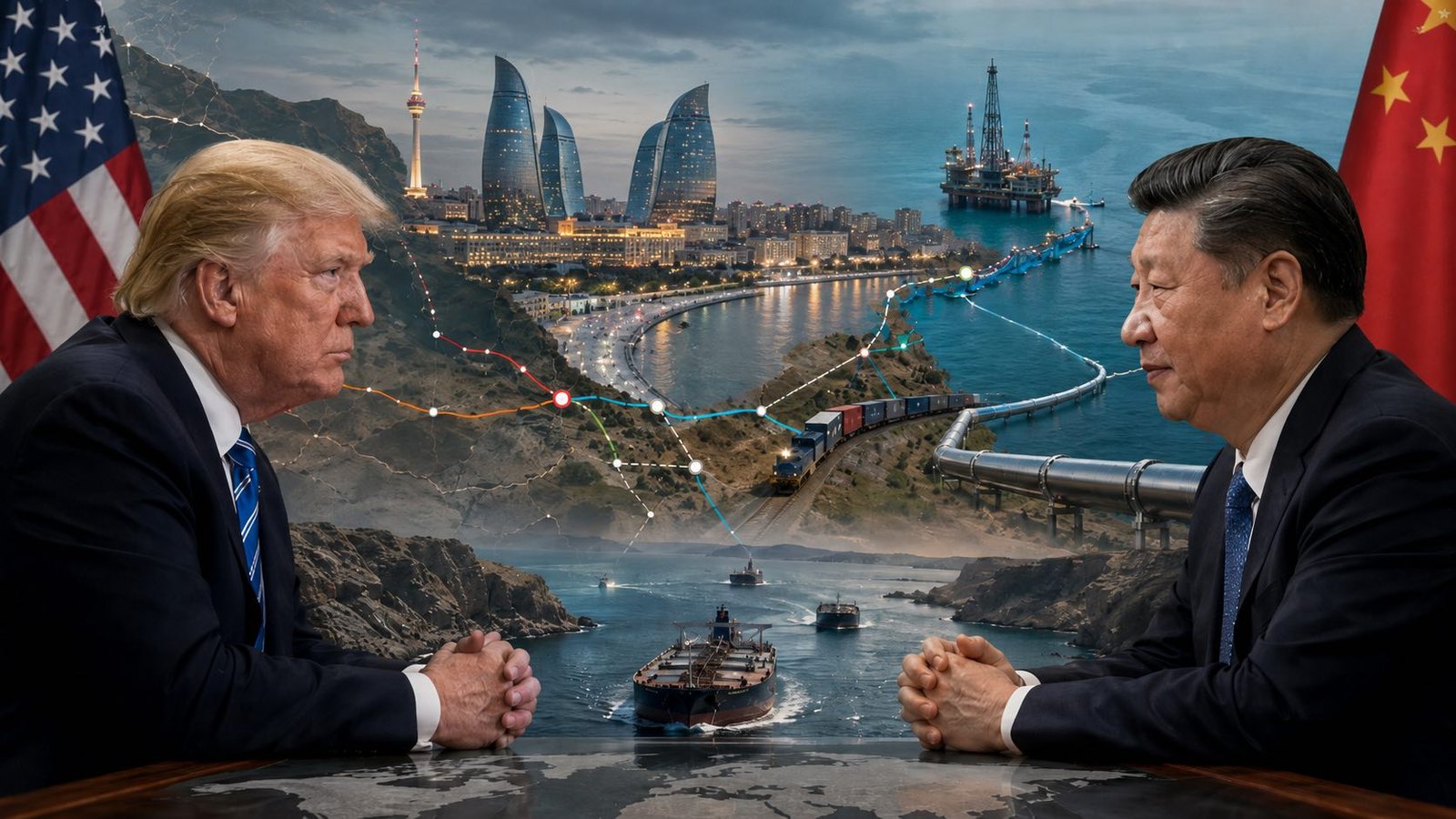
The meeting between U.S. President Donald Trump and Chinese President Xi Jinping is being presented as a summit about trade, Taiwan, Iran, artificial intelligence and global stability.
In reality, it is about something larger.
Washington and Beijing are trying to manage a world in which nearly every major issue is now connected to every other one. Tariffs are linked to technology. Technology is linked to Taiwan. Taiwan is linked to U.S. security guarantees. Iran is linked to oil, the Strait of Hormuz and global shipping. And shipping routes are linked to the growing importance of alternative corridors between Asia and Europe.
That is where Azerbaijan enters the picture.
Not as a superpower, and not as a direct party to the U.S.-China rivalry. Azerbaijan’s role is different. It sits at the intersection of energy, transit, the Caspian region, Türkiye, Central Asia and Europe. In a world where major powers are looking for stable routes and backup options, geography once again becomes political capital.
Reuters reported that Trump said he would discuss the Iran war with Xi during the China visit, although he also insisted he did not need China’s help to end the conflict. That statement was meant to project strength. But the fact that Iran is part of the agenda shows the opposite side of the reality: without China, the Middle East crisis cannot be fully separated from global trade and energy politics. China remains deeply tied to Iranian oil and has influence that Washington cannot ignore.
The Strait of Hormuz is the clearest example. Reuters reported that the United States and China have agreed that no country should impose tolls on shipping through the strait. That is a rare point of alignment between two rivals, and it tells us something important: even when Washington and Beijing disagree on almost everything, both understand that disruption in Hormuz would hit the global economy hard.
For Azerbaijan, this matters.
Every new crisis around Hormuz, the Red Sea or other maritime arteries increases the value of alternative routes. The Middle Corridor will not replace ocean shipping. That would be an exaggeration. But in an age of war risks, sanctions, blockades and political uncertainty, even a partial alternative becomes strategically important.
Azerbaijan has spent years trying to position itself not only as an energy supplier, but also as a transit state linking the Caspian Sea, Central Asia, Türkiye and Europe. The more fragile global routes become, the more valuable that role becomes.
Taiwan adds another layer.
Ahead of the summit, China again warned against U.S. arms sales to Taiwan, according to Reuters. Beijing views Taiwan as part of its territory, while Washington remains tied to the island through security commitments and arms supplies. The issue is not only military. Taiwan is central to global semiconductor supply chains, and any escalation there would send shockwaves through technology, trade and manufacturing.
That may sound far from Baku. It is not.
If the Taiwan issue worsens, global companies and governments will look even harder for backup routes, safer supply chains and more politically flexible connections between East and West. The South Caucasus cannot solve that problem alone, but it can become part of the wider answer.
The same applies to trade. The Associated Press reported that both Washington and Beijing want to keep relations broadly stable, even as the summit covers difficult issues from tariffs to security. That means the two powers are not ending their rivalry. They are trying to keep it controlled.
This is the key point for countries like Azerbaijan.
When great powers compete, smaller and mid-sized states face risks. Deals can be made over their heads. Pressure can come from more than one direction. Neutrality becomes harder. Balancing becomes more expensive.
But there is also opportunity.
Countries that offer stability, infrastructure, energy access and credible transport routes gain weight. Azerbaijan’s advantage is not in choosing between Washington and Beijing. Its advantage is in becoming useful to different sides without being absorbed by any one of them.
That requires discipline. Baku cannot afford to treat geography as enough. Geography is only valuable when it is supported by ports, railways, customs efficiency, predictable diplomacy and a reputation for reliability.
The Trump-Xi summit is therefore not just a distant meeting between two leaders. It is part of a larger global bargaining process in which routes, resources and political loyalty are being repriced.
For Azerbaijan, the lesson is clear. The country’s value will grow if it can prove that it is not simply located between East and West, but can actually connect them.
In the new world, corridors are no longer just lines on a map. They are instruments of influence.
And Azerbaijan’s task is to make sure it is seen not as a bypass, but as a necessary route.
AZE.US