By AZE.US Editorial Team
The Houthi advance toward the Bab el-Mandeb Strait, renewed attacks on Saudi Arabia and Washington’s refusal to open another military front have transformed the balance of power in the Middle East. Riyadh is now testing its new defense partnership with Turkey and Pakistan, but Ankara’s readiness to help does not necessarily mean it will enter the war.
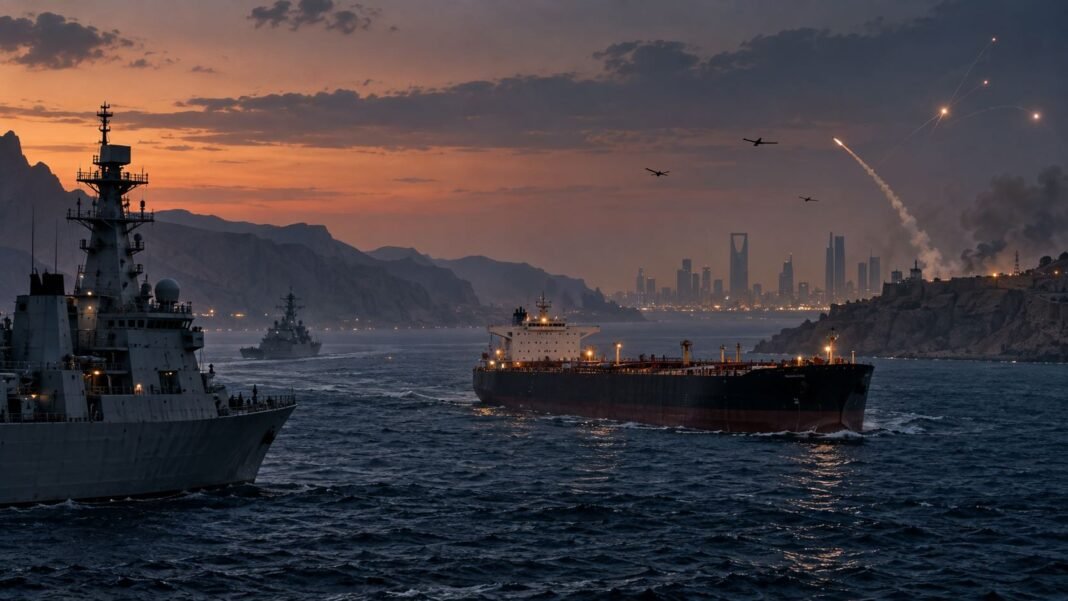
By September 20, the conflict in Yemen was no longer simply another episode in the long confrontation between the Houthis and Saudi Arabia. After seizing the strategic port of Mokha and islands near the Bab el-Mandeb Strait, the Iran-aligned movement gained greater leverage over a vital shipping route connecting the Indian Ocean, the Red Sea and the Suez Canal.
The danger is particularly serious because traffic through the Strait of Hormuz has already been disrupted by the broader conflict involving Iran. Simultaneous pressure on both maritime corridors could turn a regional confrontation into a global energy and shipping crisis.
The central political question, however, is why the United States – long viewed as the principal security guarantor of the Gulf monarchies – is not entering the fight on Riyadh’s side.
Washington Has Limited Its Support
It would be misleading to say that Washington has completely abandoned Saudi Arabia. The United States reportedly continues to provide intelligence and technical assistance. However, President Donald Trump’s administration has resisted Saudi requests for direct U.S. military action against the Houthis.
According to Reuters, Washington does not want to open another front while already managing a confrontation with Iran and wider instability across the region.
The U.S. position is also tied to a ceasefire arrangement reached with the Houthis in 2025. During an undisclosed meeting at the U.S. Embassy in Muscat, Houthi representatives said they would not attack American vessels as long as Washington refrained from resuming airstrikes in Yemen.
The meeting was facilitated by Oman, according to Reuters.
That has created an uncomfortable arrangement for Riyadh: American vessels may be protected by a separate understanding, while Saudi targets and Saudi-linked shipping remain exposed.
This is not an alliance between Washington and the Houthis. It is a U.S. attempt to contain its own risks and avoid turning Yemen into another open-ended American war.
Claims that Trump is deliberately punishing Saudi Arabia for failing to support the campaign against Iran have not been substantiated by reliable sources. A more convincing explanation is that the White House does not want to assume the costs and consequences of another war, particularly ahead of the U.S. midterm elections.
The Houthis Have Changed the Balance of Power
Until recently, the Houthis were largely viewed as an armed movement controlling northern and western parts of Yemen. They are now emerging as a force capable of influencing global trade and energy routes.
Their advance along the Red Sea coast and seizure of Mokha and nearby islands do not necessarily amount to complete physical control of the Bab el-Mandeb Strait. But disrupting shipping does not require control over every mile of the waterway.
Missiles, drones, unmanned boats and the ability to target selected vessels can be enough to raise insurance costs, force shipping companies to reroute and interrupt energy exports.
The threat is no longer limited to maritime traffic. Saudi Arabia said it intercepted a ballistic missile heading toward Riyadh, while smoke and flames were reported near King Khalid International Airport. Security alerts were also issued in other Saudi cities.
The Houthis claimed responsibility for the attacks, describing them as retaliation for Saudi operations in Yemen.
The escalation has already affected markets. Saudi Arabia’s benchmark stock index closed 0.3% lower on September 20, while ACWA Power shares fell 2.8%, according to Reuters.
That is not yet a market collapse. But investors are signaling that the threat is no longer theoretical.
Will Turkey Join the War?
Saudi Arabia, Turkey and Pakistan signed the Mecca Joint Defense Agreement in August. Its central principle resembles NATO’s collective-defense clause: aggression against one member is to be treated as aggression against all three.
Turkish Foreign Minister Hakan Fidan said Ankara was prepared to help meet Saudi Arabia’s military and technical requirements. His remarks were reported by Reuters on September 19.
But there is a considerable distance between technical assistance and entering a war.
Turkey could provide air-defense equipment, electronic-warfare systems, drones, munitions, radar support, military specialists or intelligence. It could also help Saudi Arabia strengthen the protection of airports, oil facilities and other critical infrastructure.
Deploying Turkish aircraft to strike Yemen or sending troops into combat would represent a fundamentally different level of involvement.
Ankara must consider at least four major risks.
First, the Houthis could retaliate against Turkish ships, bases or commercial interests.
Second, direct intervention would further complicate Turkey’s relationship with Iran, an important neighbor and trading partner.
Third, escalation could threaten Turkish commercial routes through the Red Sea and the Suez Canal.
Fourth, Ankara could become trapped in a prolonged Yemeni conflict that Saudi Arabia previously failed to resolve through military force.
There is also legal and political ambiguity surrounding the Mecca agreement. It remains unclear whether its collective-defense provision automatically applies to an attack by a nonstate armed group or requires a separate political decision by all three members.
The most likely scenario is therefore limited Turkish assistance without direct participation in combat. Ankara will seek to demonstrate that its alliance commitments have substance while preserving room for diplomacy.
Why the Houthis Are Warning Turkey and Pakistan
The Houthis have already warned countries considering military support for Riyadh. Senior Houthi official Mohammed al-Bukhaiti told the Associated Press that foreign forces joining the Saudi campaign would face retaliation.
The message is primarily directed at Turkey and Pakistan. The Houthis want to prevent the Mecca agreement from developing from a political declaration into an operational military coalition.
Ankara and Islamabad face their own test. If they provide no meaningful assistance, the credibility of their new defense partnership with Riyadh will immediately be questioned. If they become too deeply involved, they risk turning themselves into direct participants in the war.
Iran Has Influence, but the Houthis Have Their Own Agenda
The Houthis receive weapons, technology and political support from Iran. Their territorial gains strengthen Tehran’s regional position by increasing pressure on Saudi Arabia and global energy markets.
It would nevertheless be an oversimplification to portray the movement as a unit that carries out every order from Tehran.
After years of war, the Houthis have developed their own leadership, governing structures, military strategy and political objectives. Iran can support their capabilities and influence their calculations without necessarily directing every missile or drone attack.
That distinction matters for diplomacy. If the Houthis are viewed only as an Iranian proxy, policymakers may assume that an agreement with Tehran alone can end the crisis. Recognizing their independent interests means that any durable settlement will also require a separate Yemeni political process.
The U.S. Security Model Is Changing
Washington’s refusal to launch direct strikes illustrates a broader shift in American policy.
The United States remains willing to sell weapons, provide intelligence, support air-defense networks and offer political backing. But automatic U.S. military intervention to defend every regional partner can no longer be taken for granted.
For Saudi Arabia, that is an uncomfortable message. The kingdom has invested heavily in advanced Western weapons, yet relatively inexpensive missiles and drones continue to threaten its cities, airports and energy infrastructure.
Riyadh is consequently being forced to diversify its security relationships. It is strengthening military cooperation with Turkey and Pakistan, seeking China’s help in communications with Iran and exploring its own path toward de-escalation in Yemen.
A Wider War Is Not Yet Inevitable
Turkey does not appear eager to enter a direct war with the Houthis. The United States is also trying to avoid opening a new front, while Pakistan continues to act cautiously despite its close defense relationship with Saudi Arabia.
Diplomacy therefore still has room to operate, but that space is narrowing.
A Houthi strike causing mass casualties, seriously damaging Saudi oil infrastructure or hitting Turkish or Pakistani assets could rapidly increase pressure on the members of the Mecca defense pact to respond.
The question is no longer simply whether the Houthis can close the Bab el-Mandeb Strait. The larger issue is whether emerging regional alliances can deter further attacks without turning collective defense into collective entry into war.
While Washington negotiates separately to protect American shipping, Saudi Arabia is being forced to build a new security architecture. Turkey now faces a difficult choice: demonstrate that it is a serious military partner or maintain its distance from a conflict capable of engulfing the entire region.
AZE.US