AZE.US
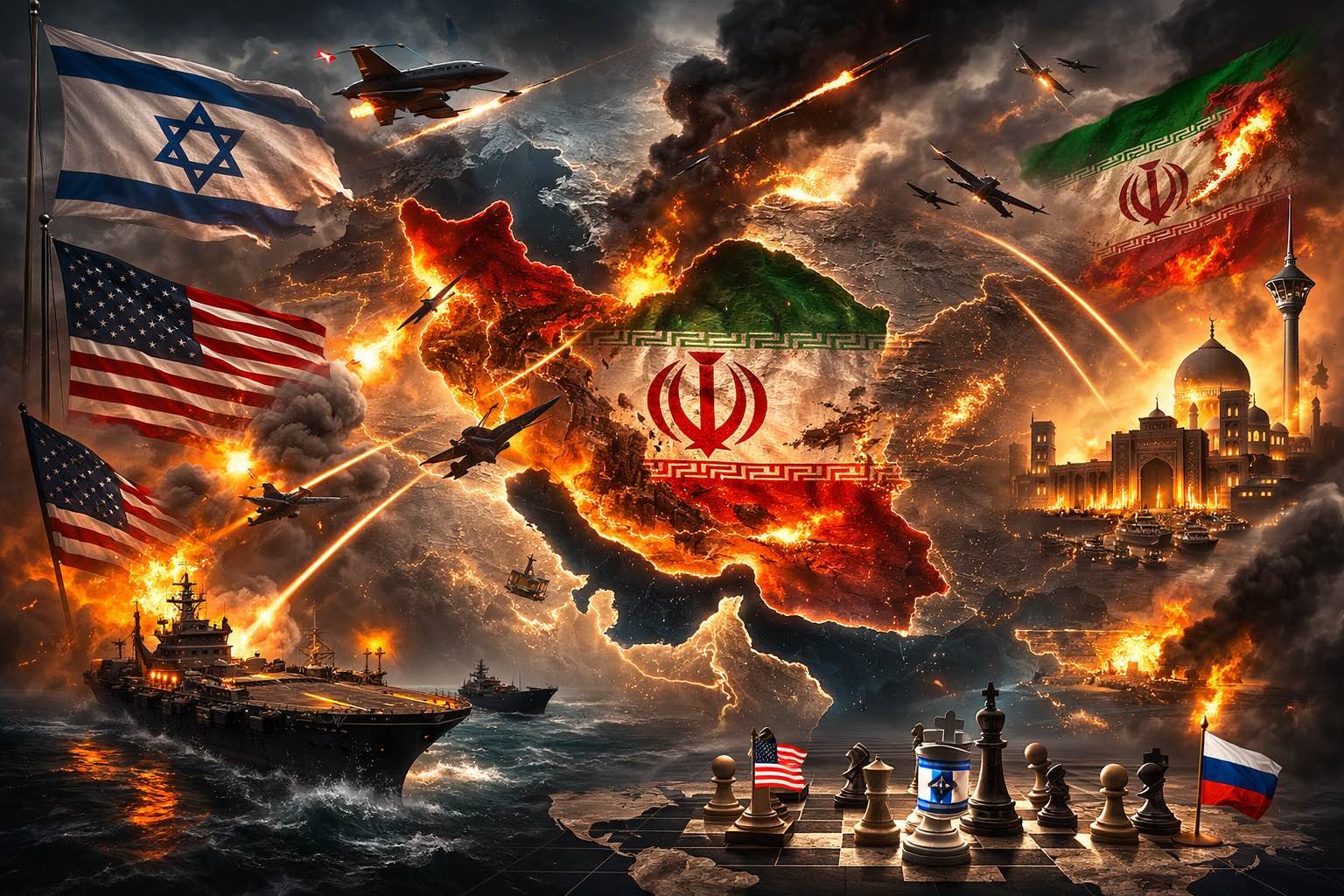
As the United States and Israel launch military operations against Iran, Azerbaijani historian and political analyst Rizvan Huseynov says the world may be witnessing something larger than a regional escalation.
In an interview with the YouTube channel Daily Europe Online, Huseynov argued that the real question is not who struck first – but what this means for the global order.
“If we are seeing a cascade collapse of international law, that is not a moment for celebration. It means the strong decide, and the weak pay the price.”
While openly critical of Iran’s ruling system, Huseynov warned that replacing legal norms with force sets a precedent that could destabilize multiple regions – not just the Middle East.
Four Possible Scenarios For Iran
Referring to a recent analytical forecast published in Forbes, Huseynov outlined four potential trajectories:
1. Regime Radicalization (≈35%)
The Islamic Revolutionary Guard Corps (IRGC) consolidates control, Iran becomes more isolated, and shifts toward a North Korea–style security model.
2. Reformist Takeover (≈30%)
President Masoud Pezeshkian and reformist elites gradually sideline the hardline security apparatus and seek détente with the West.
3. Regime Change
The clerical establishment collapses and a secular system emerges – a scenario widely associated with U.S. strategic objectives.
4. Internal Collapse And Civil Conflict
A fragmentation of state authority leading to prolonged instability – considered the least desirable outcome.
Huseynov described a controlled, reform-led transition as the most stabilizing option for both Iran and neighboring states.
Internal Elite Struggle
According to the analyst, Iran’s political establishment is not monolithic.
-
Reformist forces seek to reduce the external activism of the IRGC and focus on domestic recovery.
-
The security establishment remains committed to a regional ideological strategy.
Public opinion, he noted, is fatigued by economic hardship – yet external military pressure often strengthens internal consolidation rather than fragmentation.
What About Turkey?
Addressing recent remarks by former Israeli Prime Minister Naftali Bennett that Turkey poses a comparable threat to Israel, Huseynov dismissed the likelihood of direct confrontation.
Turkey’s position differs fundamentally from Iran’s:
-
It is one of NATO’s most militarily capable members.
-
It is deepening strategic coordination with Pakistan and Saudi Arabia.
-
Pakistan is a nuclear-armed state.
Any attempt to destabilize Ankara, he suggested, would dramatically reshape regional alliances.
Implications For The South Caucasus
For Azerbaijan, stability remains the overriding priority.
Huseynov emphasized that Baku has consistently advocated dialogue rather than forced regime change. Regardless of political outcomes in Tehran, Azerbaijan’s objectives are clear:
-
Prevent instability along its southern border.
-
Protect ethnic Azerbaijanis residing in Iran.
-
Continue advancing regional infrastructure and transit projects.
He noted that Tehran has effectively adapted to the new geopolitical realities in the South Caucasus following the 44-day war and subsequent regional shifts.
Russia-Iran Relations Under Stress
The conflict also tests Moscow–Tehran relations.
Despite Iran’s support for Russia in the war against Ukraine, Moscow has not provided comparable backing to Tehran. According to Huseynov, this weakens Russia’s credibility as a security partner.
He added that U.S. strikes on Iran should also be viewed through a broader strategic lens: pressure on China, which relies heavily on Iranian energy supplies.
Ukraine’s Position
Ukrainian President Volodymyr Zelensky expressed support for efforts to weaken the Iranian regime.
Huseynov noted that Kyiv’s position reflects its dependence on Western military assistance. At the same time, he questioned the broader narrative that external intervention reliably produces liberal transformation, arguing that power transitions often replace one elite with another rather than transform governance structures.
Europe’s Alignment With Washington
European governments have largely aligned with Washington’s position, though divisions remain – particularly regarding Israel’s conduct in Gaza.
Huseynov suggested that European policy often mirrors shifts in U.S. leadership. The transition from the Biden administration to Donald Trump’s more openly Israel-centered stance has influenced European rhetoric and positioning.
A Structural Shift In Global Politics?
Beyond the immediate battlefield, Huseynov sees something more structural unfolding:
The erosion of multilateral mechanisms and a reversion to bloc-based power competition.
Whether the outcome in Iran is reform, hardline consolidation, or destabilization, the precedent set by open force without broad international mandate may define the next phase of global politics – from the Middle East to the Indo-Pacific and beyond.