AZE.US
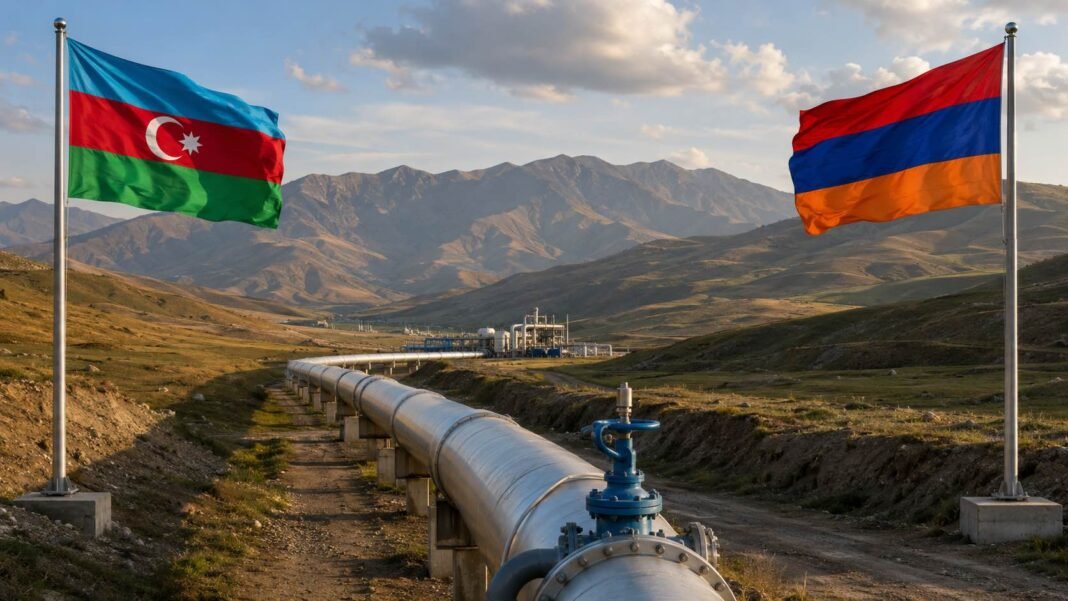
Azerbaijan could eventually help Armenia reduce its dependence on Russian natural gas, particularly if Moscow increases economic pressure on Yerevan, according to analysts participating in a joint Armenian-Azerbaijani media program.
The possibility was discussed by Baku-based political analyst Ahmad Alili and Yerevan-based expert Samvel Meliksetyan in the latest edition of “Events of the Week,” part of the Line of Contact program on Press Clubs TV.
Meliksetyan said deteriorating relations between Armenia and Russia have pushed Yerevan to search for alternative energy suppliers. Moscow has already imposed restrictions on several categories of Armenian exports, and future negotiations over Russian gas prices could become another source of pressure.
Armenia’s existing gas arrangement with Russia expires at the end of the year, after which the two countries will need to agree on new terms.
Armenia Turns to Iran
Yerevan is already seeking to expand energy cooperation with Tehran. Armenia and Iran recently agreed to establish a specialized working group focused on increasing natural gas trade and developing additional energy projects.
Iran has also proposed a new commercial model for expanding gas exports beyond the existing gas-for-electricity arrangement, under which Armenia returns approximately three kilowatt-hours of electricity for every cubic meter of Iranian gas it receives. The current agreement runs through 2030 and allows for higher trade volumes.
Meliksetyan estimated that the Iran-Armenia pipeline could potentially cover up to 90% of Armenia’s natural gas requirements but is currently operating at approximately 20% of its capacity.
Armenia consumes between 2.3 billion and 2.7 billion cubic meters of gas annually, he said. Iranian deliveries totaled approximately 476 million cubic meters last year, according to the figures he cited.
Significantly increasing imports from Iran would nevertheless require infrastructure upgrades. Armenia’s gas transportation system was designed primarily to move supplies from north to south, while larger Iranian deliveries would flow in the opposite direction.
New compressors and other equipment would therefore be needed to maintain sufficient pressure and distribute the gas across the country.
Could Azerbaijan Supply Gas?
Azerbaijan represents another potential alternative.
There is no operational direct gas connection between Azerbaijan and Armenia. However, supplies could potentially be arranged through Georgia’s infrastructure or through a swap mechanism involving regional energy companies.
Alili said Moscow has long operated under the assumption that Armenia has no viable alternative to Russia and will eventually be forced to return to its previous foreign policy and security model.
Yerevan is now attempting to demonstrate that it has other options by expanding relations with the European Union, Iran and Azerbaijan.
“Azerbaijan definitely wants Armenia to have many alternatives,” Alili said.
From Baku’s perspective, greater Armenian energy independence could strengthen the country’s sovereignty and reduce its exposure to political pressure from outside the South Caucasus.
Alili acknowledged that he was not an energy-market specialist and could not assess how much uncommitted gas Azerbaijan currently has available. Much of the country’s export capacity is already tied to long-term contracts with Turkey and European customers.
However, he argued that if Armenia required additional gas, Baku should consider the request within the broader context of regional stability.
Energy Trade Could Reinforce Peace
Azerbaijan has already begun supplying Armenia with limited quantities of petroleum products, including gasoline and diesel fuel. Natural gas would represent a much more significant stage of economic cooperation.
Such deliveries would face commercial, technical and political obstacles. The countries would need to agree on pricing, transit, payment mechanisms and guarantees protecting energy infrastructure.
Yet a gas arrangement could also create a form of mutual dependence that would make renewed confrontation more costly for both sides.
For Armenia, Azerbaijani gas could provide leverage in negotiations with Moscow and reduce the risk of supply disruptions. For Azerbaijan, energy trade with Armenia could help anchor the peace process in practical economic interests.
The project would therefore be more than a commercial transaction. It could become part of a new regional architecture in which neighboring countries depend less on external powers and more on direct cooperation with one another.
AZE.US