By AZE.US Editorial Team
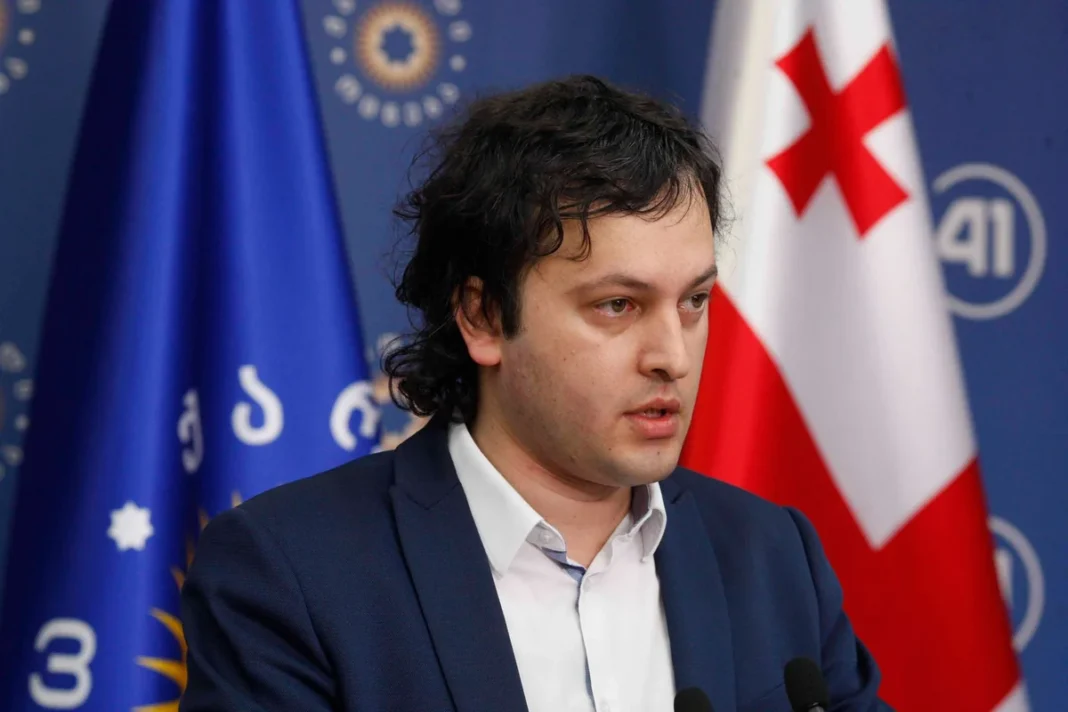
Georgian Prime Minister Irakli Kobakhidze’s speech marking the 11th anniversary of the country’s State Security Service was formally devoted to terrorism, corruption and external threats. Its political meaning, however, went far beyond a routine review of the agency’s work.
Kobakhidze claimed that foreign intelligence services and “destructive forces” had attempted to destabilize Georgia and overthrow its government through violence. Those efforts had been prevented, he said, but the threats themselves had not disappeared.
This was more than a warning about national security. It was a description of the political reality Georgia’s ruling establishment is steadily constructing: the country is under permanent attack, enemies operate both abroad and at home, and any weakening of government control could lead to unrest, a coup or even war.
Georgia does face genuine security challenges. Parts of its internationally recognized territory remain under Russian control, major wars are being fought nearby, and the country sits at the intersection of Russian, Turkish, European and American interests.
Georgia is also a vital transit state for energy and transport routes connecting Azerbaijan with Türkiye and European markets. Foreign intelligence activity, political interference and terrorism therefore cannot simply be dismissed as imaginary threats.
The real question is where the protection of the state ends and the protection of the ruling party begins.
Kobakhidze did not identify the intelligence services allegedly involved in attempts to overthrow the government. Nor did he offer detailed evidence or clearly define who the authorities consider to be “destructive forces.”
That vagueness is politically useful. The label can potentially be applied to opposition parties, nongovernmental organizations, journalists, protesters or foreign partners.
Once political opponents are no longer treated as legitimate participants in democratic competition and are instead portrayed as possible agents of a foreign conspiracy, the security services inevitably begin to acquire a political role.
That is the central danger now facing Georgia.
Relations between Tbilisi and the West have deteriorated sharply following mass protests, the adoption of legislation targeting foreign-funded organizations and the government’s decision to suspend its European Union accession efforts until 2028.
European institutions have described Georgia’s accession process as effectively stalled and have accused the authorities of democratic backsliding, pressure on protesters and restrictions on independent media and civil society.
The Georgian government presents the confrontation as a struggle for sovereignty. According to its narrative, foreign actors are trying to use NGOs, opposition parties and street demonstrations to engineer a change of power.
But sovereignty is not merely the ability of a government to suppress alleged conspiracies. It also depends on institutions trusted by citizens, an independent judiciary, free media and a political system in which governments can be replaced through elections rather than through force.
Kobakhidze was right to say that peace and stability are essential for economic and democratic development. Stability based almost entirely on control, however, eventually becomes political stagnation.
A government may restrict protests, cut off foreign funding, arrest opposition leaders and accuse critics of serving outside interests. Such measures cannot eliminate the reasons for public dissatisfaction. They can only push that dissatisfaction out of sight for a time.
There is also a striking contradiction in Georgia’s current security rhetoric.
While warning about unnamed foreign forces, the authorities increasingly avoid directly confronting the state that continues to exercise effective control over Abkhazia and South Ossetia.
Kobakhidze referred to the occupation of Georgian territories, but the central focus of his speech was not Russia. Instead, attention was directed toward unidentified foreign intelligence agencies and domestic “destructive forces.”
The result is a dangerous shift in priorities. A real external threat is pushed into the background, while internal political opponents become the primary focus of the security apparatus.
Developments in Georgia are particularly important for Azerbaijan. A stable and predictable Georgia is essential to the operation of regional energy, trade and transport corridors.
Real stability, however, cannot be built through a permanent search for enemies or by dividing society into “patriots” and “foreign agents.”
The more Tbilisi clashes with European institutions and restricts political competition, the less room Georgia will have for an independent foreign policy. A country that once tried to maintain ties with the West while avoiding confrontation with Moscow now risks losing that balance and drifting toward deeper international isolation.
Kobakhidze’s speech suggests that the government has increasingly chosen the model of a fortress state. In this system, the security services are expected not only to fight terrorism, espionage and sabotage, but also to serve as the principal guarantor of political stability.
The history of the South Caucasus offers a clear warning: when the security of the state becomes indistinguishable from the security of the ruling party, law enforcement institutions gradually stop protecting the constitutional order and begin protecting the political system in power.
Georgia may not have crossed that line completely. Kobakhidze’s remarks show, however, that it is moving dangerously close.
AZE.US