By AZE.US Editorial Team
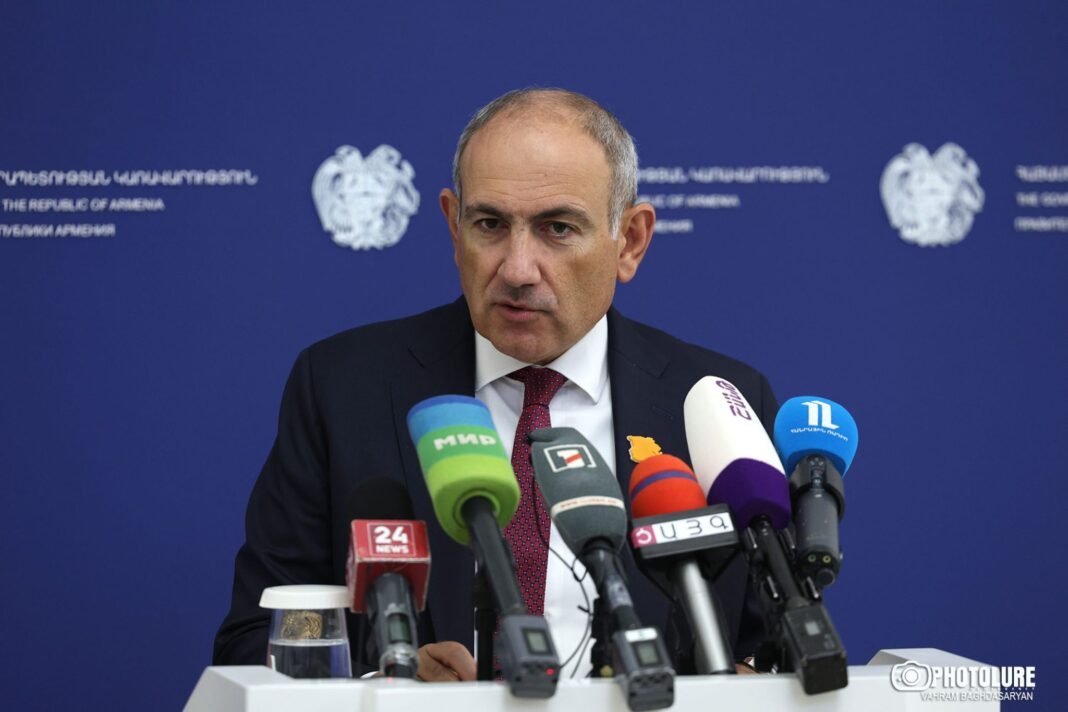
The meeting between Russian President Vladimir Putin and Armenian Prime Minister Nikol Pashinyan in Bishkek did little to resolve the widening disagreements between Moscow and Yerevan.
Behind the diplomatic language lies a question Armenia can no longer avoid: Can it move toward the European Union while retaining the economic advantages of the Russian-led Eurasian Economic Union and preserving its traditional relationship with Moscow?
Russia’s answer is clear: It cannot.
The EU and the EAEU have different customs rules, regulatory systems and trade policies. Putin has urged Armenia to hold a referendum and decide which direction it wants to pursue. Pashinyan argues that Armenia has not formally applied for EU membership, received candidate status or been offered an accession roadmap. Therefore, he says, there is not yet a concrete proposal to put before voters.
Pashinyan’s argument may be procedurally sound, but politically, Armenia’s period of strategic ambiguity is approaching its limit. Moscow wants an answer not because Armenia is about to join the EU, but because Russia needs to know whether Yerevan intends to remain within its economic and geopolitical orbit.
Sovereignty Requires Infrastructure
Armenian officials increasingly speak of a pivot toward the West. Yet the country’s foreign policy remains constrained by economic, energy, transportation and security dependencies accumulated over decades.
Russia remains Armenia’s largest trading partner. Even after bilateral trade fell by 21.5% in the first five months of 2026, Russia still accounted for approximately 28% of Armenia’s total foreign trade.
When Moscow restricts Armenian imports, Yerevan is forced to appeal directly to the Kremlin. Reuters reported that Pashinyan sought Putin’s intervention after Russia imposed restrictions on Armenian agricultural products and alcoholic beverages.
Armenia’s railway system has been managed since 2008 by South Caucasus Railway, a wholly owned subsidiary of Russian Railways. The 30-year concession is scheduled to remain in effect until 2038. Yerevan has proposed transferring management to a third party acceptable to Russia, but terminating or restructuring the agreement would require negotiations, compensation and a new investor prepared to modernize the network.
It is inaccurate to say Russia “leases” Armenia’s Metsamor Nuclear Power Plant. The facility belongs to Armenia. However, its second reactor, which produces more than one-third of the country’s electricity, depends heavily on Russian technology and expertise. Rosatom is overseeing work intended to extend the reactor’s operating life until 2036.
Russia also maintains its 102nd Military Base in Gyumri under an agreement running through 2044. Pashinyan recently said Armenia no longer considers the base’s presence a vital necessity and would not object if Moscow decided to withdraw its forces.
At the same time, he acknowledged that Armenia has not formally asked Russia to leave. His remarks were reported by Public Radio of Armenia.
That exposes the central contradiction in Yerevan’s strategy: Armenia wants greater independence but still appears to expect Moscow to dismantle its own instruments of influence voluntarily.
Great powers rarely surrender strategic positions simply because a smaller partner has begun reconsidering its orientation.
How Azerbaijan Built Strategic Autonomy
Azerbaijan also emerged from the Soviet Union within Russia’s traditional sphere of influence. But Baku began building the foundations of strategic autonomy soon after restoring its independence.
Azerbaijan did not announce a dramatic rupture with Moscow or turn relations with Russia into an ideological confrontation. Instead, it methodically created alternatives.
First came energy export routes that bypassed Russian territory. The 1,767-kilometer Baku-Tbilisi-Ceyhan pipeline connected the Caspian Sea to the Mediterranean and provided capacity to transport up to 1 million barrels of oil per day.
The South Caucasus Pipeline, TANAP and TAP followed, creating the Southern Gas Corridor and turning Azerbaijan into an independent supplier of natural gas to Türkiye and Europe.
Baku declined to join either the Collective Security Treaty Organization or the Eurasian Economic Union, preserving its freedom of action in defense, trade and foreign policy. At the same time, Azerbaijan maintained working relations with Russia and avoided allowing other powers to turn the country into an anti-Russian platform.
Russia stopped operating the Gabala radar station in Azerbaijan in 2012 after the two governments failed to agree on new lease terms.
In 2024, Russian peacekeepers withdrew from Karabakh ahead of schedule following Azerbaijan’s restoration of sovereignty over the region. The departure of nearly 2,000 Russian personnel took place without a public confrontation between Baku and Moscow, Reuters reported.
That is the defining feature of Azerbaijan’s experience. Baku did not try to push Russia out of the region through slogans. It ensured that Russia was no longer Azerbaijan’s only door to the outside world.
Why Armenia Cannot Simply Copy Azerbaijan
Armenia does not possess Azerbaijan’s Caspian energy resources, access to international energy corridors or comparable financial reserves. Its rail connections remain limited, its border with Türkiye is closed, and normal trade with Azerbaijan is only beginning to be discussed.
Armenia is also more deeply integrated into Russian-led economic and security structures than Azerbaijan ever was.
The Azerbaijani model therefore cannot simply be copied. But its central principle remains relevant: A country must build alternatives before it changes its geopolitical course.
If Yerevan genuinely wants to reduce its dependence on Moscow, opening EU offices, holding military exercises with Western partners and passing declarations about European integration will not be enough.
Armenia must complete the peace process with Azerbaijan, remove territorial claims, normalize relations with Türkiye and reopen regional transportation links.
Peace with its neighbors could provide Armenia with something political declarations from Brussels cannot guarantee: new markets, railway connections, investment and genuine freedom of choice.
Without open borders and alternative supply routes, a sudden withdrawal from the Russian system could produce an economic shock rather than sovereignty. Moscow has already demonstrated the leverage available to it, including import restrictions, energy pricing, migration policy and the possible loss of trade privileges within the EAEU.
The European Union, meanwhile, has not granted Armenia candidate status or offered a timetable for membership. Abandoning existing economic advantages in exchange for a promise that has not been made would be an extremely risky gamble.
Can Armenia Do It?
Armenia can reduce its dependence on Russia, but not quickly and not by replacing one patron with another.
It would require a long-term strategy to diversify energy supplies, trade routes, transportation infrastructure and security partnerships. Yerevan would need difficult negotiations with Moscow over the railway concession and military base, while preparing to absorb the financial costs of the transition.
Most importantly, Armenia’s path to strategic autonomy does not begin in Moscow or Brussels. It begins in the South Caucasus.
Azerbaijan succeeded because it spent decades building its own resources, alliances and export routes. Armenia is attempting to change its geopolitical direction while remaining inside the infrastructure of its previous alignment.
Azerbaijan did not simply move away from Russia. It learned how to maintain relations with Moscow without depending on its permission.
If Armenia wants to achieve the same, it must begin not with anti-Russian rhetoric, but with peace with Azerbaijan, normalization with Türkiye and economic reintegration into the South Caucasus.
Otherwise, its pivot toward the West will remain a compelling political gesture - without a viable road capable of taking the country there.
AZE.US