By AZE.US Editorial Team
There are statements that sound merely old-fashioned. And then there are statements that collide with the history of the country in whose name they are made.
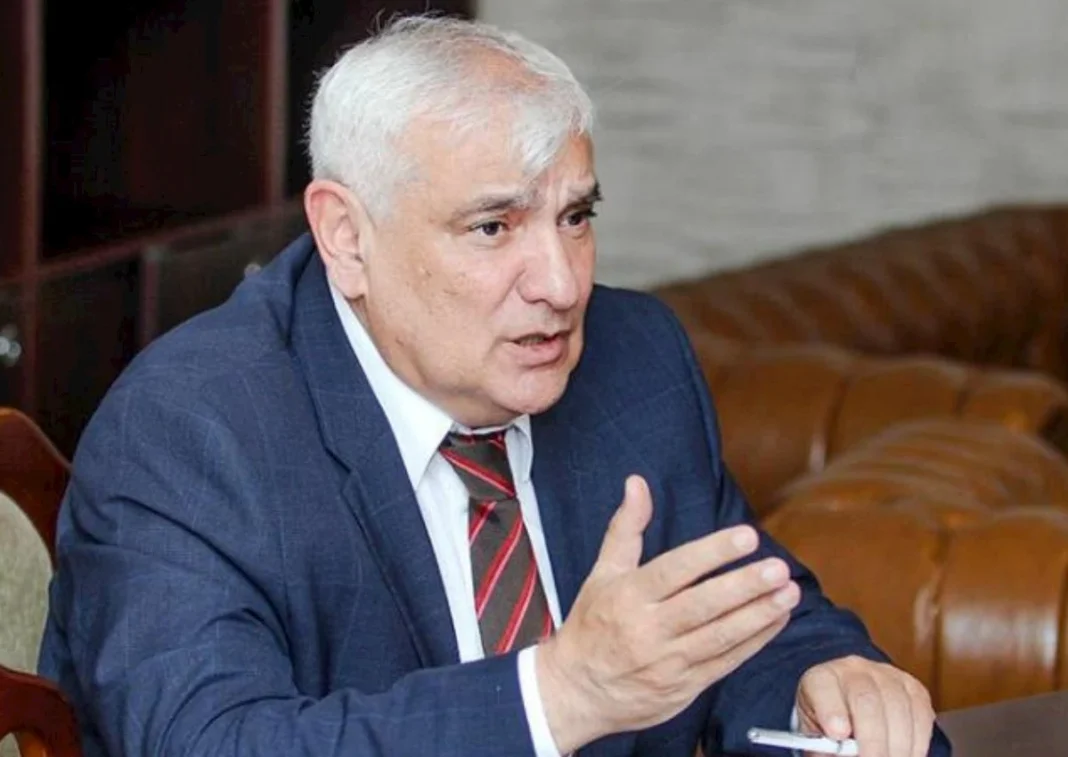
Kamal Abdulla, a prominent Azerbaijani writer, academic and rector of Azerbaijan University of Languages, has said that it would be better if women stayed at home, looked after their children and cared for their families.
“If a woman stays at home and looks after her children and family, it is better. That is how I think,” Abdulla said in an interview with Qafqazinfo, according to Azerbaijani media reports.
He went further. If some women, through “special talent,” manage to show themselves in certain circles, he said, that is another matter. But, in his view, if society directed women toward staying at home, in the kitchen and caring for children, it could bring more benefit to Azerbaijan.
This is not a harmless personal preference. It is a public message from the head of a university.
And that makes it different.
A private citizen may hold conservative views about family life. A parent may wish for a daughter to marry early or stay close to home. Families may argue over tradition, work, motherhood and modern life. These are real conversations in many societies, including Azerbaijan.
But when a university rector says the country may benefit from directing women toward the kitchen, the words carry institutional weight. They do not land as nostalgia. They land as a warning.
A university is supposed to tell young women that their minds matter. That their languages, ideas, ambitions and professional futures are part of the country’s future. It is supposed to expand the space of possibility, not quietly point half of its students back toward the stove.
Azerbaijan University of Languages is not a monastery of men debating women from a distance. Its classrooms are filled with young women studying languages, translation, diplomacy, education, journalism, culture and international communication. Many of them are preparing to become teachers, interpreters, public servants, researchers, editors, business professionals or diplomats.
What are they supposed to hear from such a remark?
Study, but know your “natural” place. Earn a diploma, but do not forget the kitchen. Build a career, but only if you are exceptionally talented enough to be treated as an exception.
That last part is especially revealing.
Men are rarely asked to prove “special talent” before being allowed into public life. A mediocre man may become an official, a professor, a manager, a commentator, a director or a permanent guest on television without anyone suggesting that society would benefit more if he stayed home with the children.
But women, apparently, must be exceptional just to be ordinary.
That is the real insult. Not only the kitchen. The condition attached to freedom.
A woman should not need to be a genius to have a job. She should not need to be unusually gifted to have a public voice. She should not need to be a national treasure before society agrees not to reduce her to unpaid domestic labor.
The issue is not motherhood. Motherhood is work. Family care is work. Raising children is one of the most important and least properly valued forms of labor in any society. A woman who freely chooses to stay home with her children is not backward, weak or invisible. She deserves respect.
But choice is the key word.
Feminism is not the demand that every woman leave home and enter an office. It is the demand that no woman be pushed into the home by custom, pressure, fear, financial dependence or the public philosophy of powerful men.
A woman may choose family. She may choose career. She may choose both. She may choose neither marriage nor children. She may become a mother, a minister, a scientist, a translator, a business owner, a rector, a judge, a journalist or a homemaker.
What she cannot be told - especially by the head of a university - is that society has already drawn the proper map of her life.
This is where Abdulla’s statement becomes larger than one interview.
Azerbaijan has a deeper and prouder history on this question than his words suggest. In 1901, Haji Zeynalabdin Taghiyev helped open a school for Muslim girls in Baku. At the time, educating girls was not a fashionable slogan. It was a social battle. Conservative resistance was real. The pressure was real. The fear of educated women was real.
Taghiyev understood something that still seems difficult for some educated men to accept in 2026: a nation cannot become stronger by keeping its daughters intellectually smaller.
The Azerbaijan Democratic Republic granted women voting rights in 1918, placing Azerbaijan ahead of many countries that now lecture others on democracy and gender equality. Azerbaijani women went on to become doctors, teachers, writers, scientists, artists, public figures and professionals. They helped carry families, institutions and communities through war, poverty, transition and state-building.
That is also Azerbaijan. Not only oil, war and geopolitics. Not only corridors and summits. Azerbaijan is also the country where the education of girls became a modernizing cause more than a century ago.
So when a rector tells women that the kitchen may be better for them, he is not defending national tradition. He is contradicting one of Azerbaijan’s strongest modern traditions.
He is arguing with Taghiyev. He is arguing with the women who entered classrooms when society was not ready for them. He is arguing with the mothers who educated daughters so they would not live under the same limits. He is arguing with the very students whose tuition, labor and ambition keep universities alive.
There is also a hard economic truth here. No country can afford to waste half of its human capital.
Azerbaijan speaks often about modernization, digital services, smart cities, artificial intelligence, global connectivity and post-conflict reconstruction. These are serious ambitions. But no modern economy is built by telling educated women that their highest social usefulness is domestic confinement.
Who will teach? Who will translate? Who will manage? Who will research? Who will build institutions? Who will represent the country abroad? Who will run businesses, clinics, classrooms, media platforms and public programs?
A society that trains women and then morally sends them home is not protecting tradition. It is burning its own investment.
And families do not become stronger when women have fewer choices. They become more fragile.
A woman with education, income and professional identity is not a threat to the family. She is often its backbone. She is better able to protect herself and her children. She is less vulnerable to humiliation, dependency and abuse. She can leave danger. She can negotiate respect. She can raise children who see partnership, not submission, as normal.
The home is not the problem. The kitchen is not the problem. The problem begins when home becomes a cage and the kitchen becomes a national policy.
That is why this conversation matters beyond one man’s words.
Azerbaijan does not need a war between men and women. It needs a serious defense of women’s full citizenship. It needs universities that speak clearly to their female students: you are not guests in public life. You are not exceptions. You are not tolerated because of “special talent.” You belong here because this country is yours too.
A rector has every right to value family. He has no moral right to reduce women to family service.
He has every right to admire motherhood. He has no right to turn motherhood into a polite argument against female freedom.
And he has every right to hold a personal view. But once that view is delivered from the height of academic authority, society has the right to answer just as publicly.
No, Azerbaijan will not benefit from keeping women at home.
Azerbaijan will benefit from women who are free to choose their lives. Women in universities. Women in families. Women in laboratories. Women in classrooms. Women in newsrooms. Women in courts. Women in business. Women in diplomacy. Women in public office. Women at home, if they choose home freely.
The difference is not cosmetic. It is the difference between dignity and permission.
In 1901, Azerbaijan opened a door for girls. In 1918, it recognized women as political citizens. In 2026, no rector, academic or public intellectual should be allowed to quietly point them back to the kitchen and call it social benefit.
Women do not need “special talent” to deserve freedom.
Some men in authority may need a stronger memory of their own country’s history.
AZE.US