By AZE.US
Azerbaijan is again debating the fate of an estimated 500,000 homes whose owners cannot obtain full property documents. Economist Natig Jafarli says the scale of the problem reflects not only violations by residents but also a failure of government oversight.
If approximately half a million homes in Azerbaijan lack complete legal documentation, one question is difficult to avoid: How could so many properties have been built without the knowledge of municipal and state authorities?
Economist Natig Jafarli raised the issue while discussing the country’s large number of so-called illegal homes.

According to Jafarli, as many as 14 government and municipal bodies are involved in overseeing construction, land use and property registration. Responsibility for the current situation, he argued, therefore cannot be placed entirely on homeowners.
“If 500,000 homes are illegal, where is the responsibility of the agencies that were supposed to supervise this sector?” he asked.
An Official Document That Is Later Rejected
One of the central problems is the unclear definition of an “illegal building.”
Many families did not seize land and build homes overnight. They received documents from municipalities or local executive authorities and constructed their houses on the understanding that those papers were valid.
However, when the leadership of a municipality or executive authority changed, new officials sometimes refused to recognize decisions issued by their predecessors. As a result, documents bearing an official seal were no longer sufficient for homeowners to obtain a state property deed, commonly known as a kupcha.
Jafarli argued that this practice undermines trust in public institutions. A document issued by an official body should not lose its legal force simply because the leadership of that institution has changed, he said.
The inconsistencies can sometimes be seen on the same street: several houses have state registration documents, while neighboring properties built under similar circumstances remain undocumented.
A 1,000-Manat Legalization Fee
Jafarli proposed a large-scale legalization program supported by a clear and affordable state fee – potentially 1,000 manats.
After resolving the accumulated problem, he said, the authorities could introduce much stricter controls to prevent new unauthorized construction.
Such an approach would draw a clear line between housing built under unclear rules over previous decades and any future violations.
Legalizing the properties would also bring hundreds of thousands of homes into the formal economy. Their owners would be able to sell, insure, mortgage and legally transfer their property through inheritance.
A major increase in the number of homes with state deeds could expand supply and affect prices in Azerbaijan’s housing market.
Compensation Far Below Nearby Prices
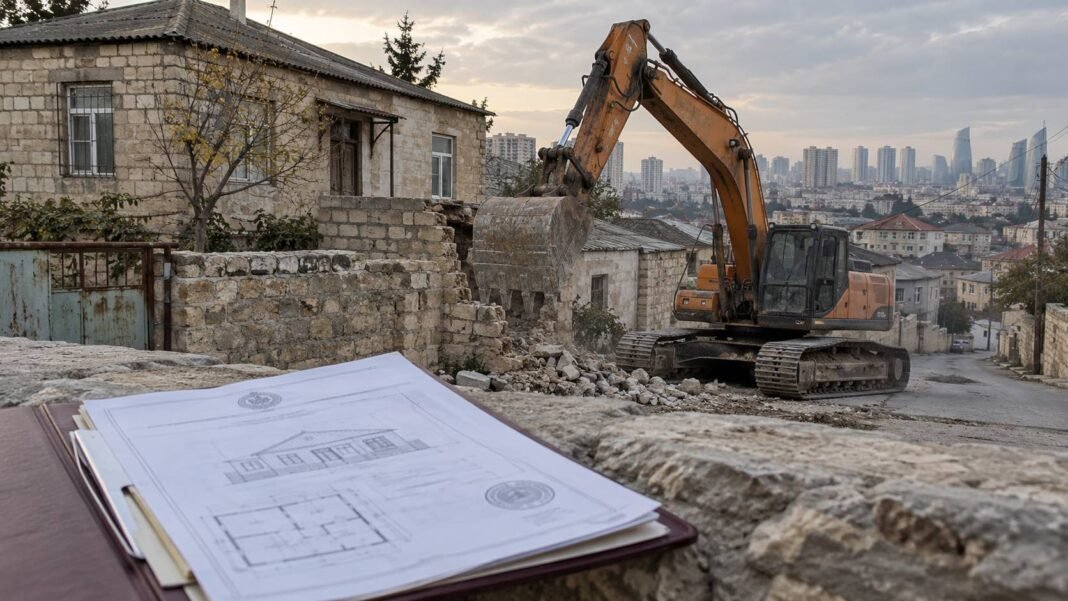
The issue is particularly sensitive in central Baku, where residents of older neighborhoods face demolition and relocation.
According to Jafarli, homeowners may be offered between 2,000 and 3,000 manats per square meter, while apartments in nearby new developments are sold for 6,000 to 8,000 manats per square meter.
A family accepting such compensation may therefore be unable to purchase a comparable home in the same neighborhood and could be forced to move to the outskirts of the capital.
For longtime residents, the loss involves more than the number of square meters listed in a property document. Some families have lived in central Baku for three or four generations. Their children grew up near Fountain Square, Baku Boulevard and other central public spaces.
Jafarli said monetary compensation alone cannot replace this social and cultural environment.
Let Residents Return After Redevelopment
One possible solution would be to provide former residents with apartments in the buildings constructed on the same site instead of permanently removing them from the neighborhood.
The developer could pay two or three years of rent in central Baku while construction is underway. Once the new building is completed and the apartment is renovated, the homeowner would receive housing of at least the same size.
Jafarli said versions of this model have already been used in parts of Yasamal and near the Inshaatchilar area. However, he argued that it is applied less frequently in central Baku, where newly built apartments command much higher prices.
Public Need or Private Development?
Jafarli also called for a clear distinction between property acquired for genuine public needs and homes demolished for private commercial developments.
Azerbaijani law allows property to be acquired for public purposes under specific circumstances, including infrastructure, public safety and major utility projects. However, many buildings constructed after demolitions are private residential or commercial developments.
In such cases, Jafarli questioned whether the government’s authority should be used to remove homeowners for the benefit of private developers.
He also said owners must be given sufficient time to challenge both the demolition decision and the proposed compensation in court. Beginning demolition while families, furniture and personal belongings remain inside a home would constitute a serious violation of property rights, he argued.
Why Property Rights Matter to the Economy
The issue extends beyond undocumented housing and urban redevelopment. Secure property rights are a basic requirement for investment and long-term economic growth.
When an official document can later be rejected, or when compensation is set far below the cost of replacement housing in the same area, public confidence in the legal system suffers.
A transparent legalization program, consistent registration rules and fair compensation could protect homeowners while bringing a large volume of property into Azerbaijan’s formal economy.
The central question is no longer simply why so many homes lack property deeds. It is how they were built over several decades under the supervision of numerous public institutions – and why responsibility is being discussed only now.
AZE.US