AZE.US
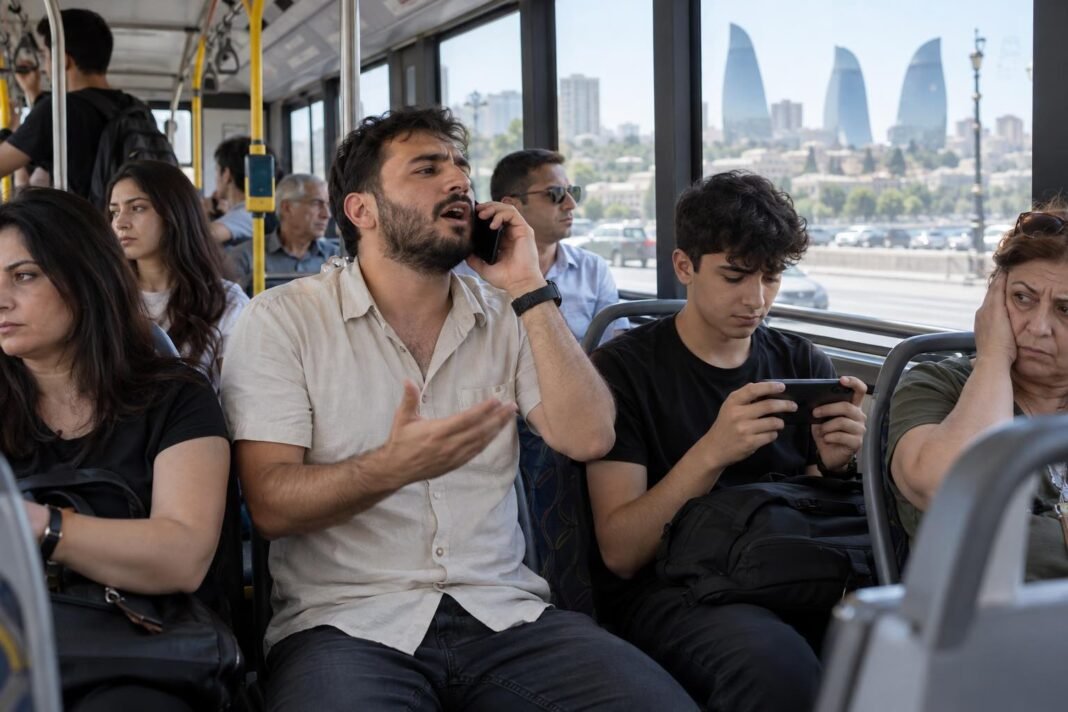
Loud phone conversations on buses, music blasting from cars, late-night renovations and noisy neighbors are becoming a persistent source of stress in Baku.
Sociologist Uzeyir Shafiyev says the problem requires continuous enforcement and a broader change in public behavior.
Noise pollution is becoming an increasingly visible problem in Azerbaijan’s capital. Residents encounter it on public transportation, inside apartment buildings and throughout the city’s streets and courtyards.
Uzeyir Shafiyev, head of the Department of Social Work at Baku State University, said the problem is particularly severe in large cities, where rapid urbanization and high population density force people to share limited space.
According to the sociologist, the argument that people can do whatever they want inside their own homes is misguided. Even in a private apartment, residents must respect their neighbors’ right to rest.
One Phone Call, an Entire Bus Listening
Loud conversations and videos played without headphones are among the most common disturbances on public transportation.
Some passengers hold video calls, watch livestreams, play music or use speakerphone, effectively forcing everyone else in the vehicle to listen.
“Public transportation is not a private car,” Shafiyev said. “Other passengers may not want to hear someone’s conversation or the content they are watching.”
Personal freedom, he argued, ends when it begins to interfere with the comfort and rights of others. Addressing the problem will require not only restrictions but also clear standards of conduct on buses and the Baku Metro.
Late-Night Renovations and Noisy Neighbors
Noise is also a frequent source of conflict in apartment buildings. Poor sound insulation in many properties amplifies ordinary household sounds, while loud music, shouting and construction work late in the evening can make life unbearable for neighbors.
Shafiyev said renovation work should be limited to permitted hours. Drilling or using loud equipment late at night is especially unacceptable when residents have returned from work and expect to rest.
Building management companies and housing cooperatives could display community rules in entrances and warn residents about possible penalties for repeated violations.
Not every dispute, however, needs to involve law enforcement. Many conflicts can be prevented through mutual consideration and advance notice to neighbors.
Urban Noise Can Affect Health
Constant city noise is more than a minor inconvenience. Prolonged exposure can contribute to irritability, fatigue, sleep disruption and psychological stress.
The sociologist said special attention should be paid to defective cars and motorcycles, as well as drivers who deliberately install excessively loud exhaust systems or misuse their horns.
Noise levels on city streets should be measured regularly, while vehicles exceeding permissible limits should be identified through continuous monitoring.
Shafiyev stressed that enforcement should not take the form of occasional campaigns. Oversight must be systematic and cover transportation, construction work and other major sources of urban noise.
Fines Alone Will Not Solve the Problem
Administrative penalties can discourage the most serious violations, but fines alone cannot create a culture of respectful urban living.
Residents need to understand why loud music, speakerphone conversations and nighttime renovation work infringe on the rights of others. Public-awareness messages could be displayed in apartment buildings and on public transportation, while television and social media could help promote basic standards of conduct.
The principle is straightforward: anyone who does not want to suffer because of other people’s behavior should avoid becoming a source of discomfort themselves.
In a densely populated city, quiet is no longer purely a private matter. It is part of public order and every resident’s right to a livable environment.
AZE.US