By AZE.US Editorial Team
The latest diplomatic mission by U.S. envoys Steve Witkoff and Jared Kushner has confirmed an uncomfortable reality: communication between Moscow and Kyiv may have resumed, but neither side is politically prepared to make the concessions required to end the war.
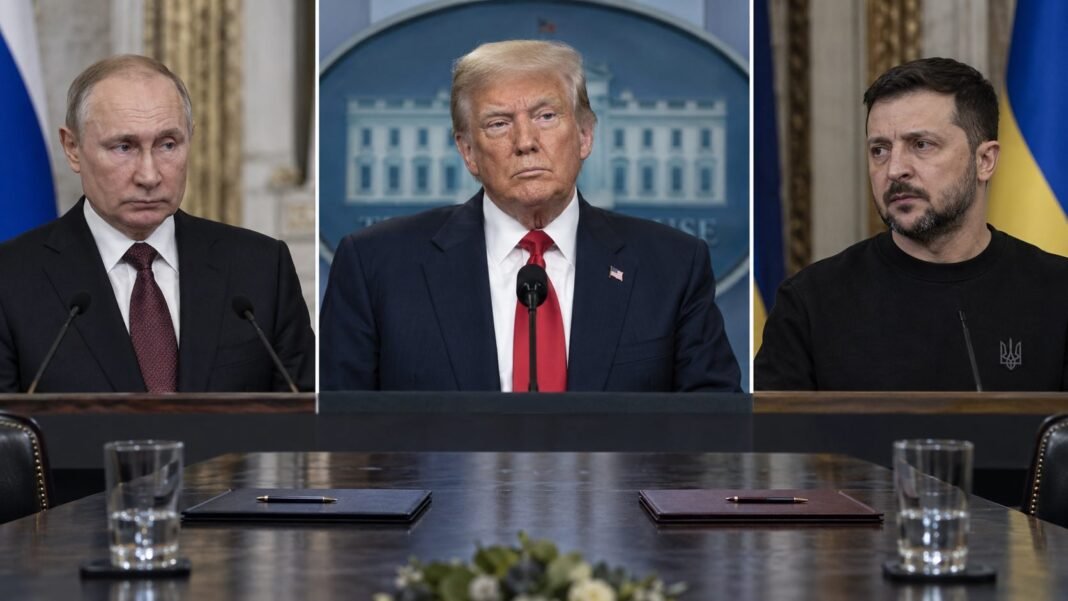
The American representatives held more than three hours of talks with Russian President Vladimir Putin in Moscow before traveling to Kyiv to meet Ukrainian President Volodymyr Zelenskyy. No breakthrough was announced.
The Kremlin subsequently said it did not rule out renewed trilateral talks involving Russia, Ukraine and the United States, but added that it was too early to discuss a venue or timetable.
The diplomatic channel is therefore open. The foundation for peace is not.
Moscow Needs an Outcome It Can Call a Victory
Russia is seeking more than a ceasefire along the current front line. Moscow wants the political recognition of territorial changes achieved through military force, restrictions on Ukraine’s armed forces and guarantees that Kyiv will not join NATO.
For the Kremlin, this is not only a strategic issue but also a domestic political necessity. After more than four years of war and enormous military, economic and demographic losses, the Russian leadership must be able to explain what the country has gained.
A ceasefire without a visible political achievement would immediately raise a difficult question inside Russia: if the declared objectives were not accomplished, what was the purpose of the sacrifices?
Putin therefore cannot easily abandon demands that have been presented to Russian society as essential. Even if the economy is under growing pressure and the military campaign has failed to produce a decisive victory, retreating from those goals may appear more dangerous to the Kremlin than continuing the war.
Kyiv Cannot Sign a Capitulation
Ukraine faces an equally difficult calculation.
Kyiv remains heavily dependent on Western military and financial support. It needs more air defense systems, money, ammunition and energy assistance to survive another winter of Russian attacks.
Yet accepting Moscow’s terms would not necessarily provide lasting peace. Withdrawing from Ukrainian-held territory, reducing the size of the army and accepting weak security guarantees could simply give Russia time to regroup before launching another offensive.
For Zelenskyy, agreeing to such conditions would amount to political suicide. Ukrainians would understandably ask why, after years of resistance, their country should voluntarily surrender fortified territory that Russian forces have not been able to capture.
This is the central deadlock. Moscow is demanding decisions that Kyiv views as capitulation, while Ukraine is seeking security guarantees that Russia considers a threat to its own strategic position.
Trump Is Offering a Deal, Not Just Diplomacy
President Donald Trump’s approach differs from traditional diplomacy. He is attempting to turn a settlement into a broader political and economic bargain.
That package could include sanctions relief, frozen Russian assets, the restoration of economic ties, energy projects and Moscow’s future relationship with Washington.
The selection of Witkoff and Kushner reflects that deal-making logic. Russia is being asked to weigh not only what it might still gain on the battlefield, but also what it could recover economically by ending the war.
However, a deal becomes possible only when both sides conclude that compromise is less dangerous than continued fighting. That point has not yet been reached.
Russia appears to believe it still has the resources to increase pressure on Ukraine. Kyiv hopes Western support, domestic weapons production and long-range attacks on Russian military and energy infrastructure will gradually change the balance.
Both sides are preparing for a difficult winter, not for postwar reconstruction.
A Ceasefire Is More Realistic Than Peace
A comprehensive peace agreement remains unlikely in the near term. The more realistic scenario is a ceasefire broadly based on the existing front line, possibly accompanied by international monitoring and a special arrangement for the Zaporizhzhia nuclear power plant.
Even that option leaves critical questions unanswered.
Who would monitor the front line? What would happen after a violation? Would Ukraine continue receiving weapons? Would sanctions against Russia be partially lifted? What security guarantees would prevent the ceasefire from becoming a temporary pause before another war?
Without a credible enforcement mechanism, a ceasefire could become an intermission rather than an ending.
Azerbaijan understands better than many countries that a ceasefire and peace are not the same thing. A truce may stop the immediate loss of life, but it does not automatically resolve the causes of a conflict. Unsettled disputes can remain frozen for years before erupting again with even greater force.
Ukraine therefore needs more than a Russian promise not to attack again. It needs guarantees capable of functioning during the next crisis, not merely language that looks reassuring on paper.
The Outcome Depends on More Than Moscow and Kyiv
Washington can pressure Ukraine by limiting weapons deliveries and financial assistance. Europe can replace part of that support, but European decisions are slower and require agreement among numerous governments.
China, meanwhile, holds some of the most significant leverage over Russia. Moscow depends heavily on Chinese markets, technology, industrial components and energy purchases.
If Beijing concludes that the war is damaging its economic interests, Russia will find it much harder to ignore demands for a ceasefire. China, however, will not apply such pressure for free. Its involvement would become part of a much larger negotiation with Washington over trade, sanctions, technology and global influence.
The war has therefore long ceased to be a conflict involving only Russia and Ukraine. Ending it requires at least a partial alignment of interests among Washington, Moscow, Kyiv, European capitals and Beijing. That alignment does not yet exist.
Why It Matters to Azerbaijan
For Azerbaijan, the outcome will have direct consequences. It will influence Russia’s posture in the South Caucasus, global energy prices, sanctions risks, regional transport routes and Moscow’s ability to project power across the former Soviet space.
Baku has an interest in an end to the war that reduces regional instability and restores predictability to international trade. But a settlement that simply legitimizes territorial changes imposed by force could establish a dangerous precedent.
The region therefore needs more than just any peace agreement. It needs a sustainable settlement that does not prepare the ground for another war.
The Witkoff-Kushner mission has shown that bargaining has begun. The agenda now extends beyond territory and weapons to sanctions, frozen assets and future economic relations.
But the war will not end simply because Trump wants to announce another diplomatic success. It will end when Moscow and Kyiv both decide that continued fighting costs more than compromise.
For now, neither side has reached that conclusion. The coming months are therefore more likely to bring another attempt to improve negotiating positions on the battlefield than a lasting peace at the negotiating table.
AZE.US