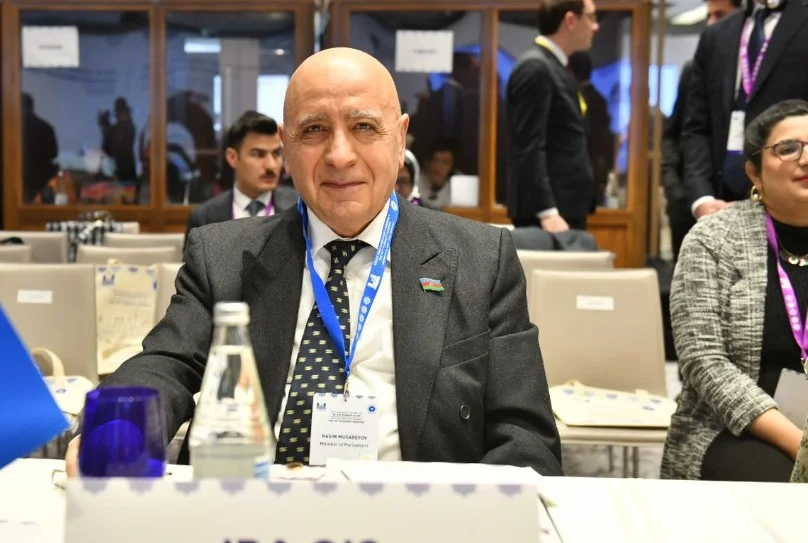
BAKU, Oct. 19 - Azerbaijan’s alliance with Turkey does not require Baku to clear its foreign policy with Ankara or accept interference in its domestic affairs, lawmaker and political analyst Rasim Musabekov said.
Speaking on the Caucasus News channel, Musabekov argued that disputes over school headscarves and relations with Israel had exposed attempts by some Turkish politicians to turn support for an ally into political leverage.
“There is a desire in Turkey to behave toward Azerbaijan as a patron. Azerbaijan accepts no patrons,” he said.
Musabekov said the school-uniform and hijab controversy was a trigger for disagreements extending beyond religion to Azerbaijan’s independence in security, energy and its choice of international partners.
Support in Karabakh Does Not Confer Control
Musabekov rejected the idea that Turkish assistance during the Karabakh war entitled Ankara to impose political conditions on Azerbaijan.
It was the Azerbaijani army that fought the war, he said. Turkish advisers and military-technical cooperation played a role, but that did not justify attributing the recovery of territory to another state.
Azerbaijan paid for the weapons it purchased, he added. Cooperation should not be treated as a one-sided favor that Baku must repay through foreign-policy concessions.
Alliances require reciprocal support, Musabekov said, pointing to Azerbaijani investment in Turkey, gas supplies, financial assistance and help following the devastating earthquake.
He put Azerbaijani investment in Turkey at about $20 billion and Turkish investment in Azerbaijan at about $16 billion. He also cited $100 million allocated to rebuilding Kahramanmaras. Azerbaijan’s presidency has described the Azerbaijan Quarter built there with Azerbaijani financing as a $100 million project.
Baku should not turn its own assistance into a list of counterclaims either, he argued, saying the two countries were working toward common goals rather than keeping a ledger of obligations.
Northern Cyprus and Israel
Musabekov cited pressure to recognize Northern Cyprus and involve the State Oil Company of Azerbaijan, SOCAR, in exploration on a disputed continental shelf as examples of demands Baku should resist.
Such steps, in his assessment, could seriously complicate relations with the European Union and jeopardize energy cooperation with Europe.
He also rejected demands to weaken relations with Israel, linking that partnership in part to Azerbaijan’s ties with the United States. His concern was a model in which Baku progressively restricted its other international relationships and had to conduct its most important external contacts through Ankara.
Azerbaijan’s ties with Turkey were fraternal and allied, he said, but remained relations between sovereign, independent states. Ankara would have to respect Baku’s independent policy whether or not individual politicians welcomed it.
Musabekov nevertheless said he did not expect the alliance to unravel. Its military cooperation, energy infrastructure, trade, education links and close social ties were stronger than individual diplomatic incidents or public attacks.
He cited a $500 million arms deal with Turkish manufacturers amid the disagreements as evidence of that resilience. APA reported on Sept. 30 that a package of defense contracts exceeded $500 million, citing Turkey’s defense-industry chief Haluk Görgün.
The current episode would be overcome, Musabekov said, but lessons should be drawn from it.
Territorial Exchanges Need More Than Equal Area
On Armenian-Azerbaijani relations, Musabekov supported a territorial exchange to resolve the enclave and exclave issue, while cautioning that equal land area would not necessarily make a deal equivalent in value.
Road locations, the importance of territory for transport links and security considerations must also count, he said.
He distinguished the Armenian enclave of Bashkend, known in Armenia as Artsvashen, from Azerbaijani exclaves associated with important transport routes inside Armenia. If Armenia wanted something important to it, he argued, it should offer something important to Azerbaijan, not merely an equivalent piece of land.
Rebuilding isolated settlements within a neighboring country, returning residents and maintaining secure access would be expensive and impractical, he said. An agreed exchange could avoid those difficulties.
Practical Peace Work Over Signing Deadlines
Musabekov opposed rushing a constitutional referendum in Armenia solely to accelerate a peace treaty. Armenia’s domestic political circumstances mattered, he said: a failed vote could weaken Prime Minister Nikol Pashinyan without bringing a settlement closer.
Constitutional changes could combine several questions, including Armenia’s foreign-policy orientation and removal of a reference to its Declaration of Independence, he suggested.
He regarded practical progress on the border and transport connections as more significant than arguments over signing dates, saying the start of work on the ground on TRIPP was particularly important to him.
Musabekov also proposed interest sections before full diplomatic relations: an Armenian section at Georgia’s embassy in Baku and an Azerbaijani section at Kazakhstan’s embassy in Yerevan. In his view, that arrangement could help the two countries address bilateral issues while formal diplomatic relations remained absent.