AZE.US
Baku commuters are preparing for nearly a year of difficult journeys as construction work forces a temporary separation of the capital’s Red and Green metro lines.
Beginning August 15, direct train service between Nizami and 28 May stations will be suspended for approximately 10 to 11 months. Passengers traveling between the two lines will instead have to use temporary express buses or other surface transport.
The decision to charge passengers for the replacement buses has already triggered criticism, with commuters arguing that they will be forced to pay more and spend additional time traveling because of a state infrastructure project.
“I will have to get off at Nizami, take a bus and pay again just to reach 28 May,” one passenger said. “It is both an extra expense and a waste of time.”
Another commuter said the changes could effectively double the cost of a daily round trip for passengers who need both the metro and a shuttle bus.
Six Temporary Express Routes
Baku Metro said six temporary express routes, designated M1 through M6, will be introduced to connect major metro stations and help passengers bypass the closed section.
A total of 87 buses will operate on the new express routes, while another 97 buses will be added to existing city routes.
The temporary services will connect stations including 28 May, Nizami, 20 January, Inshaatchilar, Elmler Akademiyasi, Ganjlik and Koroglu.
Authorities say information about alternative routes and temporary travel arrangements will be distributed through stations, digital platforms and public information campaigns.
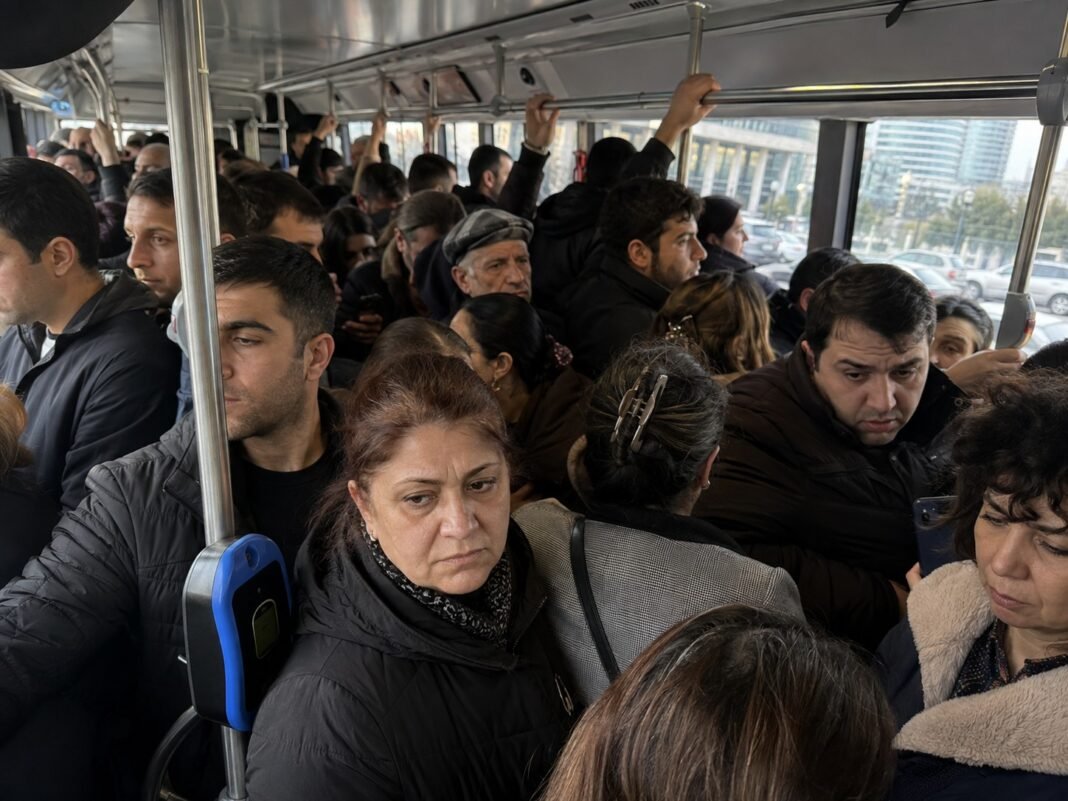
However, transport specialists warn that even a large number of buses will struggle to replace the capacity of the metro during rush hour.
Buses Cannot Fully Replace Trains
Transport expert Elmaddin Muradli said replacing metro trains with buses would be extremely difficult in practice.
According to him, at least seven or eight large buses would be needed to carry the number of passengers transported by a single metro train.
Even dedicated bus lanes would not fully solve the problem, he said, because passengers leaving the metro will be traveling in different directions and will place additional pressure on roads, bus stops and nearby intersections.
“The buses will reduce some of the burden, but they will not be able to meet the entire demand,” Muradli said.
The increased use of buses, taxis and private vehicles could also worsen congestion across central Baku.
Stations expected to face the heaviest pressure include Nizami, 28 May, 20 January, Ganjlik and Elmler Akademiyasi, where large numbers of passengers, buses, taxis and private cars could converge during peak hours.
Calls for Free Replacement Transport
Road traffic expert Arshad Huseynov argued that the shuttle routes should be free because the disruption is directly connected to a government-funded construction project.
He said the operating cost of the temporary buses should have been included in the project’s overall budget.
According to Huseynov, free replacement transport would represent only a small percentage of the total investment required for the metro construction work.
“It would have been better to include the cost of the temporary replacement routes in the project and make the express buses free of charge,” he said.
Huseynov warned that additional expenses and longer travel times could push some commuters away from the metro altogether.
Some may switch to existing bus routes, while others may increasingly rely on taxis or private cars. If passengers find those alternatives more convenient during the 10- to 11-month disruption, some may not return to the metro after the work is completed.
That could reduce metro ridership while adding even more vehicles to Baku’s already congested streets.
Difficulties for Elderly and Disabled Passengers
The changes are also likely to create particular difficulties for elderly passengers, people with disabilities, parents traveling with children and commuters carrying heavy luggage.
Instead of making a direct underground transfer, passengers will have to leave the station, reach a bus stop, wait for a shuttle and then enter the metro system again.
The process may become especially difficult during bad weather and peak travel periods, when queues and overcrowding are expected around temporary stops.
Clear signs and staff assistance will be essential, particularly for passengers who do not regularly use mobile transport applications.
Why the Metro Lines Are Being Separated
The construction project will create a new tunnel of approximately 200 meters connecting the Jafar Jabbarli section with the Green Line near Nizami station.
During the work, Red Line trains will continue operating through 28 May station. Green Line trains will operate between Darnagul and Nizami, while the Nizami-28 May connection will remain closed.
After the project is completed, the Red and Green lines will operate independently.
At present, disruptions or delays on one line can affect the other because both share part of the same infrastructure.
Baku Metro says separating the lines will improve reliability, reduce crowding at 28 May station and allow shorter waiting times.
The interval on the Jafar Jabbarli-Khatai section is expected to fall from approximately eight minutes to three minutes and 30 seconds. Future infrastructure upgrades could eventually reduce train intervals on both lines to around two minutes.
Baku Metro also says its wider expansion program, including the planned construction of 10 new stations, could increase annual passenger capacity by 88 million journeys.
The long-term benefits could be significant, but for passengers the immediate concern is how the city will manage almost a year of additional costs, transfers, delays and road congestion.
The success of the temporary system will depend not simply on the number of buses provided, but on whether authorities can maintain reliable schedules, prevent overcrowding and introduce a fair payment system for passengers forced to change their daily routes.
AZE.US