By AZE.US Editorial Team
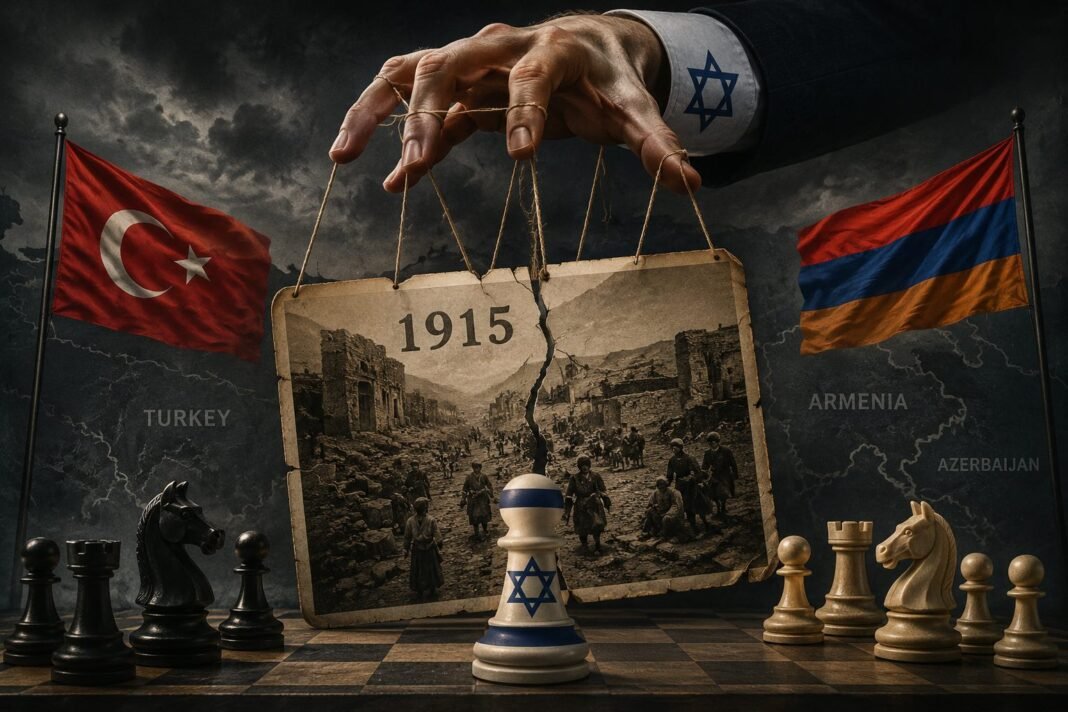
Israel’s decision to support recognition of the 1915 events as genocide does not look like an act of historical memory. It looks like a political move, aimed less at Armenia and more at Turkey.
The key question is not only what Israel has decided to say about events that took place more than a century ago. The real question is why it has decided to say it now.
For decades, Israeli governments avoided such a step. The reason was obvious. Turkey was too important for the regional balance, security calculations, trade, military logistics and Israel’s broader relationship with the Muslim world. In Jerusalem, policymakers understood very well how sensitive Ankara is about the legal qualification of the 1915 events as genocide.
Today, the political environment has changed.
Relations between Israel and Turkey are in one of their deepest crises in years. Ankara has become one of the sharpest critics of Israel’s actions in Gaza. President Recep Tayyip Erdogan has repeatedly accused Prime Minister Benjamin Netanyahu’s government of brutality toward Palestinians. International pressure on Israel is growing, while Netanyahu himself is under serious domestic and external pressure.
It is against this background that Israel has suddenly pulled the Armenian issue back onto the table.
If this were purely about historical justice, the step could have been taken earlier. It could have been taken at a calmer moment. It could have been taken without the clear connection to today’s confrontation with Turkey. It could have looked like an independent moral position, not a tactical political strike.
But the timing is too precise to be accidental.
Netanyahu needs a symbolic answer to Turkey. He needs to show that Israel can hit back not only militarily, but also through painful historical questions. He also needs to shift part of the attention away from Gaza, international criticism and his own political problems toward a dispute that is guaranteed to provoke Ankara.
The problem is that the force of such a move weakens when the calculation behind it is so visible.
Turkey will not change its historical position because of a decision by the Israeli government. Ankara has rejected the legal classification of the 1915 events as genocide for decades and insists that this subject should be handled by historians, not used by parliaments and governments as an instrument of pressure.
Moreover, Israel’s decision gives Turkey an additional argument. A government that is itself under intense international criticism over Gaza is now trying to assume the role of moral judge over events from more than a century ago. That is not a convincing position.
The moral weight of a political statement depends not only on its content, but also on the moment in which it is made. When a government accused by many countries and international institutions of excessive use of force suddenly speaks the language of historical responsibility, the natural question is whether this is memory or distraction.
In this case, the answer looks too transparent.
For Azerbaijan, this move cannot be viewed as neutral either. Turkey is Azerbaijan’s closest ally, and any attempt to use the 1915 issue as leverage against Ankara is naturally watched with concern in Baku.
This is especially true at a time when the South Caucasus is going through a difficult transformation. The agenda includes a peace agreement between Azerbaijan and Armenia, the opening of regional communications, the future of the Zangezur route, the role of the Middle Corridor and the emergence of a new regional security architecture. At such a moment, external actors could help the region move forward. Instead, Israel has added another irritant to an already sensitive agenda.
There is also an Armenian dimension. Prime Minister Nikol Pashinyan has been trying, slowly and often inconsistently, to move Armenia away from the logic of permanent historical mobilization. Armenia needs open borders, transport links, economic normalization, peace with Azerbaijan and at least a limited chance for pragmatic relations with Turkey.
But every time outside actors use the Armenian historical issue for their own political purposes, Armenia is pulled back into the past. Not toward the future, but toward an old diaspora-driven agenda in which symbolic recognition matters more than real roads, trade, security and state interests.
So the question is not only why Israel needs this move. The question is also whether it helps Armenia itself.
Most likely, it does not.
Israel, of course, has the right to make its own political decisions. But every decision has a price. In this case, the price may be higher than the symbolic benefit. Relations with Turkey will deteriorate further. Dialogue with the Muslim world will become more difficult. And in Azerbaijan, where ties with Israel have long been built on pragmatism, security and mutual interests, this move will inevitably raise questions.
The main question is simple: if Israel considers Azerbaijan an important partner, why support a step that is deeply sensitive for both Baku and Ankara?
The likely answer is uncomfortable for Israel itself. This decision was probably not made with the South Caucasus in mind. It was not made for Armenian-Turkish reconciliation. It was not made for historical dialogue. It was made for Netanyahu’s immediate political battlefield.
That is why its legal weight is limited, its moral authority is questionable and its political meaning is clear.
Israel has not opened a new page of historical memory. It has taken an old wound and tried to turn it into leverage.
But when the past is used so openly as a political instrument, it stops looking like memory. It becomes pressure. And an instrument pulled out at a moment of political weakness says less about the past than it does about the fears of the present.
AZE.US