By AZE.US Editorial Team
Russia loves to call itself an energy superpower.
Oil, gas, pipelines, tankers, global markets, grand maps on Kremlin walls.
Then an ordinary driver pulls up to a gas station and asks a very simple question: where is the fuel?
That is Vladimir Putin’s problem in one sentence.
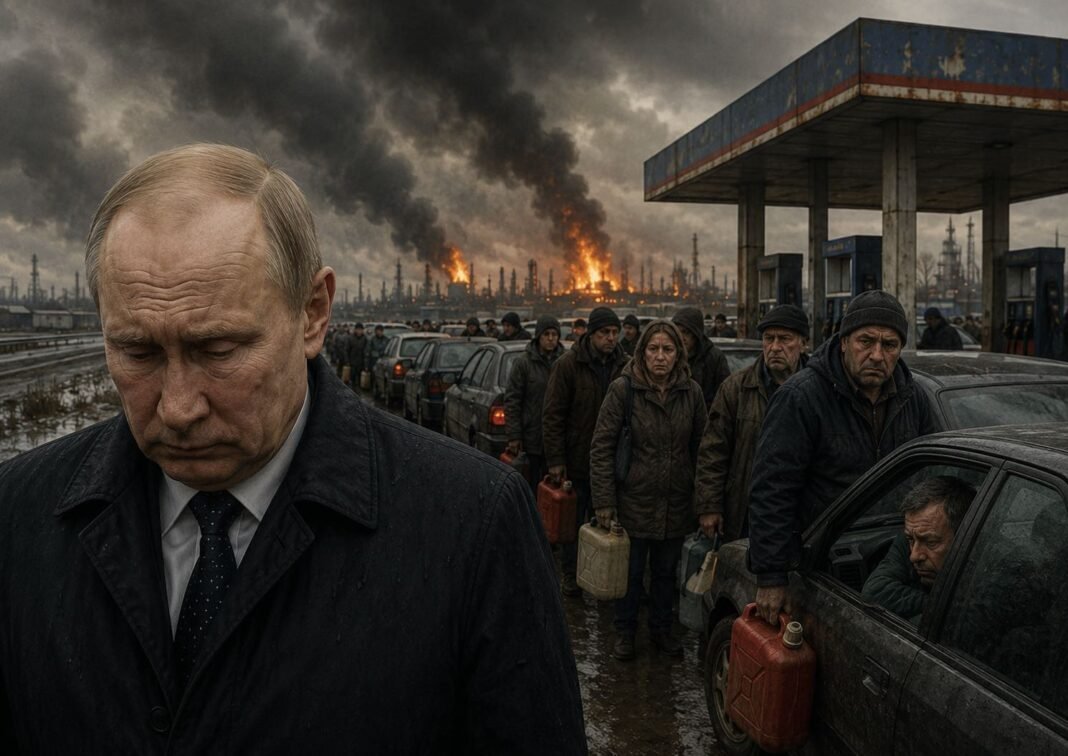
Russia’s fuel crisis is no longer just a regional inconvenience. It is not merely a logistics glitch, seasonal pressure or another bureaucratic failure. It is the war coming home to the basic machinery of Russian life.
Not to television studios. Not to military parades. Not to patriotic slogans. To the gas pump.
And that is far more dangerous for the Kremlin than it may look at first glance.
For years, Putin sold Russians a simple bargain: do not ask too many questions, and the state will preserve the appearance of order. The war is somewhere else. The sanctions are somewhere else. The losses are somewhere else. At home, there will still be fuel, groceries and the feeling that the authorities remain in control.
Now that myth is cracking.
When a country sitting on enormous oil resources begins to face fuel disruptions, every official explanation sounds weak. The Kremlin can talk about temporary difficulties, repairs, seasonal demand and enemy plots as much as it wants. For ordinary people, the picture is much simpler: if fuel is missing or becoming more expensive, something has gone wrong.
And it has gone wrong under Putin.
He is trapped in a situation with no clean exit.
If the Kremlin admits the scale of the problem, it admits that Ukraine has found a painful pressure point inside the Russian economy. If it pretends everything is under control, queues, limits and local panic say otherwise. If Putin escalates the war, attacks on infrastructure may continue. If he looks for negotiations, the entire image of the unbending wartime leader begins to collapse.
This is Putin’s stalemate.
He cannot stand still. He cannot retreat. Moving forward is becoming more expensive every month.
The most uncomfortable part for the Kremlin is that fuel connects almost everything. This is not an elite problem that can be hidden inside government reports. Fuel is needed by farmers, truckers, the military, taxi drivers, regional businesses and ordinary families. Any disruption quickly turns into higher prices, public irritation and the one question the authorities hate most: what is all this for?
Ukraine appears to have found a nerve in the Russian system. It does not need to destroy the entire oil industry to create political pressure. It only needs to keep showing that Russia’s rear is no longer untouchable. Refineries, depots, logistics and processing capacity are now part of the battlefield.
Putin built this war as a one-way instrument of pressure. Russia attacks, Ukraine absorbs. Russia threatens, others react. Russia dictates, everyone else calculates.
That logic is changing.
The war is returning to Russia not only through drones and fires, but through daily discomfort. That may be the most toxic kind of pressure for the Putin system. Russians can tolerate abstract losses for a long time. They are less patient when geopolitics starts reaching into their own wallets.
So what does Putin do next?
Most likely, nothing original.
He will reach for the old toolkit: bans, manual control, export restrictions, priority supplies for the army, threats against businesses, televised meetings, scapegoats and another wave of propaganda.
Someone will be blamed.
A regional official. A trader. “Speculators.” The West. Ukraine. Anyone except the man who launched the war and continues it at any cost.
But the problem is not traders or governors. The problem is that Russia’s war machine is beginning to consume its own economic base. A country can still export oil and at the same time struggle with refining, delivery and domestic balance. That is not a paradox. It is the price of war.
Putin may try to wait out the crisis. That is what he usually does: delay, pressure, subsidize, ban discussion and invent a new formula of control.
But a fuel crisis is difficult to treat with television.
Propaganda can call defeat a victory. It can call retreat a regrouping. It can turn isolation into sovereignty.
But it cannot fill a tank. That is the Kremlin’s nightmare.
Putin wanted Russians to see the war as a grand historical confrontation. Now more of them may begin to see it as a source of queues, shortages, expensive logistics and declining living standards.
This is no longer geopolitics. It is the receipt at the gas station.
And the longer the war continues, the more often that receipt will arrive for Russian society itself. Putin can keep pretending he controls the situation. But the fuel crisis points in the opposite direction: control is becoming more expensive, more fragile and more temporary.
The energy superpower has suddenly discovered that its weak point is not in Washington, not in Brussels and not even only on the front line.
It is at home. At the pump.
AZE.US