By AZE.US Editorial Team
History rarely returns to international politics on its own. More often, it is brought back when it becomes useful.
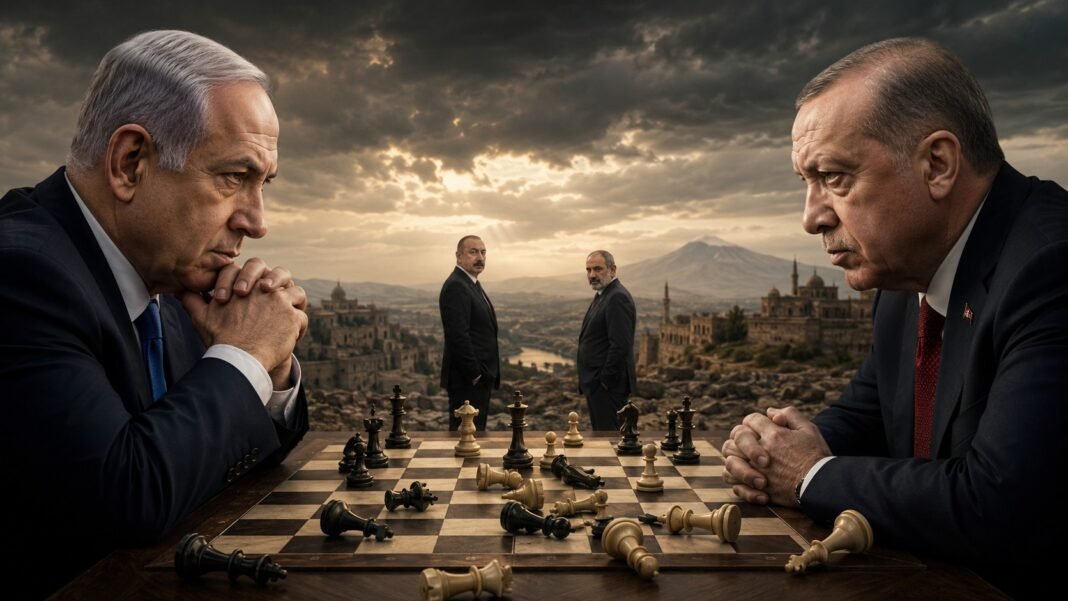
That is exactly how Israel’s latest move on the Armenian issue looks. Foreign Minister Gideon Saar is reportedly preparing to bring to the government a proposal for Israel to officially recognize the Armenian genocide. Formally, the language is noble: moral duty, historical memory, and the rejection of denial. But the central question remains obvious: why has this moral duty awakened now, after decades of silence?
The answer is probably not in the archives. It is in the current crisis between Israel and Turkey.
Ankara and Jerusalem are no longer simply going through a period of diplomatic tension. After the war in Gaza, President Recep Tayyip Erdogan’s harsh statements, Turkey’s active support for the Palestinian cause and Ankara’s growing regional ambitions, the dispute has become part of a wider struggle for influence in the Middle East.
Turkey is no longer the secular Kemalist partner Israel once relied on. It has become a more independent regional power, speaking directly with Washington, building influence in Syria, the Caucasus, the Eastern Mediterranean and across parts of the Islamic world.
In this context, recognition of the Armenian genocide becomes not only an act of memory, but also a precise strike at one of the most sensitive points of Turkish statehood.
For Turkey, this is not only about the past. Ankara has for decades rejected the legal qualification of the events of 1915 as genocide and has insisted that the issue should be approached historically rather than politically. That is why every new act of recognition is seen in Turkey not as a neutral humanitarian gesture, but as a form of pressure on the Turkish state.
Turkey is therefore in a difficult position. On the one hand, it has strengthened its regional role and become far less dependent on old channels of influence. On the other hand, the more visible Turkey becomes, the more its opponents will search for painful pressure points. The Armenian issue, in that sense, becomes a convenient diplomatic instrument.
But the situation is even more delicate for Azerbaijan.
Baku is bound to Turkey by alliance, strategic coordination and the principle of “one nation, two states.” At the same time, Azerbaijan has important relations with Israel, built over many years and carrying real weight in security, energy, technology and regional balance.
That is why an Israeli move of this kind creates an uncomfortable dilemma for Baku. Azerbaijan cannot remain indifferent when a deeply sensitive issue for Turkey is used in a political confrontation. But it also cannot automatically damage a strategic partnership that serves Azerbaijan’s national interests.
This is where Azerbaijan’s position should be firm, but pragmatic. Israel has the right to make its own decisions.
But it should also understand that if historical memory is used as a tool against Turkey, Baku will inevitably read it as an unfriendly political signal. Azerbaijan does not have to turn this issue into a full crisis with Israel, but it does have to make clear that Turkey’s interests cannot simply be placed outside the equation.
There is another important question that many prefer to avoid: does Nikol Pashinyan himself actually want this recognition now?
At first glance, any act of international recognition of the Armenian tragedy should look like a diplomatic gain for Yerevan. But today’s Armenia is no longer living only by the logic of diaspora politics and historical resolutions.
After the defeat in Karabakh, Pashinyan has been trying to build a new line: peace with Azerbaijan, normalization with Turkey, recognition of Armenia’s real borders and an attempt to pull the country out of old conflict traps.
He has repeatedly signaled that Armenia’s foreign policy should focus not on an endless return to the past, but on statehood, peace and the opening of communications. Armenian officials have also made clear that international recognition of the genocide is not the central priority of Armenia’s foreign policy. Pashinyan has warned that the issue should not become a tool in the hands of outside powers fighting their own battles.
That point is essential.
If Israel recognizes the Armenian genocide not because it has morally arrived at this decision after decades of reflection, but because it wants to hurt Erdogan today, then this is exactly the type of situation Pashinyan himself has warned about. The Armenian tragedy is once again turned into someone else’s diplomatic currency.
For the Armenian diaspora, this may look like a victory. For the opposition in Yerevan, it may become another opportunity to pressure Pashinyan and accuse him of making concessions to Turkey and Azerbaijan. But for Pashinyan himself, who is trying to normalize relations with Turkey and complete a peace process with Baku, such a move may be more of a problem than a gift.
That is the paradox of the moment. By trying to punish Turkey, Israel may complicate not only its relations with Ankara, but also the fragile regional architecture in which Azerbaijan, Turkey and Armenia have come closer than they have in decades to a real conversation about the future.
Historical memory should not be used as a bargaining chip. But in world politics, it too often becomes exactly that. The United States avoided official recognition for decades until relations with Turkey deteriorated. Israel avoided the issue for decades while Turkey remained useful as a partner. Now, when ties with Ankara are badly damaged, moral duty has suddenly become less costly than political silence.
None of this erases the pain of the Armenian people. But it does require honesty. This is not only about memory. It is also about geopolitics.
For Turkey, it is a challenge. For Azerbaijan, it is a diplomatic test. For Armenia, it is a dangerous temptation to become not a subject of regional politics, but once again a pretext in someone else’s game.
And perhaps the main question today is this: if even Pashinyan is trying to move Armenia out of the prison of old symbolic wars, why are outside players trying to drag the region back into the same trap?
AZE.US