By AZE.US
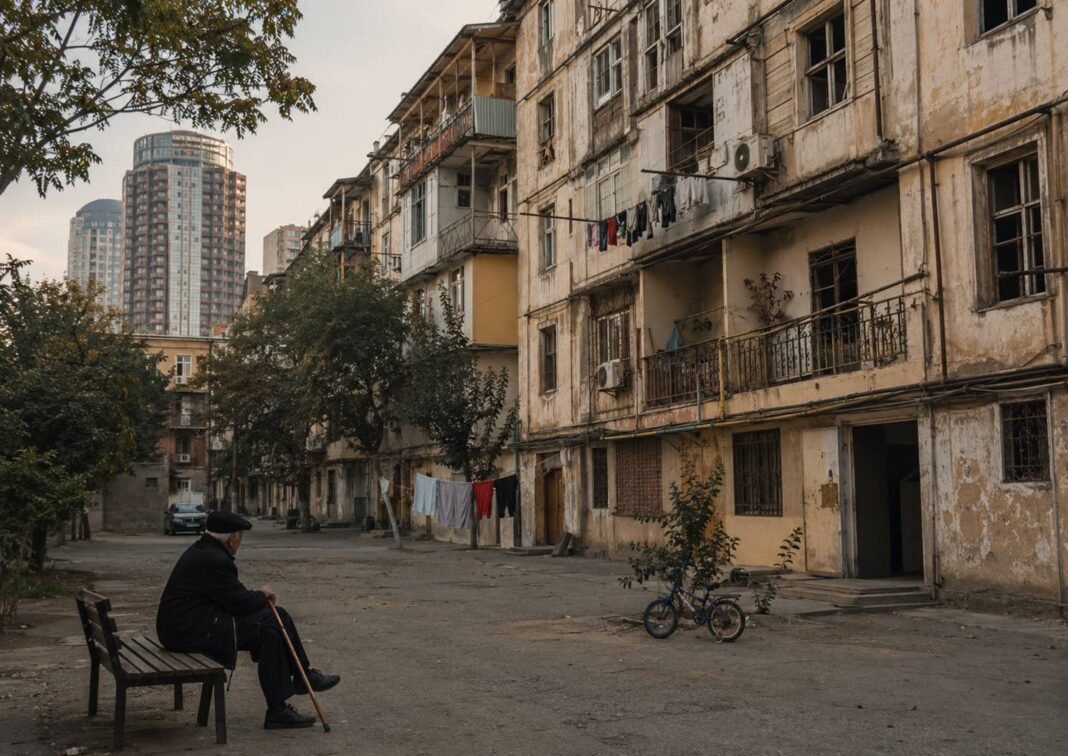
Baku’s traditional courtyard culture is quietly disappearing. Where neighbors once gathered for backgammon and conversation, courtyards are becoming increasingly silent, children are rarely heard playing outside, and much of everyday communication has moved to smartphones and group chats.
Residents say the change is being driven by several forces at once: the rise of social media, the demolition of older apartment buildings, frequent moves and the anonymity of life in modern residential complexes.
Hassan Agha Rahimov, a longtime Baku resident, recalls a time when nearly everyone in his neighborhood knew one another. Doors were often left open, adults met in the courtyard every day to play backgammon, dominoes or checkers, and children spent hours outside.
He said close relations between some longtime neighbors remain, but the old atmosphere has never fully returned.
Other residents share that view. They remember neighborhoods where people knew what was happening in each family, celebrated good news together and offered help during difficult times.
Today, the population of many apartment buildings changes frequently. Some residents rent homes for a year or two, while others relocate after only a few years. These shorter stays make it harder to build the relationships that once developed over decades.
Many residents blame smartphones and the internet for accelerating the decline.
“People used to go outside, talk and play backgammon,” one resident said. “Now young people spend their time on their phones and online. Everyone once greeted each other, but today even that is disappearing.”
Technology, however, is only part of the story. The physical environment that supported Baku’s traditional courtyard life is also changing.
As Vesti Baku previously reported, older residential blocks have been gradually emptying in several parts of the capital, including the Nasimi, Yasamal, Narimanov and Binagadi districts. When residents are relocated, social ties built over many years are often broken.
Modern residential complexes may offer elevators, security guards, surveillance cameras, landscaped grounds and underground parking. But better infrastructure does not necessarily produce closer relationships. People can live on the same floor for years while barely knowing who lives next door.
Psychologist Vusala Rustam has said relocation involves more than the loss of a familiar home. Residents may also lose their established social circle, daily routines and sense of belonging. A new apartment can be more comfortable, but the atmosphere of an old courtyard cannot simply be transferred with the furniture.
Neighborhood communication has not vanished completely. Instead, much of it has moved online.
Residents now create WhatsApp and social media groups to exchange information, discuss building problems, warn one another about local issues and organize help for families in need.
Conversations that once took place on a bench outside the entrance now unfold in group chats. A phone call has replaced a knock on the neighbor’s door, while message notifications have replaced the sound of backgammon pieces striking a wooden board.
Yet digital contact does not always create the same sense of connection as daily face-to-face interaction. A neighbor who was once part of family life can gradually become little more than a name in a messaging group or a stranger behind the next door.
Some Baku neighborhoods still preserve elements of the old tradition. Residents continue to meet outside, talk and help one another. But such courtyards are becoming less common.
The decline of Baku’s courtyard culture is therefore more than nostalgia for backgammon games, children’s voices and evening conversations. It reflects a broader transformation of urban life, driven by technology, redevelopment and the weakening of long-standing community ties.
Buildings can be replaced and residents can move into newer apartments. Recreating a courtyard’s shared memories, friendships, arguments and reconciliations is far more difficult.
AZE.US