By AZE.US Editorial Team
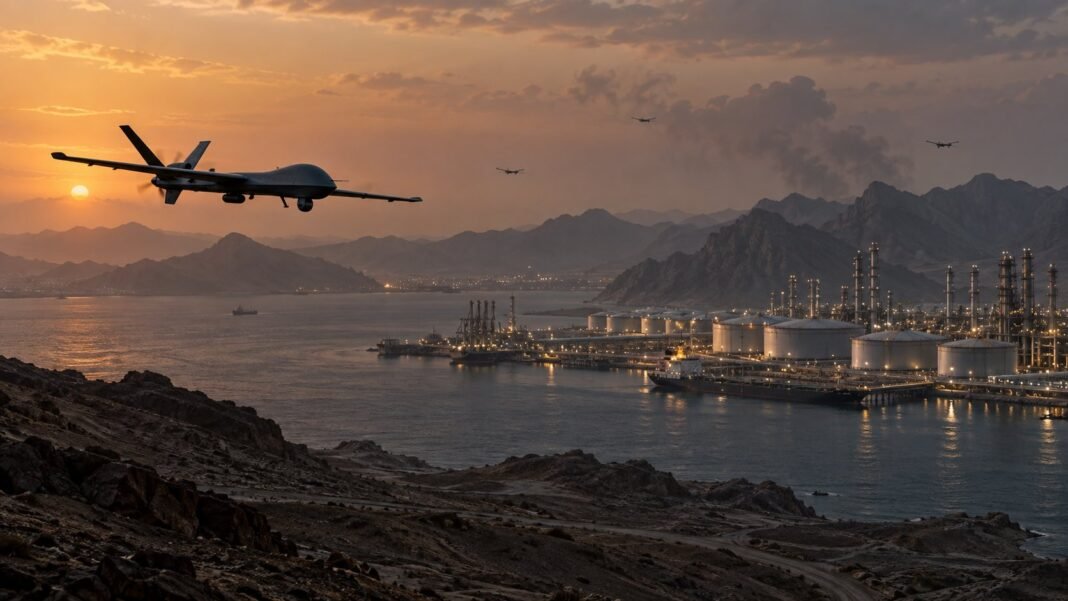
Riyadh’s overwhelming military superiority has failed to produce a political victory. The Houthis have learned to use low-cost drones, Yemen’s geography and the kingdom’s dependence on vulnerable oil infrastructure against one of the world’s wealthiest states.
Saudi Arabia possesses advanced fighter jets, U.S.-made air defense systems and one of the world’s largest military budgets. The Houthis control a war-ravaged part of Yemen and command forces that, on paper, are no match for the Saudi military.
Yet it is Riyadh that must now monitor emergency alerts, defend oil installations and decide how much it is prepared to risk in another costly war.
On Sept. 15, threat warnings were issued in Jeddah, Abha, Jazan, AlUla, Taif and Yanbu. The last city is particularly important because it is Saudi Arabia’s main oil-export terminal on the Red Sea.
The Houthis said they launched dozens of missiles and drones at King Khalid Air Base in Khamis Mushait. Saudi authorities said 13 civilians were injured.
At the same time, Houthi forces have been consolidating their position along Yemen’s western coast. They captured the port city of Mokha, Perim Island inside the Bab el-Mandeb Strait and later the Greater and Lesser Hanish islands.
The advances allow the group, officially known as Ansar Allah, to threaten not only Saudi territory but also the maritime routes on which the kingdom’s oil exports depend.
This does not mean the Houthis can defeat Saudi Arabia in a conventional war. But they have already achieved something more important: They have forced a far more powerful adversary to fight on their terms.
A War Air Power Could Not Win
Saudi Arabia intervened in Yemen in 2015 with the stated goal of restoring the internationally recognized government and driving the Houthis out of Sanaa.
Over the following years, the Saudi-led coalition carried out thousands of airstrikes but failed to achieve that strategic objective. The Houthis retained control of the capital and most of Yemen’s densely populated northwest.
More significantly, they evolved from a local armed movement into a force capable of launching ballistic missiles, cruise missiles and long-range attack drones.
Iranian assistance has been critical. Tehran has supplied technology, components, training and political support. But the group’s survival cannot be explained by Iran alone.
The Houthis have a centralized command structure, more than a decade of battlefield experience and the ability to mobilize resources across the territory they control.
The Saudi-backed camp, by contrast, has relied on a collection of Yemeni factions with competing political, regional and ideological agendas. Some have been aligned with Riyadh, others with Abu Dhabi, while southern separatists have pursued their own objectives.
Air power could destroy a military site, but it could not create an effective government on the ground. Without reliable local forces, even overwhelming control of the skies has limited strategic value.
The latest Houthi offensive has exposed that weakness again. Saudi aircraft can strike enemy positions, but Saudi-backed Yemeni forces abandoned several strategic areas with little resistance. Recovering that territory requires capable ground troops – precisely what Riyadh does not have.
Asymmetry Favors the Houthis
A Saudi fighter jet can cost tens of millions of dollars. A Houthi drone may be hundreds or thousands of times cheaper. Yet intercepting it can require a combat aircraft or an expensive surface-to-air missile.
The Houthis do not necessarily need to destroy a major oil facility. A temporary shutdown, an emergency warning or rising concern among insurers and tanker operators may be enough to inflict damage far greater than the cost of the weapon used.
Saudi Arabia must protect a vast network of cities, airports, military bases, pipelines, pumping stations, refineries and ports. Providing complete protection for every potential target is impossible.
The Houthis only need to identify one vulnerable point.
This imbalance is particularly dangerous while traffic through the Strait of Hormuz remains severely restricted. Saudi Arabia redirected much of its oil exports through the 1,200-kilometer East-West Pipeline to Yanbu.
That alternative route has also proved vulnerable. The pipeline was shut down after an attack that Riyadh blamed on Iran-aligned militias in Iraq. Officials cited by The Associated Press said repairs could take three to five weeks. The route had recently been carrying an average of 2.6 million to 4 million barrels per day.
The Houthis did not claim responsibility for the pipeline attack. Their advance toward the Bab el-Mandeb Strait, however, has created a second threat to Saudi exports.
The kingdom is effectively being pushed into an energy trap: Hormuz is restricted, the cross-country pipeline has been damaged and the southern entrance to the Red Sea is under growing pressure.
Riyadh’s Main Vulnerability Is Not Military
Saudi Arabia is capable of launching an extensive new bombing campaign in Yemen. The question is not whether it can do so, but what such a campaign would accomplish.
Years of war have shown that airstrikes are unlikely to force the Houthis to surrender. Renewed bombing would almost certainly cause civilian casualties, destroy more infrastructure and deepen Yemen’s humanitarian emergency. The Houthis would probably retain enough missiles and drones to continue retaliating.
For Crown Prince Mohammed bin Salman, a return to prolonged war would also threaten his central domestic project: Vision 2030.
The kingdom wants foreign tourists, investors, major corporations and international events. Emergency alerts over Jeddah and attacks on energy facilities are incompatible with the image of a secure global business hub.
The Houthis understand this vulnerability. Their objective is not to seize Saudi territory. It is to increase the economic and political cost of confrontation until Riyadh decides that negotiations are preferable.
That is why Saudi restraint can look like helplessness. The kingdom can inflict enormous damage on its opponent, but it has no clear way to translate that destruction into a lasting political outcome.
U.S. Protection Is No Longer Guaranteed
Riyadh also faces uncertainty over Washington’s willingness to intervene.
The United States has so far resisted Saudi requests for direct military involvement beyond intelligence support, according to Reuters. That is an alarming signal for the Saudi leadership.
For decades, the relationship rested on an implicit formula: Saudi Arabia helped stabilize global oil markets, while the United States guaranteed the kingdom’s security. The new Middle Eastern reality suggests that American protection has limits.
Washington does not want to be drawn into another Yemen war, particularly one that could widen its confrontation with Iran. The Houthis, meanwhile, have sought to persuade the United States to stay out and treat the fighting as a bilateral conflict with Saudi Arabia.
Riyadh is therefore confronting an uncomfortable choice: fight largely on its own, accept a painful compromise or continue living under the threat of renewed attacks.
Houthi Success Is Not Yemen’s Victory
Ansar Allah’s battlefield gains should not be confused with progress for Yemen.
The renewed fighting has already produced devastating consequences. International organizations say more than 500 people were killed in Yemen in one week, while nearly 94,000 were displaced. About 200 schools have reportedly been converted into temporary shelters.
The Houthis may be strengthening their military position, but Yemen continues to pay the price through economic destruction, hunger, collapsing public services and the country’s prolonged division.
Control over islands and shipping routes gives the movement greater leverage. It does not solve any of Yemen’s fundamental problems.
There is also a risk that recent gains could lead the Houthis to overestimate their strength. An attempt to fully control the Bab el-Mandeb Strait would affect not only Saudi Arabia but also the United States, Egypt and major European and Asian economies.
Such a move could eventually produce a much broader international coalition against the group.
Saudi Arabia’s Impossible Choice
Saudi Arabia is not literally powerless. It retains enormous technological, financial and military advantages. But none of its available options is attractive.
A major war would threaten its oil infrastructure and economic modernization program. Limited airstrikes have failed to stop the Houthis. Negotiations would amount to recognizing Ansar Allah as the dominant power in northern Yemen. Saudi-backed local forces have yet to demonstrate that they can reverse the situation on the ground.
That is the Houthis’ real achievement. They have not become stronger than Saudi Arabia. They have made much of Saudi Arabia’s superior military power strategically ineffective.
Modern wars are not always won by the side with the most aircraft and missiles. They are often won by the side that better understands its opponent’s vulnerabilities.
Riyadh can destroy dozens of targets in Yemen. The Houthis need only create doubt about the security of one pipeline, one port or one flagship investment project.
As long as that equation remains unchanged, one of the Middle East’s wealthiest kingdoms will continue to look weaker than the movement it has spent more than a decade trying to defeat.
AZE.US