By AZE.US Editorial Team
The Turkic world has reached a point where shared history, language and declarations of brotherhood are no longer enough. Its influence will now be measured by freight moving across the Caspian Sea, border waiting times, trade volumes, joint industrial projects and the ability of member states to coordinate during regional crises.
The 13th summit of the Organization of Turkic States is scheduled for Oct. 30, with foreign ministers due to meet in Ankara a day earlier. Preparations suggest that governments expect more than another political declaration.
The real question is whether the OTS is ready to evolve from a platform built on cultural affinity into a functioning system of shared economic and strategic interests.
Azerbaijani political analyst Eldar Namazov recently described Azerbaijan and Türkiye as the engines of Turkic integration. That assessment is difficult to dispute. But the Ankara summit must demonstrate that the organization can produce practical results for every participating state, not only its two most politically active members.
Azerbaijan as the Essential Bridge
Azerbaijan’s position is defined not only by its close alliance with Türkiye, formalized through the 2021 Shusha Declaration.
Geography has made the country a natural bridge connecting Türkiye and the South Caucasus with Central Asia. Azerbaijan sits at the center of the most viable trans-Caspian route linking Chinese and Central Asian markets with Europe without passing through Russia or Iran.
That gives Baku strategic importance exceeding the size of Azerbaijan’s population or economy.
Without Azerbaijan, Türkiye and the Turkic states of Central Asia remain separated by the Caspian Sea and a complicated collection of transit routes. With Azerbaijan, they have the potential to establish an integrated transportation axis extending from Central Asia to the Mediterranean and Europe.
Geography alone, however, guarantees nothing. A corridor may look impressive on a political map and still fail commercially if cargo remains stuck at borders, ferries operate irregularly and customs authorities cannot exchange information.
The Middle Corridor Matters More Than Rhetoric
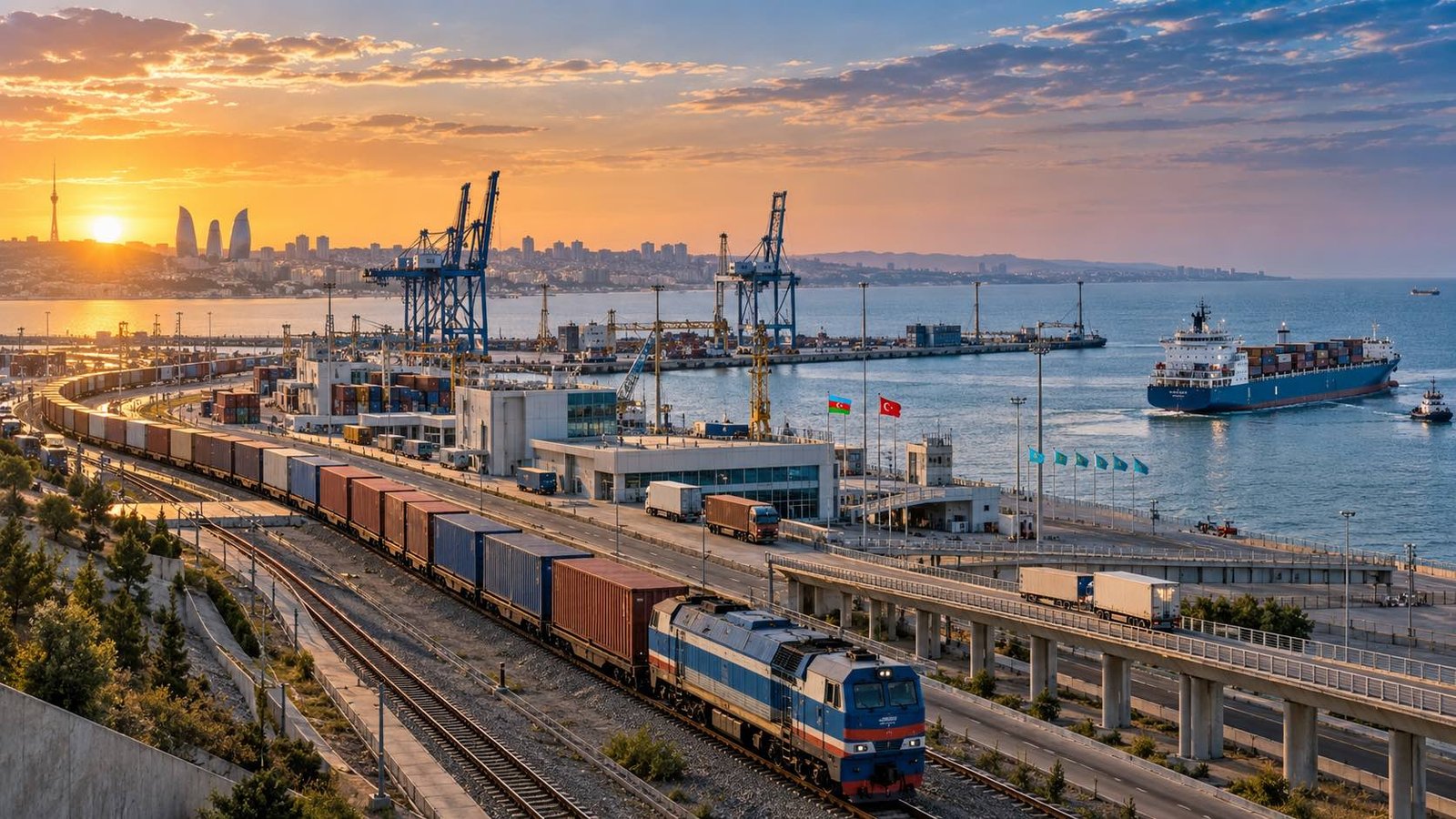
The Middle Corridor – a network of rail, road and maritime routes connecting China and Europe through Central Asia, the Caspian Sea, Azerbaijan, Georgia and Türkiye – is becoming the economic foundation of Turkic integration.
The World Bank estimates that the right combination of investment and efficiency measures could triple freight volumes along the corridor by 2030 while cutting transit times in half.
That matters more than broad claims about rising and declining civilizations. Geopolitical power does not come from historical declarations. It comes from building infrastructure that businesses use every day.
If goods from Kazakhstan or Uzbekistan can reach European markets faster and more cheaply through Azerbaijan and Türkiye, regional integration will acquire its own commercial momentum. Exporters, ports, rail operators and logistics companies will all have a direct interest in preserving it.
Economic necessity can accomplish what ideology alone cannot: transform a common cultural space into a durable strategic partnership.
TRIPP Should Add Resilience, Not Create Dependency
The proposed route through Armenia – known internationally as TRIPP and frequently described in Azerbaijan as the Zangezur Corridor – could become another important part of this network.
It could provide a more direct connection between mainland Azerbaijan, the Nakhchivan Autonomous Republic and Türkiye. But it would be a mistake to make the project the sole condition for developing the Middle Corridor.
The route through Georgia is already operational. Azerbaijan is also developing infrastructure connecting its mainland with Nakhchivan through Iran. The more complementary routes the region possesses, the more resilient its transportation system becomes.
TRIPP should create an additional opportunity, not a new monopoly.
The project could also help Armenia move beyond its transportation isolation, attract investment and turn peace with Azerbaijan into an economically beneficial choice.
That requires Yerevan to accept a basic condition of regional connectivity: Transportation networks cannot operate efficiently amid permanent territorial disputes and political uncertainty.
The OTS Should Not Rush to Become a Military Bloc
Security cooperation is one of the organization’s most sensitive areas.
Azerbaijan conducts military exercises with Türkiye and other Turkic states. Contacts between defense ministries and defense industries are expanding, even if official OTS declarations generally place less emphasis on military cooperation.
Namazov argues that practical defense cooperation is developing faster than its legal framework. That is not unusual. Armed forces often establish interoperability through exercises, training and procurement before governments create permanent institutions.
The OTS, however, should not prematurely declare itself a military alliance.
An immediate attempt to create a “Turkic NATO” would provoke resistance from Russia, China and Iran while forcing Central Asian states to make geopolitical choices they have consistently sought to avoid.
The organization’s members also have different security obligations and do not always share the same threat assessments.
A more realistic approach would focus on joint defense production, compatible communications and logistics standards, officer training, cybersecurity, intelligence exchanges and emergency response.
Such cooperation could gradually establish meaningful interoperability without turning the OTS into an explicitly anti-Russian, anti-Chinese or anti-Iranian coalition.
Russia, China and the West Are Not Only Sources of Pressure
The OTS’s growing profile will inevitably attract greater attention from outside powers.
Russia has traditionally viewed Central Asia and the South Caucasus as part of its privileged sphere of influence. China wants reliable trade routes. The European Union is seeking more diversified transportation and energy connections, while the United States supports projects that reduce regional dependence on Moscow and Tehran.
Yet these powers do not necessarily have to become opponents of Turkic integration.
The Middle Corridor serves China by providing an additional route to European markets. Europe needs it to strengthen supply-chain resilience. Washington sees it as a way to expand the economic options available to Central Asia and the South Caucasus.
Even Russia could participate in regional transportation projects if it accepts that it no longer holds an exclusive right to control trade between Asia and Europe.
The OTS should not seek another external patron. It should build a position in which major powers compete for economic cooperation with its members.
The Organization Cannot Be Only About Ankara and Baku
Azerbaijan and Türkiye are clearly the political core of the organization. Their relationship demonstrates how far cooperation can develop when it combines public support, infrastructure, trade and defense ties.
But the OTS will not become a credible institution if other participants see it merely as an extension of Ankara’s or Baku’s foreign policy.
Kazakhstan, Uzbekistan, Kyrgyzstan and Turkmenistan must view the organization as a platform for equal cooperation rather than a hierarchical structure.
Each country needs measurable benefits: access to ports, new markets, investment, transportation capacity and technology.
Future integration must therefore rest on overlapping national interests, not political subordination to a single center.
What the Summit Should Do
The Ankara summit should focus on several practical priorities.
First, the participating states need interoperable digital cargo documents, coordinated customs procedures and real-time data exchanges between border agencies. New railways and modern ports will still lose their competitive advantage if freight remains trapped in paperwork.
Second, the region needs additional Caspian shipping capacity and more efficient coordination between ports. The maritime section remains one of the Middle Corridor’s most vulnerable links.
Third, the OTS needs stronger joint investment mechanisms capable of financing infrastructure and industrial projects. An organization dependent entirely on funding from outside powers cannot claim strategic autonomy.
Fourth, the member states should expand energy connectivity. That includes traditional oil and gas infrastructure, electricity transmission and the potential export of renewable energy from Central Asia and Azerbaijan through Türkiye to European markets.
Finally, cooperation should extend to education, science, digital technology and defense production. A transit bloc without its own technological and industrial foundation risks becoming little more than territory through which other powers ship their goods.
An Opportunity Is Not a Guarantee
The Turkic world has been given a rare strategic opening.
The Russia-Ukraine war has weakened established northern transportation routes. Instability surrounding Iran has increased demand for alternative connections. China, Europe and the United States are simultaneously interested in greater access through Central Asia and the South Caucasus.
That international environment will not remain favorable forever.
Azerbaijan, Türkiye and the Central Asian states must use the current moment to create institutions capable of surviving changes in relations among Moscow, Beijing, Washington and Brussels.
The 13th OTS summit will be a test of the organization’s maturity.
If it produces only speeches about brotherhood and a shared past, it will soon be forgotten. If the participants agree on faster transportation, customs integration, coordinated investment and industrial cooperation, the summit could mark the beginning of a new phase.
The Turkic world already possesses a common history. It must now build the shared infrastructure of its future.
AZE.US